Showing posts with label Population Genetics. Show all posts

Friday, November 19, 2021

As New Zealand’s Endangered Kākāpō Rebounds, Researchers Measure Genomic Signs of Inbreeding

The Creature Feature: 10 Fun Facts About the Kakapo | WIRED

The Kākāpō bird which used to flourish in New Zealand is now endangered due to mammalian predators. The population has now dwindled down to 201 birds which are on a predator free island and studied by conservationists and geneticists. Currently, due to the genetic bottleneck this bird faces, geneticists are studying the health impacts of inbreeding within this small population. The results from a study they conducted show that inbreeding isn't reducing their survival chances and that introducing genetic variety does not always produce the intended expectations. Since creating complex multigenerational pedigrees would not be possible for the founding population of this species, researchers began to use DNA sequencing and genome-wide mapping of single nucleotide polymorphisms for analysis. After studying this, they realized that the one male from the New Zealand mainland population as well as the birds found in the Stewart Island population were both inbred. This study led to an interesting concept of how combining two inbred populations in an attempt to diversify can actually tend to increase deleterious alleles. In conclusion, by using different methods to compare levels of inbreeding with survival in the Kākāpō bird suggested that decreased inbreeding did not relate to improved survival chances. This study has helped conservationists and researchers learn more about the species and how they can expand their efforts for the future. 

Sunday, August 4, 2019

California Mountain Lions

        Puma concolor, or the mountain lion goes by many names. Puma, cougar, catamount and panther are just a few. While the mountain lion goes by many names, it's genetic code remains relatively the same. Although the mountain are not in direct danger of extinction, their population is decreasing at a high rate. The mountain lion itself is what is known as a indicator species. This means that the speices can be used as a great reference on how an environemnt is doing, and how well the environement has remained connected. The large cat also acts as an umbrella species. These "umbrella species" are extremely important biologically and ecologically. Umbrella species are usually greatly monitored and protected beceause in protecting them, many other species become protected indirectly. Due to this, conservation techniques have been put in place in many areas where the puma exist. However in a recent study to observe how geography changes genes, researchers stumbled upon something rather interesting.
      431 mountain lions from various location were used in a study to collect data about the levels of genetic diversity among the species. In order to accomplish this 12 microsatellites loci were analyzed in each cat. After looking closely at the data gathered, it was found that each cat had distinct genetic  subdivisions that were specific to the region they were from. It was found that cats from coastal regions displayed more heterozygosity than the cats sampled from inland areas. Heterozygosity is important in population genetics, as the heterozygote advantage plays a large role in species survival. Scientists came to the conclusion that geographic barriers like the Los Angeles Basin, the San Fransisco Bay and the Central Valley turned out to be enormous barriers to natural gene flow of the species. The disruption of gene flow can result in many things particularly different allele frequencies among the species. Metapopulations in Southern California have exhibited normal gene flow but recently human development has increased how hard it is for populations to travel, which in turn decreased gene flow. With this, human development has displaced many of these large cats leading them to environments their ancestors did not inhabit before, or into urban areas. These new environments present challenges for the species, one which they may not actually be able to survive.
    In essence this study provided conservationists with a ton of new data to analyze, think about and act upon in the coming years. Most importantly, it displayed an important concept. Conservation genetics, and genetic preservation. This study indicates that not every case can be treated the same way. Each population of these cougars has different genetic subdivisions, and faces different enviroenmtal cahllenges. From this work, scientists hope to come up with movement corridors in unpopulated regions, to help the pumas travel from area to area, and increase biological diversity.  Landscape-level conservation is not only crucial to the survival of this species, but crucial in helping the species become more heterozygotic.
      This study was awesome because it really shows the connectedness of species between each other. In protecting the mountain lion, you protect the big horn sheep, which in turns help stabilize plant growth, and the list goes on and on about the connectedness of the mountain lion to almost everything it interacts with. Population genetics are studied extensively with animal populations, and I hope to work with wildlife one day, so reading these articles get me excited for the future. Hopefully measures can be put in place so that these animals can travel more freely and give themselves a fighting chance against their ever-changing environment.


https://link.springer.com/article/10.1023/A:1024069014911

https://www.sciencedaily.com/releases/2018/12/181221142514.htm

https://www.scientificamerican.com/article/highways-fragment-southern-california-mountain-lion-gene-pool/
       

Saturday, April 20, 2019

Three Distinct Denisovan Lineages Have Been Revealed

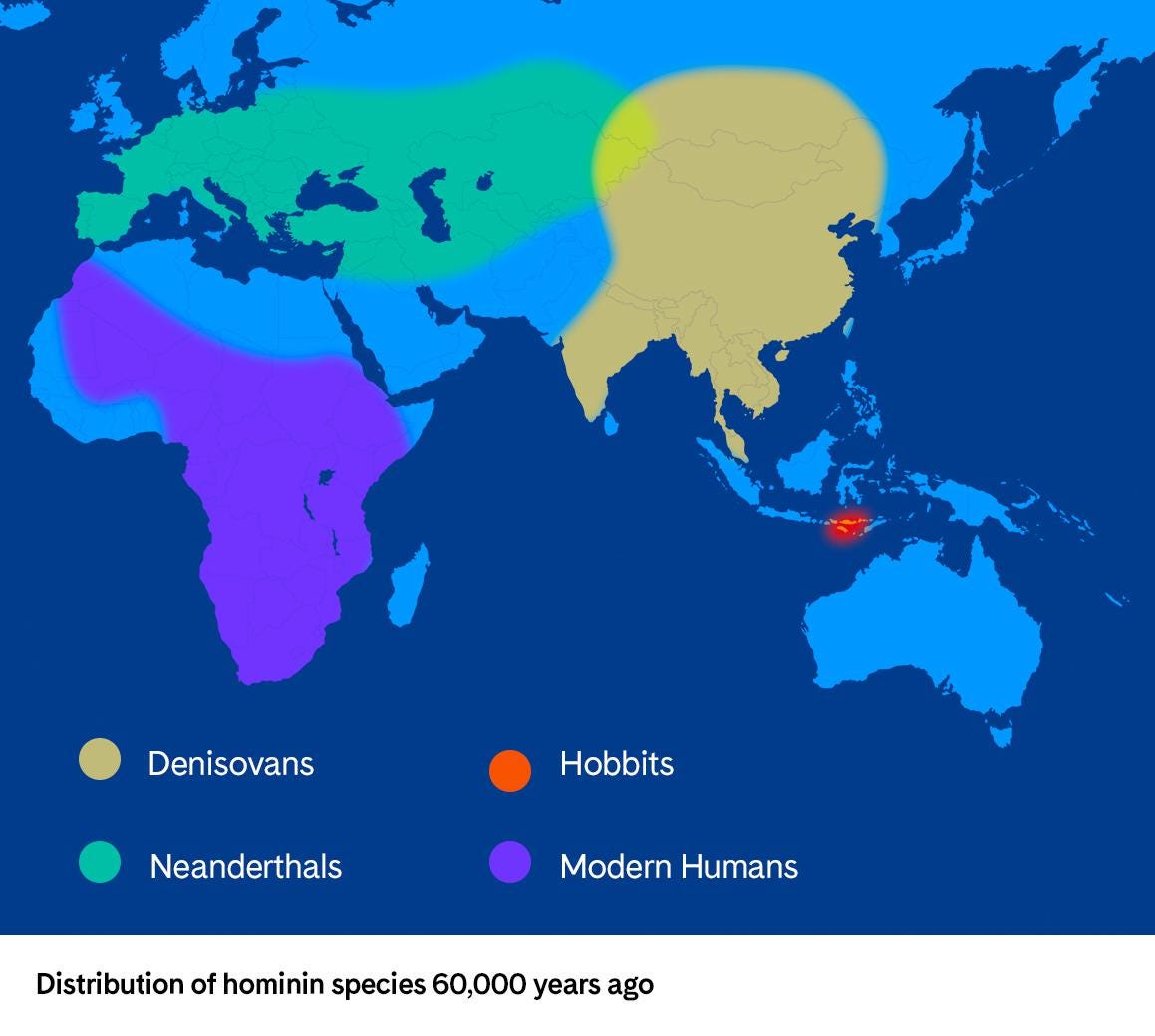
Map of four different species of the genus Homo, "Humans"
A new study has proven that the hominins discovered in 2010 that we have been referring to as Denisovans have much greater genetic diversity than scientists previously thought, constituting three separate lineages. One of these groups is so different from the other two, it could be considered a new species entirely.

An international team of researchers has analyzed the genomes of 161 modern humans from islands across Southeast Asia and New Guinea and have concluded that they have DNA that has been inherited from independent and diverse populations of Denisovans. It was in 2018 that it was first uncovered that more than one lineage existed. Now we know that the family tree of Homo denisova is increasingly complex.

Drawing on modern people’s DNA, the scientists realized that these hominins interbred with their Homo sapiens cousins in two different waves. The two interbreeding events have created distinct genetic patterns that can still be identified in the people of Oceania and East Asia today.

The specimens that were found in a cave in Siberia’s Altai Mountains are the only Denisovan skeletal fragments known to science. The lineage of these individuals is being called D0, while the other two are D1 and D2. The group that is closely related to the Altai line has DNA that is found in modern East Asians. The other group – more recently discovered – is very divergent from the Altai line and its DNA is found across modern Oceania and much of Asia. In fact, it is as genetically dissimilar to the Altai Denisovans as it is to Neandertals.

Thus, many scientists are calling for this group to be given their own name, as they may truly comprise a separate species from Homo denisova. Moreover, based on their analysis, the researchers propose that interbreeding between Homo sapiens and Homo denisova took place as recently as 15,000 years ago. If this date is accurate, the implications are shocking. This would mean that Denisovans are the last hominin species related to modern humans known to have died out.

Saturday, March 30, 2019

Ancient DNA Show Possible Migration

An article in National Geographic discusses some interesting information found in the DNA of early humans in southern Europe. Population geneticists have found that in the Iberian Peninsula area a migration that occurred roughly 4500 years ago had a drastic impact of the genetics of the people there. By sequencing the DNA of 271 ancient Iberians they found out that around 2500 B.C. there was the appearance of individuals from the Black and Caspian sea area which caused a change in the DNA of the population by about 40 percent. They also found that by 2000 B.C. the Y chromosome was completely changed, meaning that the migration that took place earlier consisted largely of men. Researchers believe that these men might have helped to usher in the Bronze Age in that area. There was also the skeleton of a single North African individual found in the Iberian area from about 2500 B.C. who shows that there was movement between North Africa and the Iberian Peninsula earlier than they believed.

I think that the information that was discussed in this article was interesting because there is so much about our early human ancestors that we don’t know so any information that we can get can be rather fascinating. I also think it’s interesting how we can sequence the DNA of people back then, and how what we can find from this DNA can inform us about things like migration patterns from the Russia area to Europe, and what kind people might was traveled in this migration.    

Saturday, February 16, 2019

Rabbits Evolved Resistance to Myxoma Virus

In the 1950's scientists released the myxoma virus to rabbits in order to reduce the rapidly growing population size. This worked until rabbits became genetically resistant to the virus over time, and sparked interest amongst researchers at Arizona State University who partnered together with University of Cambridge. In Science Direct's article entitled, "Hop to it: Researchers evaluate rabbits' evolved resistance to myxoma virus", it discusses the findings found at the Grant Mcfaddens Center for Immunotherapy, Vaccines and Virotherapy that validate the gene held responsible for the resistance and possible replication for potential use of treating cancer.


As said by a scientist at the center, "The idea was to sequence examples of many rabbit genomes of all three places (Australia, France, and the UK)…..and came up with a half dozen gene variations in common--our job was to determine whether these variants of genes affected that virus in a lab setting." It was then discovered that the trend seen in the three geographically distinct locations served as an example of co-evolution operating between viruses and their host.

Researchers in the UK used modern sequencing technology to sequence rabbit genomes to past populations and the population now for comparison. At this time McFadden and the center determined whether the genes found correlated with antiviral effects by testing the virus in cell culture. By doing this as a group the scientists validated the role of genes in viral replication, and still serves as a great example of co-evolution.

-picture credit to google images

Sunday, April 23, 2017

Knockout Genes In Human Population


Image result for population genetics
An example of genetic variance across different regions of the world (picture from Wikimedia Commons)
      In the quest to figure out how specific genes work in laboratory mice, creating "knockout" mice is usual the way to go. In this practice, a specific gene is targeted and eliminated to see how it affects its functioning. For obvious reasons, creating "knockout" humans is not a feasible way to study the effects of missing genes in humans.
      Recently, there has been a push by researchers to look for the effects of naturally occurring knockout humans. One such study focuses specifically on individuals from Pakistan. This study notes the prevalence of knockout humans as a result of consanguineous mating practices in a group of Pakistanis participating in a long-term study of heart disease and diabetes. Researchers were intrigued to find that the absence of some genes seemed to have no negative affects on their health; furthermore, researchers concluded that such knockouts help explain why some drugs are more effective than others in terms of a person's individual genome.
     Overall, there is now multiple calls for a Human Knockout Project to document such findings in a single database. As the picture above helps illustrate, genes vary across populations; thus specific drugs may have varying efficiency in their modes of action based on the overall genetic composition of a population. Hopefully such a database drawn from large population studies would lead to a more personalized medicine approach to treating certain illnesses. This is relevant now, especially with population genetics being the subject of our current lectures.


Wednesday, November 23, 2016

Why Don't Humans Have Much Neanderthal DNA in Them?

A long time ago, Neanderthal's and modern day humans diverged from a common ancestor, but only 1 of the 2 species did well.  The neanderthals did not just get wiped off the earth, since about 50,000 years ago, they interbred with modern humans as they were leaving Africa, leaving a small amount of their DNA behind.  And by small, I mean very small.  The question is, why is there such a small amount of DNA left over by the neanderthals, and why did the neanderthal human hybrids not survive well?  One answer is as simple as population size.  In smaller populations, natural selection is not as strong of a factor in the population, and so the neanderthals were subject to a lot of inbreeding, and overall the entire population developed and spread more and more mutations around within themselves.  Since these mutations did not stop them from breeding with each other, it can be assumed that all of these mutations built up, and eventually became a very large problem for  neanderthals.

This information also shows why not much neanderthal DNA remains in modern day humans.  Since the neanderthals already were so heavily mutated, when they bred with humans, they passed along their mutations to the hybrid offspring, who then either would have died from the mutations, or would have then passed them down again to their offspring, and so on.  Overtime this process makes it so that the small amount of DNA that was transferred from neanderthal to human was slowly lost, but not completely, resulting in a very small amount of their DNA found in modern humans.


I'm a little surprised that the answer to this problem is so simple.  All it really has to do with is population size, and I think that that is really interesting.  Granted the small population size does make a lot of sense, I didn't think to take into account that this means that there would be a lot of inbreeding occurring among the population, which also makes a lot of sense.  It is also pretty interesting that because of this initial inbreeding, that the major effects of it made the neanderthal human hybrids less likely to survive, and so the amount of neanderthal DNA in modern humans is so small.

http://www.nytimes.com/2016/11/09/science/neanderthal-dna-natural-selection.html?rref=collection%2Fsectioncollection%2Fscience&action=click&contentCollection=science&region=stream&module=stream_unit&version=latest&contentPlacement=58&pgtype=sectionfront 

http://journals.plos.org/plosgenetics/article?id=10.1371/journal.pgen.1006340

Friday, October 21, 2016

Global Genetic Diversity Map


    Throughout history, maps have been used to represent many aspects of the animal kingdom, such as the range, regional mix, and species at risk. Now however, there is a new set of maps designed to show the distribution of genetic diversity around the world. These maps can help track loss of biodiversity and its cause in a certain region. As population geneticist Andreia Miraldo says, "Without genetic diversity, species can't evolve into new species," and "It also plays a fundamental role in allowing species populations to adapt to changes in their environment."


    Miraldo and her research team conducted an experiment in which they gathered geographical coordinates for over 92,000 records of mitochondrial DNA from 4,675 species of land mammals and amphibians. They compared the changes in cytochrome b, a gene used to measure genetic diversity within a species, and mapped the average genetic diversity for all species within areas of about 150,000 square kilometers.
   
    On the map above, the results show that the tropical Andes and the Amazon have high genetic diversity for both mammals and amphibians, which are shown in dark blue. The South African subtropical regions has high genetic diversity in mammals, while eastern North America has high genetic diversity for amphibians. Results also determined that genetic diversity is 27% higher in the tropics than in non-tropic regions. In conclusion, Industrialized cities and rural areas that are occupied by humans are shown to have very low genetic diversity than wild habitats, as shown in green and yellow. This implies that a lot of human activity could have a large impact on genetic diversity for other species. However, more research has to be done in this area in order to confirm these results and Miraldo hopes to learn more about how human activity and climate change affect global genetic diversity.

  I found this research topic very interesting because it can help us learn more about endangered species and how to save them from extinction. I also think that it can help us as humans to learn the harm and impact our actions have on other living organisms sharing our planet. I believe that it can perhaps prove that climate change is indeed happening and that it's negatively affecting genetic diversity around the world. And maybe when we accept this reality, we can start reducing pollution, deforestation, and over-hunting.

Links:

Thursday, November 19, 2015

Gene Drive Reversibility

Would it be incredible to genetically alter mosquitoes so they would not harm you? Such idea is already being tested. In 2003, Austin Burt, a leading geneticist, proposed the idea of gene drives. Gene drive is defined as the process of stimulating biased inheritance of certain genes to alter entire populations. In other words, they are genes that are inherited throughout a species almost 100% of the time. This process relies on endonucleases (restriction enzymes that cut DNA sequences) and CRISPR/Cas9, an enzyme from bacteria that can be used to alter any DNA sequence or genome. As an organism's DNA is cut, guided RNA sequences will take the place of the cut-out sequence and drive the "RNA guided gene"into an organism's genome. This imposed gene will be passed down throughout generations, altering an entire species. For example, a particular species of mosquitoes that carry malaria may not be able to carry the disease any more. 

While there are many questions and concerns about gene drives, scientists have recently made an important discovery. On November 16, 2015, a team of researchers at the Wyss Institute for Biologically Inspired Engineering at Harvard University and Harvard Medical School (HMS) experimentally showed that the effects of gene drives on populations can be reversed, and the team developed safeguards for using gene drives. First, by separating guided RNA from Cas 9 enzyme or inserting an artificial gene into an organism, gene drives could only be activated in the laboratory. This means the organism cannot survive in the wild. Also, by experimenting on yeast, gene drive traits have been reversed by reversing the gene drive machinery.  

This is a fascinating discovery. Much experimental work and research must still be accomplished, and safeguards and reversibility of using gene drives must be further explored. Gene drives could be used for great good in an ecosystem, but scientists are also tampering with an incredibly designed DNA code for life. I will choose to remain optimistic about this work. "Gene drive technology has great potential to solve global problems, such as malaria, for which we have no solutions today," says Wyss Institute Founding Director Donald Ingber, M.D., Ph.D…" 


Original Article: http://www.sciencenewsline.com/news/2015111617430047.html

Other Article: http://hplusmagazine.com/2015/03/10/gene-drives/

Friday, September 18, 2015

Is fish oil good for you? Depends on your DNA.


The Inuits of Greenland have been known to have excellent cardiovascular health, which is a rising health issue in America. Their extreme lifestyle, mainly the freezing cold temperatures, is supported by their diet. It is rich in omega-3 fatty acids, found in the fat from their consumption of fish and marine mammals. Scientists are still putting the pieces together as to why their diet specifically is so beneficial to their health and hardiness in extreme conditions.

Rasmus Nielson, a population geneticist of the University of California, sought to find the specific DNA differences between populations that may account for the differences in the way we process fatty acids. His research team looked at differences in DNA between 191 Inuits, 60 Europeans, and 44 Han Chinese. They found significant differences on chromosome 11, where many genes control processing of fatty acids. They narrowed down on one DNA base found in most of the Inuits, but only 15% in the Han Chinese and rare in the Europeans. From this research, it is hypothesized that certain populations lacking the base that most Inuits have, have less protection from fats.

Nielson's research is important to world of genetics because it may be leading us towards diets that are determined based on "personalized genetic profiles." I find this information valuable because social media and many dietary journals stress the importance of specific diets to the point where it reaches a startling conformity. Everyone is different and we all require varying levels of fats and vitamins. Fish oil may not be good for everyone, but it definitely makes a difference for the Inuits. In a similar way, other supplements and vitamins found in our foods may have profound differences in effect from person to person.

Original link

Benefits of fish oil

Friday, November 22, 2013

Transgenic Salmon and the use of genes from the Zebrafish to better protect these cultured fish from diseases and pathogens.


The article, "Isolation of the Atlantic salmon β-actin promoter and its use to drive expression in salmon cells in culture and in transgenic zebrafish," portrays how genetic roles with salmon aquaculture are continuously growing. Researchers are working towards successful genetic improvement of the fish. Many scientists study which genes are in control of disease protection or which genes can be enhanced to enlarge the size of the fish. Transgenic salmon have recently been introduced to the world of aquaculture. Those genes that control the growth hormones in the salmon are altered to be more receptive and therefore pump more of this hormone into the fish. This will increase the size, as stated before, and furthermore increase the production of the salmon crop. To salmon famers this sounds like a dream come true. However, the general consensus of the human population is not as confident with consuming transgenic salmon. This feeling of doubt is not uncommon since there is still minimal evidence of the effects, if any, on human life after they eat these salmon.


I personally feel that introducing genes from another organism into the salmon populations, controlled in cultures, is a smart idea, but with multiple outcomes. I agree with the general consensus of the public,  and demand more answers before this becomes an everyday occurrence in salmon aquaculture. There are so many "what if" questions that come from mixing genetics of different species. Therefore research must be conducted to test not only how the new genes will effect the fish, but also how ingesting the fish will affect the humans who eat them. 


Source: http://fx5ly8ju5l.search.serialssolutions.com

Below is a link to another article which provides more information about the Zebrafish:
http://www.academia.edu/528432/Zebrafish_as_a_model_organism_for_nutrition_and_growth_towards_comparative_studies_of_nutritional_genomics_applied_to_aquacultured_fishes

Genetic consequences of interbreeding between wild and cultured Atlantic Salmon 


             A worldwide issue, that has increased from the use of farm grown salmon, is the mixture of wild and cultured salmon genes. The two separate fish have the chance to interact when the farmed salmon escape from their pens and make their way to the native salmon’s habitats. Once they reach each other, the option to reproduce is available, but would then result in a variety of genetic combinations. The mixture between the two types of salmon is considered a “hybridization.” Typically genetic diversity can be beneficial to the organisms, but not always. In this case, when the wild salmon and the farmed salmon mix the results have shown unexpected patterns within the inheritance of the genes from the parent fish. This creates field of unknown for researches. In addition to unpredicted circumstances, researchers have found that the presence of the farmed salmon in the native territories can greatly increase the chances of the wild salmon’s extinction. 
            The farmed salmon have this negative effect on the wild populations because of a few distinct reasons. First, the cultured salmon could potentially carry diseases over to the wild populations. Second, the basic addition of more than the normal environmentally supported population of salmon can decrease resources for the native fish. And lastly, when the two interbreed, the process alters the regulation of the transcription of the salmon’s genes. 
          Gene transcription is incredibly important to the survival of the salmon, both wild and farmed. Wild salmon have their own set of genes that have been through the necessary adaptations needed to survive in their natural habitats. These genetic components allow the fish to live, to protect itself from the components of the water they live in, and to internally regulate their bodies to be able to live successfully, etc. Their gene transcriptions are their directions to life, and when they are tampered with by an outsider’s genetic instructions, important information can be lost. In the end, the main goal is to do what ever is possible to contain the farmed salmon and prevent the combination of the two fish.

Source: http://fx5ly8ju5l.search.serialssolutions.com

Another source that has further information on the topic: http://www.nature.com/news/transgenic-salmon-nears-approval-1.12903


Wednesday, March 14, 2012

New Tool Developed to Test Allele Frequencies Between Populations

A news article in Science Daily reports on a new tool that was developed by the group of Christian Schlötterer at the University of Vetrinary Medicine, Vienna. It is a software package called "PoPoolation2" which makes it possible for even non-experts to compare populations.

The emergence of rapid throughput methods and the dropping of sequencing costs has made it possible for science laboratories to produce more and more data concerning the sequencing of DNA. Even still, it is hard to interpret the data.

This is where "PoPoolation2" comes in to make data easy to understand. This new tool is a software package that offers a variety of statistical methods which aid in determining how allele frequencies vary among populations. This new technology makes it quick and cheap to compare how populations have adapated to their environments over time, thus giving more insight to evolution as a whole.