Showing posts with label WildLife. Show all posts

Sunday, November 23, 2025

Molecular Genetic Analysis Used To Solve Wildlife Crimes


        Wildlife crimes are a major cause for biodiversity loss around the world. Cruelty cases of poisoning and poaching are still a problem in 2025, however with the help of a study written by Dr. Kahila Bar-Gal from Hebrew University's Koret School of Veterinary Medicine, a solution seems to be approaching.

        Bar-Gal introduces a forensic approach, using advanced genetic tools can assist local conservation authorities by accessing their data bases. Their research plan points out the quantity and quality of the DNA that has been extracted from the crime scene are mostly limited because of the lack of preservation. This is why a thorough plan is crucial before laboratory work and all marker and methodological choices should prioritize the case's solving. 

    This particular study focuses on the poisoning of the critically endangered Eurasian griffon vulture and poaching of mountain gazelles in Israel. Each instance required multi-layered molecular genetic analysis such as identification of the species at hand, assignment of population, and comparing the DNA to the local and global databases.    

Figure I: Israeli mountain gazelles

    This research is incredibly important for the preservation of critically endangered species and biodiversity as a whole. Dr. Bar-Gal's method can help authorities and environmental lawsuits worldwide as undeniable proof wildlife crime was committed. 


Sources:

https://phys.org/news/2025-07-genetic-forensics-method-complex-wildlife.html 

https://international.huji.ac.il/news/cracking-case-new-methods-solve-complex-wildlife-crimes 


Monday, April 1, 2024

Rare yellow penguin on South Georgia island puzzle biologist

During a 2019 expedition to the South Atlantic, Belgian photographer, Yves Adams, anticipated encountering the usual king penguins, recognizable by their distinct black and yellow plumage on their heads and necks, with a streak of orange along their beaks. However, what Adams encountered was nothing short of remarkable: a strikingly vivid yellow penguin.
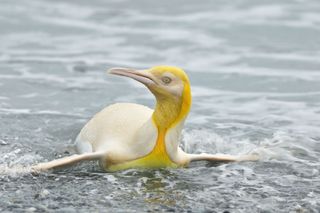
A wildlife photographer captured images of a rare yellow penguin.


At Salisbury Plains, a renowned stretch of shoreline on South Georgia Island, up to 120,000 king penguins can be seen congregating, creating a vast stretch of black plumage- but the animal Adams saw stood out from the rest: A bird with an ivory-white bill, a cream-colored body, and a mane of lemon-hued feathers. 


King penguins (Aptenodytes patagonicus), much like their close relatives, the emperor penguins (Aptenodytes forsteri), usually sport a black-and-white ensemble with a touch of yellowish-gold around their collar, however, this specific penguin appears to have maintained its yellow feathers while shedding its dark ones, typically pigmented by melanin, resulting in a distinctive appearance.


According to the Australian Antarctic Program, penguins exhibiting uncommon plumage are relatively uncommon, and determining the cause behind these rare colors solely by visual observation can be rather difficult. Some unusual coloring can be due to injury, diet or disease, but many cases are attributed to genetic mutations within the birds. These mutations can result in phenomena such as "melanistic" penguins, where typically white areas appear black, or "albinistic" penguins lacking melanin entirely, resulting in white plumage.

Unusually colored birds like these are uncommon, and there's likely a good reason for it.

When penguins have an excess of pigment in their feathers, a condition known as melanism, it results in an overall darker coloration. These darker individuals might stand out more in the water compared to their counterparts and may find it challenging to approach fish stealthily.

On the other hand, paler penguins are at a higher risk of predation by leopard seals or killer whales in the Antarctic.

Adams told  Kennedy News that the yellow bird exhibits leucism, a genetic condition causing partial loss of melanin. Dee Boersma, a conservation biologist and professor at the University of Washington, agreed- however noted that while the penguin lacks some pigment, it retains brown pigment on its head, suggesting it's not a true albino.


Others disagree.

Kevin McGraw, an integrative behavioral ecologist at Arizona State University, disagrees, suggesting the bird appears albino due to the absence of melanin in its plumage, feet, and eyes. Thomas agrees with other experts that "feather samples for biochemical testing would be needed to document if melanin is present."


As an environmental science student, I find this article fascinating. The discovery of a vivid yellow penguin exhibiting leucism must have been incredibly exciting for the researchers and photographers in the field. It's interesting to see how these photos offer a glimpse into the relationship between genetics and animal phenotypes. As I finish up my undergraduate experience, I believe it is safe to say understanding how genetic mutations manifest in wildlife populations is crucial for conservation efforts and sheds light on the complexities of natural selection- it is also always nice to see some beautiful photos of wildlife. 


Sources: https://www.livescience.com/yellow-penguin-south-georgia.html#:~:text=The%20penguin%20has%20lost%20the,out%20whereas%20others%20were%20not.


https://www.nationalgeographic.com/animals/article/extremely-rare-yellow-penguin-spotted-near-antarctica


Friday, November 19, 2021

As New Zealand’s Endangered Kākāpō Rebounds, Researchers Measure Genomic Signs of Inbreeding

The Creature Feature: 10 Fun Facts About the Kakapo | WIRED

The Kākāpō bird which used to flourish in New Zealand is now endangered due to mammalian predators. The population has now dwindled down to 201 birds which are on a predator free island and studied by conservationists and geneticists. Currently, due to the genetic bottleneck this bird faces, geneticists are studying the health impacts of inbreeding within this small population. The results from a study they conducted show that inbreeding isn't reducing their survival chances and that introducing genetic variety does not always produce the intended expectations. Since creating complex multigenerational pedigrees would not be possible for the founding population of this species, researchers began to use DNA sequencing and genome-wide mapping of single nucleotide polymorphisms for analysis. After studying this, they realized that the one male from the New Zealand mainland population as well as the birds found in the Stewart Island population were both inbred. This study led to an interesting concept of how combining two inbred populations in an attempt to diversify can actually tend to increase deleterious alleles. In conclusion, by using different methods to compare levels of inbreeding with survival in the Kākāpō bird suggested that decreased inbreeding did not relate to improved survival chances. This study has helped conservationists and researchers learn more about the species and how they can expand their efforts for the future. 

Sunday, August 8, 2021

DNA pulled from thin air identifies nearby animals

Researchers can now collect and sequence DNA from the air | Live Science 

 Tracking animal DNA is something that has been done on land and in the water but researchers have recently been able to do it in air. British and Danish researchers have found a way to identify DNA in the atmosphere released from wildlife. Teams set up vacuum pumps throughout the Hamerton Zoo Park in Cambridge and Copenhagen Zoo and were able to find DNA from the animals there in the filters. One of the most impressive parts was that not only did they get DNA from the animals currently at the zoo, they were also able to pick up on genetic material from the animals used as food for the others. This technique can be incredibly beneficial in the future as ways to study and detect rare species or those who are harder to find, e.g. those that live in caves, burrows, etc. The one downside to this technique that while they can detect that an animal was present, there is no way as of yet to figure out when it was there. There is also no way of knowing how long DNA lasts in air so this technique will have to be worked on more before being used.

 https://www.sciencemag.org/news/2021/07/dna-pulled-thin-air-identifies-nearby-animals

 https://www.theguardian.com/science/2021/aug/08/dna-from-thin-air-a-new-way-to-detect-rare-wildlife-in-hostile-environments


Wednesday, November 25, 2020

Yellowstone National Park: Genetic researchers pinpoint origin of Yellowstone’s black wolves


In the Yellowstone National Park they have somehow gotten black wolves in their park however they never had any wolves with black coats. Usually the black wolves are usually found throughout the rocky mountains in the U.S through Canada. The farther north you go the more white wolves you find which are Arctic wolves and by the central by the Great Lakes states you will find more gray wolves and very few black wolves. The things that determine black coat wolves such as camouflage, behaviors, finding mates, and thermoregulation. The genetics study that was conducted on the two breeding groups of wolves can only produce gray wolves. What created this black coat color in the wolf population is our own dogs. Domestic dogs around 7,000 years ago were first introduced to the wolf population when domestic dogs breed with wild wolves. They found this when conducting the genome experiment on the Yellowstone wolves, however they also found that it wasn’t just for colors. It also shows that black wolves do have a stronger immune system then regular wolves do. However there is a downside as well gray wolf genetics show that females have a higher success rate with their litter of pups then black coat wolves do. I found this article interesting because before I came to Stockton I remember when I was back at brookdale and they brought actual wolves in. One was 60% wolf and 40% German shepherd which the coat color was white, and the other one which did have a black was actually 90% wolf and 10% of something else I don’t think they really specified the other side. I find this interesting that man's best friend is what gave wolves another color to add to their populations. Not to mention years of repopulation the gene is still rare however it gets bigger due to the reintroduction into another population from breeding between them.  

Links:

https://missoulacurrent.com/outdoors/2020/04/yellowstone-black-wolves/

https://www.yellowstonepark.com/things-to-do/wildlife/wolves

If anybody is interested he had a Facebook live video of his presentation:

https://www.facebook.com/watch/live/?v=509928463015360&ref=watch_permalink 

Tuesday, November 24, 2020

Elephant genetics guide conservation

 A large scale study was done in Tanzania  which show the history of elephant populations and how they interact as well as what areas may be critical to conserve in order to preserve genetic diversity. Their population have declined due to habitat loss and poaching as well as other human activities. Maintaining  connection between protected areas is important to induce gene flow which can improve their genetic diversity which will help smaller populations against diseases and other treats. Researchers have compared nuclear and mitochondrial DNA of 688 elephants in 4 major areas. These areas contain varying levels of of protection which include national parks, game reserves, and private lands conserved for wildlife tourism and livestock. As well as wildlife corridors which are the areas between these protected areas The researchers found that elephants in Lake Manyara National park  were some how similar to those in Serengeti region. Even though no physical barriers between elephants there's very limited gene flow between the two populations. They have also found that it could be from cultural or behavioral roles, they have also tracked elephants moving between the areas, however they were not mating with each other. However because of the tourism within these protect areas The Lake Manyara is now completely isolated and now only include a 100 individuals. This brings in the loss of gene flow through these areas which lead to a negative effect due to inbreeding. The way elephants create gene flow is by the males when old enough are ejected from their herd and have to  find another.

links:

https://www.eurekalert.org/pub_releases/2020-11/ps-egg111920.php

https://science.psu.edu/news/Lohay11-2020  

Sunday, October 25, 2020

Blue Bullfrog


    We all know that most frogs come in a green color or a brown color, not to mention frogs are found all over the world. This frog that was found in Indiana in a residents pond. This specific color is due to a genetic condition called axanthism. This genetic condition is very rare to find in the wildlife, in which is widespread through other amphibians. The color for frog's skin comes from an combination of skin derived underlayer called structural color which is blue. As well as color from the neural crest located on the spine of the frog that gives rise to pigment cells. That neural crest produces xanthophores which is yellow pigment. In a normal frog the yellow pigment created from the neural crest is spread through out the body and combined with the blue pigment which will make the green color we all know. However, frogs afflicted with axanthism which have an absent of a neural crest does not produce the yellow pigment to merge with the blue, the phenotype that is expressed is the blue structural color. I found this interesting because when you think of frogs you believe them to be green. Finding one like this is very rare and is a site to see. I had an idea to do this article after viewing a YouTube video and it was very interesting.

Video:

https://www.youtube.com/watch?v=tH5KPgeZRpg&ab_channel=BraveWilderness     

Link:

https://www.earthtouchnews.com/in-the-field/backyard-wildlife/blue-is-the-new-green-rare-turquoise-coloured-bullfrog-spotted-in-indiana/#:~:text=The%20blue%20frog%20owes%20its,a%20genetic%20condition%20called%20axanthism.&text=Interestingly%2C%20in%20the%20case%20of,rather%20a%20lack%20of%20yellow.

Tuesday, November 22, 2016

At Chernobyl, Hints of Nature’s Adaptation

After the reactor explosion at Chernobyl in 1986, radioactive fallout coated much of the surrounding area and rendered much of the region uninhabitable. The Chernobyl disaster was a product of severely flawed Soviet-era reactor design combined with human error. The death toll due to the plants explosion was only 2 people, but it is estimated that over 4,000 people died due to overexposure to radiation. Biologists often venture inside the exclusion zone (approximately 1000 square miles around the Chernobyl power plant) and observe how different species were affected/adapting to the constant radiation.


Dr. Timothy Mousseau led a team of biologists and photographers into a few villages on the outskirts of the radioactive fallout to examine different species and how they have changed due to extended exposure to radiation. Mousseau has been coming to the exclusion zone for years in order to examine physical/behavioral changes due to large amounts of radiation. Over the years, Mousseau and his colleagues have reported evidence of radiation’s toll: higher frequencies of tumors and physical abnormalities like deformed beaks among birds compared with those from uncontaminated areas, for example, and a decline in the populations of insects and spiders with increasing radiation intensity.


In some area of the exclusion zone, the radiation levels are low enough for wildlife to live without being at an extremely large risk for genetic mutation. Since the wildlife in these areas have little to no human contact, they thrive. Recently, Mousseau had found a bird species that adapted to the radioactive environment by producing higher levels of protective antioxidants. Because of the high amount of these protective antioxidants, there was overall less genetic damage.


http://science.time.com/2011/04/22/how-many-did-chernobyl-kill-more-than-4000/
http://www.nytimes.com/2014/05/06/science/nature-adapts-to-chernobyl.html?_r=0

Friday, November 22, 2013

Genetic consequences of interbreeding between wild and cultured Atlantic Salmon 


             A worldwide issue, that has increased from the use of farm grown salmon, is the mixture of wild and cultured salmon genes. The two separate fish have the chance to interact when the farmed salmon escape from their pens and make their way to the native salmon’s habitats. Once they reach each other, the option to reproduce is available, but would then result in a variety of genetic combinations. The mixture between the two types of salmon is considered a “hybridization.” Typically genetic diversity can be beneficial to the organisms, but not always. In this case, when the wild salmon and the farmed salmon mix the results have shown unexpected patterns within the inheritance of the genes from the parent fish. This creates field of unknown for researches. In addition to unpredicted circumstances, researchers have found that the presence of the farmed salmon in the native territories can greatly increase the chances of the wild salmon’s extinction. 
            The farmed salmon have this negative effect on the wild populations because of a few distinct reasons. First, the cultured salmon could potentially carry diseases over to the wild populations. Second, the basic addition of more than the normal environmentally supported population of salmon can decrease resources for the native fish. And lastly, when the two interbreed, the process alters the regulation of the transcription of the salmon’s genes. 
          Gene transcription is incredibly important to the survival of the salmon, both wild and farmed. Wild salmon have their own set of genes that have been through the necessary adaptations needed to survive in their natural habitats. These genetic components allow the fish to live, to protect itself from the components of the water they live in, and to internally regulate their bodies to be able to live successfully, etc. Their gene transcriptions are their directions to life, and when they are tampered with by an outsider’s genetic instructions, important information can be lost. In the end, the main goal is to do what ever is possible to contain the farmed salmon and prevent the combination of the two fish.

Source: http://fx5ly8ju5l.search.serialssolutions.com

Another source that has further information on the topic: http://www.nature.com/news/transgenic-salmon-nears-approval-1.12903


Thursday, October 6, 2011

Wildlife can be saved by our friend: Forensic Genetics

There are many threats that endanger the wildlife found all over the world; habitat loss, as well as inbreeding when a certain population becomes isolated due to spreading urbanization. Another threat that wildlife face is the billion-dollar international industry for illegal trafficking of wild life and their parts. However, wildlife has an ally on its side: forensic genetics. In this article Ph.D. candidate Ashwin Naidu explains how  the Conservation Genetics Lab at the University of Arizona is working to conserve and protect wild animals. The researches use genetic techniques to determine if a small population is in danger or is inbreed already. How the scientist determine this is by collecting blood samples, hair, cheek swabs, as well as bones of animals to amplify DNA to look for certain areas in the genome. This article is very intersecting in the way the scientist use their genetic techniques to help put an end to not only inbreeding but as well as illegal hunting and selling of these marvelous animals.