Showing posts with label albinism. Show all posts

Saturday, September 21, 2024

The Autosomal Recessive Inheritance and X-Linked Inheritance Pattern of Albinism

     Albinism is the topic discussed throughout the article, 'Everything you need to know about Albinism,' as well as delves deeper into the types of albinism, symptoms, causes, diagnosis process, treatments, and the complications that may come with being diagnosed with albinism. First, the article describes albinism as a heritable condition in which the body produces substantially low rates of melanin to no melanin; thus, an individual with little to no melanin lacks all pigments that color skin, hair, eyes, etc. This results from genetic mutations in the genes that produce melanin, such as TYR, OCA2, TYRP1, and SLC45A2, resulting in this lack of pigment.  Individuals with the condition have paler complexions and lighter skin and hair tones than other family members of their ethnic or family heritage, problems with eyesight, sensitivity to UV light/ sun exposure, and higher risks of developing skin cancer due to the effects of lack of melanin that this condition causes. There are two main types of albinism: ocular albinism (OA)- in which the eyes are primarily affected, and oculocutaneous albinism (OCA)- affecting the skin, eyes, and hair of the individual. However, there are seven subdivisions between the two main types of albinism. These subdivisions are categorized by how mild to severe the symptoms are, i.e., OCA type one, two, three, and four, X-linked ocular albinism, Hermansky-Pudlak syndrome, and Chediak-Higashi syndrome. Although albinism can affect anyone, there has been a regional correlation to the condition. Albinism is estimated to affect one in every 2,000-5,000 individuals in sub-Saharan Africa. Whereas, in Europe and America, the rate of albinism is roughly one in every 17,000-20,000 people. 


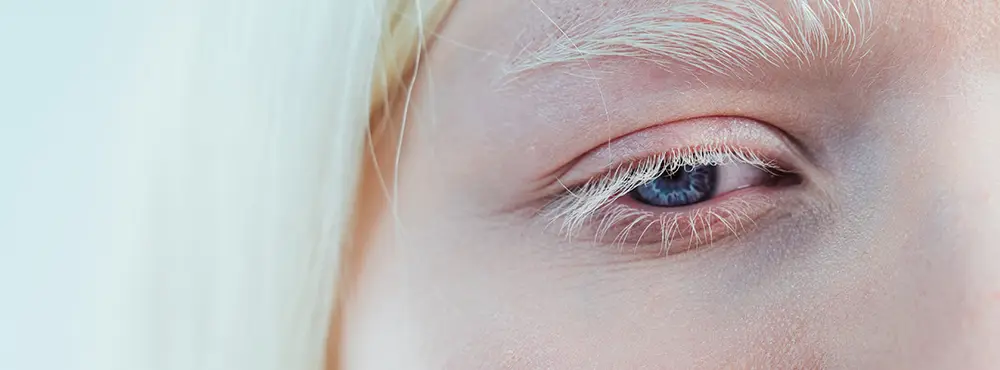
    Symptoms of albinism can range from extreme to mild: lighter skin tones (levels of melanin may slowly increase over time), darkening the skin tone over time, as well as UV sensitivity resulting in freckles, moles, or lentigines.  Hair color may also follow the broad spectrum trend, resulting in some individuals having white to brown hair, over time, as the individual ages, their hair may slowly darken due to an increase in melanin production. An individual's eye color may range from very light blue to brown but also change with age-- in some cases, the eye color may appear red or pinkish, typically caused by the low levels of melanin in the iris and light reflecting off the retina at the back of the eye. This lack of pigment in the eye may result in an individual to be light sensitive. Finally, vision may also be affected to a certain degree. Nystagmus, Strabismus, Amblyopia, Myopia/ Hypermetropia, Photophobia, Optic Nerve hypoplasia, Optic Nerve misrouting, and Astigmatism are all possible changes to eye functions that someone struggling with albinism may incur. There is no cure for the condition of albinism. However, treatments may be implemented to minimize the symptoms and aid in bettering an individual's everyday life who struggles with this condition. 


    Albinism is genetic. Generally, most albinism is a result of autosomal recessive inheritance patterns. However, albinism can have an X-linked inheritance pattern. With autosomal recessive inheritance, an individual must receive copies of the mutated gene (recessive gene) from both a maternal and paternal donor, in this case, to develop albinism. If parents are heterozygous for the trait, and the dominant allele is expressed over the recessive allele, typically making them "carriers" of the trait. Thus, they do not display any symptoms of albinism. If the parents are both heterozygous and carry the allele for albinism, there is a one-in-four chance that the offspring will have albinism. In cases where albinism is a result of X-linked inheritance, males are mainly affected. Simply because females carry two X chromosomes, if one X chromosome is damaged or mutated, the other X chromosome offsets the issue and will be expressed instead. Whereas males have an X and a Y chromosome, meaning any albino mutation in their singular X chromosome will be expressed and generate the condition. 

  
I chose this article because although I know albinism is a prevalent condition, I do not personally know anyone who has been diagnosed with it. Due to this, I only knew the visible symptoms of the condition, not any of the biological causes of the condition, the different types of albinism, the genes involved, and so on. This made researching and reading more about the topic more interesting and informative. Prior to reading this article, I never knew that albinism could be a result of two different inheritance patterns: autosomal recessive inheritance patterns or X-linked inheritance patterns. In addition, the specific genes that affect melanin production, thus, when these genes become damaged or mutated, these genes can't produce sufficient melanin or pigments, resulting in albinism. 


Monday, April 1, 2024

Rare yellow penguin on South Georgia island puzzle biologist

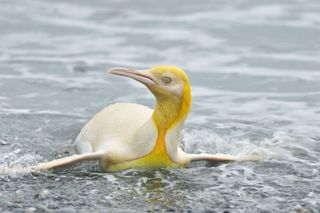
During a 2019 expedition to the South Atlantic, Belgian photographer, Yves Adams, anticipated encountering the usual king penguins, recognizable by their distinct black and yellow plumage on their heads and necks, with a streak of orange along their beaks. However, what Adams encountered was nothing short of remarkable: a strikingly vivid yellow penguin.

A wildlife photographer captured images of a rare yellow penguin.


At Salisbury Plains, a renowned stretch of shoreline on South Georgia Island, up to 120,000 king penguins can be seen congregating, creating a vast stretch of black plumage- but the animal Adams saw stood out from the rest: A bird with an ivory-white bill, a cream-colored body, and a mane of lemon-hued feathers. 


King penguins (Aptenodytes patagonicus), much like their close relatives, the emperor penguins (Aptenodytes forsteri), usually sport a black-and-white ensemble with a touch of yellowish-gold around their collar, however, this specific penguin appears to have maintained its yellow feathers while shedding its dark ones, typically pigmented by melanin, resulting in a distinctive appearance.


According to the Australian Antarctic Program, penguins exhibiting uncommon plumage are relatively uncommon, and determining the cause behind these rare colors solely by visual observation can be rather difficult. Some unusual coloring can be due to injury, diet or disease, but many cases are attributed to genetic mutations within the birds. These mutations can result in phenomena such as "melanistic" penguins, where typically white areas appear black, or "albinistic" penguins lacking melanin entirely, resulting in white plumage.

Unusually colored birds like these are uncommon, and there's likely a good reason for it.

When penguins have an excess of pigment in their feathers, a condition known as melanism, it results in an overall darker coloration. These darker individuals might stand out more in the water compared to their counterparts and may find it challenging to approach fish stealthily.

On the other hand, paler penguins are at a higher risk of predation by leopard seals or killer whales in the Antarctic.

Adams told  Kennedy News that the yellow bird exhibits leucism, a genetic condition causing partial loss of melanin. Dee Boersma, a conservation biologist and professor at the University of Washington, agreed- however noted that while the penguin lacks some pigment, it retains brown pigment on its head, suggesting it's not a true albino.


Others disagree.

Kevin McGraw, an integrative behavioral ecologist at Arizona State University, disagrees, suggesting the bird appears albino due to the absence of melanin in its plumage, feet, and eyes. Thomas agrees with other experts that "feather samples for biochemical testing would be needed to document if melanin is present."


As an environmental science student, I find this article fascinating. The discovery of a vivid yellow penguin exhibiting leucism must have been incredibly exciting for the researchers and photographers in the field. It's interesting to see how these photos offer a glimpse into the relationship between genetics and animal phenotypes. As I finish up my undergraduate experience, I believe it is safe to say understanding how genetic mutations manifest in wildlife populations is crucial for conservation efforts and sheds light on the complexities of natural selection- it is also always nice to see some beautiful photos of wildlife. 


Sources: https://www.livescience.com/yellow-penguin-south-georgia.html#:~:text=The%20penguin%20has%20lost%20the,out%20whereas%20others%20were%20not.


https://www.nationalgeographic.com/animals/article/extremely-rare-yellow-penguin-spotted-near-antarctica


Thursday, December 7, 2023

Researchers develop the most comprehensive genetic map for bison and discover gene responsible for albinism


    This study published in G3: Genes, Genomes, and Genetics and led by researchers from Texas A&M School of Veterinary Medicine and Biomedical Sciences (VMBS) presents the development of the most comprehensive genome to date of the North American bison which also brings it up to date with the most current genome sequencing technology. Researchers used this to produce the first genetic test for mutations in which they discovered the gene responsible for albinism. Albinism is a rare condition that is characterized by a lack of pigment in an animal’s body, making them appear white with red eyes. The research also provides the framework for determining other genetic variations that may impact important traits in bison like those that contribute to their health or their production value.
        The research team led by Dr. James Derr, a VMBS professor of veterinary pathobiology and genetics created the first bison genome in 2015 and now developed the new current reference genome. The technology used allowed the researcher to create the genome based on DNA from animals with DNA from two different species, known as hybrids. They used DNA from a rare F1 bison-cow hybrid meaning they were a perfect 50-50 split between both parents’ DNA. They first sequenced the genome of the F1 hybrid, the bison mom, and the domestic cattle father which allowed them to separate the bison DNA from the cattle DNA regions in the F1 hybrid.
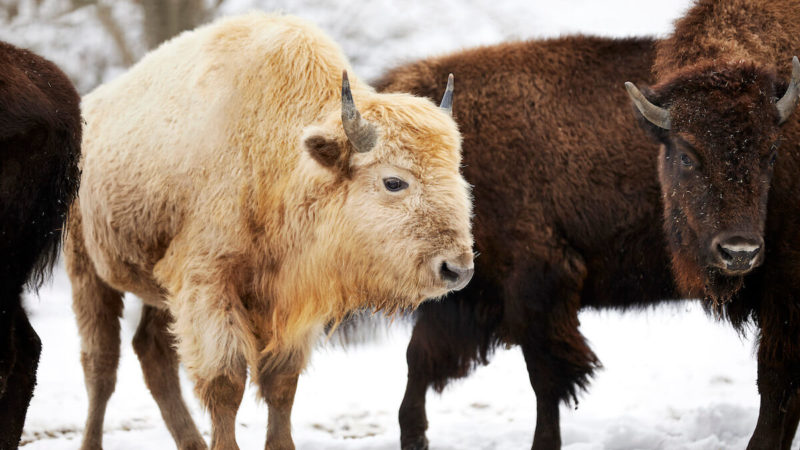
        After developing the complete high-resolution reference bison genome, the researchers then worked to find the gene mutation that was responsible for albinism in bison and to create a genetic test that could identify carriers of the mutation. They did this by sequencing the DNA from albino bison and comparing them to the wild type. They found that the mutation causes an enzyme to stop functioning properly which then leads to a lack of pigment in their skin. This discovery would be the first successful determination of the gene responsible for an observable trait in bison. Albino bison differ from white or tan bison, which are a result of crossing bison with white cattle, as they don't have red eyes and a pink nose like a true albino. Unfortunately, albino bison tend to develop skin cancer and other health issues as they get older and it is not recommended to use genetic testing to produce albino bison.
        The new development of this new reference genome and the identification of the genetic mutation that causes albinism opens new opportunities and insight into the genetics of bison. This may not only help understand bison genetics but also may have broader implications for future wildlife conservation methods and management and biodiversity preservation.


Links:
https://www.sciencedaily.com/releases/2023/11/231120124103.htm
https://www.sci.news/genetics/north-american-bison-genome-12471.html

Wednesday, November 22, 2023

Genetic Map For Bison, Discover Gene Responsible For Albinism

Genetics map for bison

Genetics map for Bison, discover gene responsible for albinism. Albinism is an inherited condition in which leads to someone having a very light skin, hair, and eyes. the cause of this is because they have less melanin than usual in their body. The first article talks about how a rare white bison cafe was born in Southwest Wyoming in which the genes led to it having a white and light fur coat. The American bison had some amount of domestic cattle genes in their DNA however breeding and getting a white bison is still rare as in fact according to the National Bison Association the birth of a white bison is one in 10-million occurrence.   

The new possibilities that were discovered was that according to Dr. James, Derr who is a professor of veterinary pathobiology and genetics. By referencing genomes and using technology created genomes based on DNA from hybrids. The case was that the bison cow was a hybrid in which it was a perfect 50-50 split Between the two parents. But to determine the albinism you would need to know the gene that is responsible. so, looking at the sequence of DNA you would need to find the mutation that caused the albinism. The fact was that the mutation caused an important enzyme to cease a function which led to a lack of skin pigmentation. (Benson D) The question that I have is how does a hybrid such as a bison and a domestic cow have a albino calf? I know a big part of this is the pigments of the skin. mainly if the animal is born with an altered or a damaged TYR the animal could be albino.    
   

Magazine, S. (2023b, May 30). Rare white bison born in Wyoming State Park. Smithsonian.com. https://www.smithsonianmag.com/smart-news/rare-white-bison-born-in-wyoming-state-park-180982262/

Benson, D. (2023, November 20). Texas A&M researchers develop comprehensive genetic map for Bison, discover gene responsible for albinism. Texas A&M Today. https://today.tamu.edu/2023/11/20/texas-am-researchers-map-bison-genome/

Staff, D. M. | K. (n.d.). 1 in 10 million: Rare white bison born at Bear River State Park. KECI. https://nbcmontana.com/news/offbeat/1-in-10-million-rare-white-bison-born-at-bear-river-state-park-bear-river-albino-indian-tribers-dna-gene-cattle-coloration


Thursday, August 5, 2021

THE DETECTION OF ALBINISM

 THE DETECTION OF ALBINISM 


    Albinism is a medical condition that affects a person's skin color, eye color, and hair color; it tends to be white. This condition is cause by the decrease of tyrosinase activity. Albinism has different types of patterns, it depends on the genes of the chromosomes and the mutation that occurs. It is an inherited condition, that is considered to be an autosomal recessive defect. This means that it is passed on from family members; meaning there must be a history of this condition in the family. According to one of the websites, "In certain ethnic groups we found at least one mutation in all, and two mutations in over 90% of albinos."  

    This medical condition can be detected by a "..light and electron microscopic examination of melanogenesis in fetal scalp biopsies or by molecular genetic tests" during pregnancy. The physical appearance of the individual can involve a major factor for detection; their skin pigmentation, eye color, and hair color is white and abnormal. This condition can also be associated with bowel disease and bleeding problems. When an individual suffers from this condition it is important for the individual to speak with their doctor to explain the treatment and restrictions; such as avoiding a long time in the sun, and wearing sunscreen. 


1. Prenatal diagnosis and carrier detection of albinism | Genetics in Medicine (nature.com)

2. Albinism | Genetic and Rare Diseases Information Center (GARD) – an NCATS Program (nih.gov)

Sunday, August 4, 2019

Knockout mice are guide to new genes for eye and skin disorders

The article, “Knockout mice are guide to new genes for eye and skin disorders”, discusses the role mice play in discoveries about humans concerning certain disorders. There is a lot of information known about albinism. Albinism is a disorder that affects the pigment of hair, skin, and eyes. It can vary from extreme to mild. Scientists have been able to connect a lot of genes to 
Above is an image that depicts the difference between a transgenic mouse and a knock-out mouse (https://www.jidsponline.org/article/S0022-202X(15)52560-8/fulltext)


the disorder, however there is still a lot unknown. At UC Davis, researchers have used mice to target certain disorders genetically. They use “knock-out mice” in which an existing gene is inactivated to learn more about its function. 
Albinism in humans is just starting to be understood. However, it is very hard to look at the genetics of humans. We can easily sequence a genome, but it is harder to figure out the tie between a gene and a disorder. Luckily, through the mice, we are able to do this much more easily. Mice are not as variable, so it is easier to find the connections. While humans are not mice, through the discoveries in mice, it makes it considerably easier to find the target genes in humans. It allows us to focus on more specific genes which is a lot less daunting than the whole genome. 
There has been success in using these knock-out mice. The article, “300 blind mice uncover genetic causes of eye disease”, explains how genes linked to vision disorders have been identified. Three quarters of these had been previously unknown. Through finding the analogous genes in humans, we will be able to locate the cause for blindness genetically with much more ease. 
The reason mice are a prime candidate for the study as well as many other studies is because their genetic background has become so consistent in a laboratory setting. This creates a pretty reliable control and leaves less room for variables and discrepancy. 

Once these genes for disorders are pinpointed in mice, the knowledge can be applied to humans. I think it is amazing how all living organisms, that we know of, are based on the same genetic code. Through this, it allows us to make discoveries into our own species through research on the genetics of another. Having more insight into these hair, eye, and skin disorders will have all sorts of positive consequences. Scientists will be able to understand certain ailments and be better equipped to treat them. 

Wednesday, April 10, 2019

blue eyed humans have a single common ancestor


In an article from Science Daily, a study shows that people with blue eyes all share one common ancestor. 6-10,000 years ago a genetic mutation took place which is the cause of the eye color of all blue eyed human beings alive on the planet today. Variation in eye color from brown to green comes from the amount of melanin in the iris. People with blue eyes only have a small variation in the amount of melanin in their iris. Which has drawn scientists to conclude that they all come from the same ancestor. Originally we all had brown eyes, but a mutation in the OCA2 gene in our chromosomes resulted in a switch which turned off the ability to produce melanin in the eyes.
 However, the mutation only affected the ability for the body to produce melanin in the eyes without affecting a gene adjacent to it which would have affected the body’s ability to produce melanin at all resulting in albinism. This mutation however has neither positive nor negative effects on the body and is a perfect example of nature trying new things.

Saturday, July 29, 2017

White Lions Found In Africa


The population of the African lion is slowly dwindling across the massive range of Africa. The majority of lions observed in the wilderness are seen to have golden brown coats, but recently a genetic mutation has caused the coats of a few cubs to be “white”. The white gene is recessive, and less commonly seen in the wild due to it being ineffective for survival. The white coat may lead you to think that the white lions are albino, but that’s incorrect because true albinos can’t produce any type of pigment. Leslie Lyons, a geneticist at the University of Missouri, says the genetic mutation is really a lighter brown, not truly white. Researchers believe if the white lions are unable to successfully hunt, the white genome may fade out. This does not mean the end of the white lion due to the trait still being in the genes. Due to inbreeding in lions it’s not unusual for the recessive trait to pop up more often. There are currently sanctuaries in place to insure the survival of several white lion prides.  


Friday, April 13, 2012

Albino Killer Whale Discovered.

Scientist on a NOAA expedition spotted and caught a rare find while doing research off Alaska'a Aleutian Islands. White whales have been immortalized by stories like Moby Dick which dealt with a sperm whale but in reality no orca has ever been scientifically documented as an albino. The orca, like most predatorial species in the ocean, relies heavily on counter shading for camouflage. An albino orca as such at a great disadvantage for catching prey and probably survived into adulthood only because of the complex social structure Killer whales are noted for.

It is interesting to note that  this whale is not a true albino and maintains small amounts of melanin. He, male orcas have distinct dorsal fins, still retains varying levels of pigmentation. Also since this whale was able to reach maturity it will probably have a good chance to pass on it's genes into the next generation something that rarely happens in species other than humans.