Showing posts with label F1 Hybrids. Show all posts

Thursday, December 7, 2023

Researchers develop the most comprehensive genetic map for bison and discover gene responsible for albinism


    This study published in G3: Genes, Genomes, and Genetics and led by researchers from Texas A&M School of Veterinary Medicine and Biomedical Sciences (VMBS) presents the development of the most comprehensive genome to date of the North American bison which also brings it up to date with the most current genome sequencing technology. Researchers used this to produce the first genetic test for mutations in which they discovered the gene responsible for albinism. Albinism is a rare condition that is characterized by a lack of pigment in an animal’s body, making them appear white with red eyes. The research also provides the framework for determining other genetic variations that may impact important traits in bison like those that contribute to their health or their production value.
        The research team led by Dr. James Derr, a VMBS professor of veterinary pathobiology and genetics created the first bison genome in 2015 and now developed the new current reference genome. The technology used allowed the researcher to create the genome based on DNA from animals with DNA from two different species, known as hybrids. They used DNA from a rare F1 bison-cow hybrid meaning they were a perfect 50-50 split between both parents’ DNA. They first sequenced the genome of the F1 hybrid, the bison mom, and the domestic cattle father which allowed them to separate the bison DNA from the cattle DNA regions in the F1 hybrid.
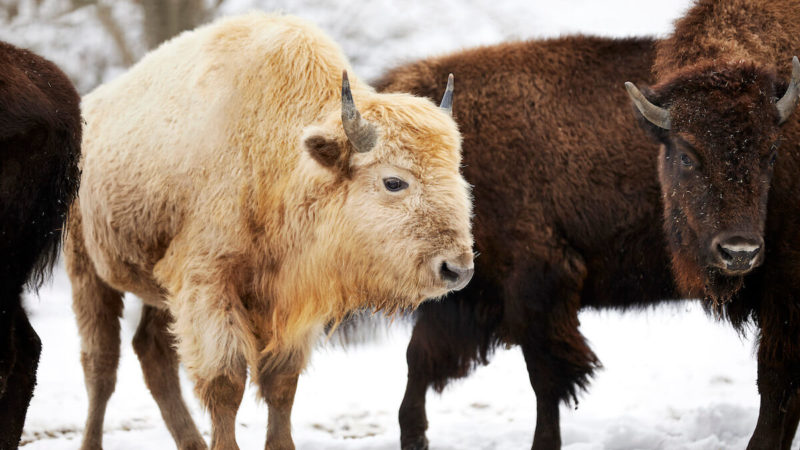
        After developing the complete high-resolution reference bison genome, the researchers then worked to find the gene mutation that was responsible for albinism in bison and to create a genetic test that could identify carriers of the mutation. They did this by sequencing the DNA from albino bison and comparing them to the wild type. They found that the mutation causes an enzyme to stop functioning properly which then leads to a lack of pigment in their skin. This discovery would be the first successful determination of the gene responsible for an observable trait in bison. Albino bison differ from white or tan bison, which are a result of crossing bison with white cattle, as they don't have red eyes and a pink nose like a true albino. Unfortunately, albino bison tend to develop skin cancer and other health issues as they get older and it is not recommended to use genetic testing to produce albino bison.
        The new development of this new reference genome and the identification of the genetic mutation that causes albinism opens new opportunities and insight into the genetics of bison. This may not only help understand bison genetics but also may have broader implications for future wildlife conservation methods and management and biodiversity preservation.


Links:
https://www.sciencedaily.com/releases/2023/11/231120124103.htm
https://www.sci.news/genetics/north-american-bison-genome-12471.html

Friday, November 27, 2015

Scientists have created a plant that rejects its own pollen to reduce inbreeding and less healthy offspring


University of Birmingham scientists took a plant called Arabidopsis Thaliana which is a self-fertile plant and made it reject its own pollen by inserting two genes found in a field poppy called “Papaver rhoeas.” The poppy creates two proteins, PrpS and PrsS which identifies the plant. When a plants flowers receives its own pollen, it recognizes it is from itself, the pollen begins its programmed cell death, and stops itself from germinating. Research shows that when just these two genes alone were transferred into the Arabidopsis Thaliana, it was enough for it to become self-incompatible. In the future, scientists hope to be able to implement this into more crops and breed hybrid plants which give off better yields and strength. They also plan to make F1 hybrids easier as this would make it cheaper and easier for plant breeders to create superior plants and seeds.


This research in this article is particularly interesting because the poppy plant isn’t even closely related to the Arabidopsis plant. It also amazes me how plants can not only reject itself, but can reject close relatives of itself as well. It is fascinating how two different breeds of plant can use the same genes to make the plants work in the same way. If this works and can become implemented into more plants, food quality will soar as well as hopefully be cheaper which can create a big impact on the world.

The Original articlecan be found here