Showing posts with label aquaculture. Show all posts

Monday, March 25, 2024

Using Gene Selection to Improve Seafood

 Specifically, shrimp!  In recent years, farming within the shrimp industry has become tough.  Shrimp is selling at incredibly low prices, yet the cost of feeding and raising the animal is high.  Not only that, many farmers' stocks are susceptible to disease, which can result in devastating financial losses.  This article goes into how the company, the Center for Aquatic Technologies (CAT), helps farmers improve their shrimp stocks.  CAT provides genotyping services that can allow farmers to select for traits better for breeding their shrimp.  Traits that could make the shrimp more disease resistant and grow better.  CAT uses panels for genotyping, which is a collection of genes that can be tested for mutations, diseases, etc.  Back in 2019, CAT developed a high-density panel for shrimp genotyping that can help farmers all around the world.

One thing that fascinated me about this article was the fact that a company like CAT even exists in the first place.  It just would have never occurred to me that there was a niche to be filled in genotyping shrimps in order to produce better seafood stocks.  Of course, humans have been breeding bigger, better, tastier plants and animals for thousands of years now.  but the realm of shrimp farming was so obscure to me that it was interesting to see such a complex technology be applied to something so specific.  In the article, one of the people working for CAT mentions how farmers can't just rely on genetics and breeding alone.  Good animal husbandry practices must be done as well, and as someone who has kept and bred my own population of shrimp before, I couldn't agree more with that statement.  Although, pet cherry shrimp aren't exactly the same as the food shrimp discussed in the article, such monodon and vannamei shrimp.


Article:https://thefishsite.com/articles/can-genetic-improvements-help-to-ease-economic-pressure-on-the-shrimp-sectorcenter-for-aquatic-technologies
Article about gene panels: https://www.genomicseducation.hee.nhs.uk/genotes/knowledge-hub/gene-panel-sequencing/


Wednesday, November 17, 2021

MUTANT SALMON: The Future of GMO's Feeding the Growing Population


Albany, Indiana

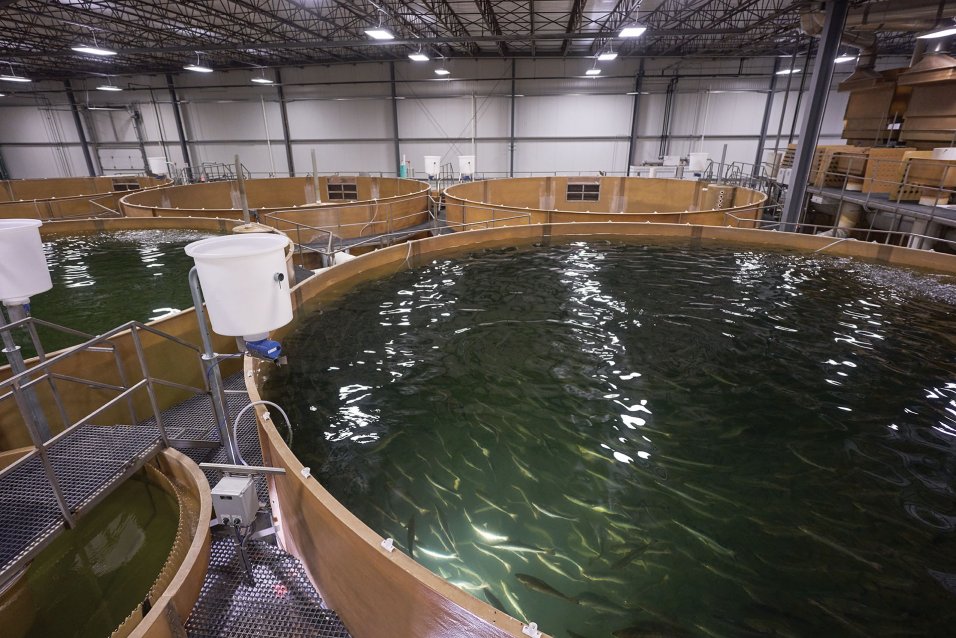
AquaBounty's facilities in Albany, Indiana 


    An Indiana-based company named AquaBounty Technologies has developed a genetically modified salmon named AquAdvantage Salmon that is the first genetically modified animal to be approved by the FDA. AquAdvantage Salmon are a combination of Atlantic salmon, Pacific king salmon, and Arctic Ocean eelpout. According to sources, Atlantic salmon have a high mortality rate as juveniles, so by inserting a growth hormone gene from Pacific salmon, the AquAdvantage Salmon not only have a higher survival rate, but they also grow twice as fast. This is important to aquaculture because when a fish reaches maturity in half the time, it can be harvested sooner, resulting in a surplus in the food supply, and lower prices in the grocery store, which will make salmon more accessible to low income households. 

    AquAdvantage Salmon are a huge milestone in genetically modified organisms. With the projected world population reaching 10,000,000,000 by 2050, food insecurity will likely become a major issue, especially in developing countries. With AquAdvantage Salmon growing twice as fast as wild caught salmon without injecting or treating them with artificial hormones, it provides a healthier and more sustainable source of food. Additionally, overfishing is already a major issue around the globe, so introducing farmed fish into the food system allows for damaged ecosystems to regenerate and heal. If this idea is applied to domesticated animals, such as chickens or cows, it could completely change how the world produces food, for the better. 


Thursday, March 14, 2019

How the Icefish Got Its Transparent Blood and See-Through Skull

A study from NY times have found that Antarctic blackfin icefish developed to have transparent blood to survive in the freezing water conditions. The Antarctic blackfin icefish, Chaenocephalus aceratus, lacks hemoglobin in their blood and have thin bones which makes the brain visible through its skull. Research have studied the genome of blackfin icefish to compare them to their close relatives and found that their genomic maps changed due to evolutionary time and gave the icefish to have unusual characteristics from their ancestors. The modern icefish no longer makes red blood cells and lacks hemoglobin to carry oxygen. Instead, the icefish is dedicated to make antifreeze for blood and ice-preventing proteins for survival. Since red blood cells become hard to pump and can freeze easily under freezing water, the icefish underwent a strategy for anaemia and developed supersize gills by losing it scales to absorb the abundant oxygen from the freezing water through its skin. Through evolution, the icefish also developed floppy bones that contained less minerals than their ancestors and enabled them to rise up in the water column to eat krill and other aquatic creatures that would not be found in deep sea level.

This is very amusing how the blackfin icefish lost their ancestor's features of having red blood cells and dense bones and developed different physiological features such as transparent blood and sloppy bones for adaptation. It is also very surprising to know that anaemia, a trait that is maladaptive to most vertebrates could be an advantageous trait for a different environment. 


Friday, November 22, 2013

Transgenic Salmon and the use of genes from the Zebrafish to better protect these cultured fish from diseases and pathogens.


The article, "Isolation of the Atlantic salmon β-actin promoter and its use to drive expression in salmon cells in culture and in transgenic zebrafish," portrays how genetic roles with salmon aquaculture are continuously growing. Researchers are working towards successful genetic improvement of the fish. Many scientists study which genes are in control of disease protection or which genes can be enhanced to enlarge the size of the fish. Transgenic salmon have recently been introduced to the world of aquaculture. Those genes that control the growth hormones in the salmon are altered to be more receptive and therefore pump more of this hormone into the fish. This will increase the size, as stated before, and furthermore increase the production of the salmon crop. To salmon famers this sounds like a dream come true. However, the general consensus of the human population is not as confident with consuming transgenic salmon. This feeling of doubt is not uncommon since there is still minimal evidence of the effects, if any, on human life after they eat these salmon.


I personally feel that introducing genes from another organism into the salmon populations, controlled in cultures, is a smart idea, but with multiple outcomes. I agree with the general consensus of the public,  and demand more answers before this becomes an everyday occurrence in salmon aquaculture. There are so many "what if" questions that come from mixing genetics of different species. Therefore research must be conducted to test not only how the new genes will effect the fish, but also how ingesting the fish will affect the humans who eat them. 


Source: http://fx5ly8ju5l.search.serialssolutions.com

Below is a link to another article which provides more information about the Zebrafish:
http://www.academia.edu/528432/Zebrafish_as_a_model_organism_for_nutrition_and_growth_towards_comparative_studies_of_nutritional_genomics_applied_to_aquacultured_fishes

Genetic consequences of interbreeding between wild and cultured Atlantic Salmon 


             A worldwide issue, that has increased from the use of farm grown salmon, is the mixture of wild and cultured salmon genes. The two separate fish have the chance to interact when the farmed salmon escape from their pens and make their way to the native salmon’s habitats. Once they reach each other, the option to reproduce is available, but would then result in a variety of genetic combinations. The mixture between the two types of salmon is considered a “hybridization.” Typically genetic diversity can be beneficial to the organisms, but not always. In this case, when the wild salmon and the farmed salmon mix the results have shown unexpected patterns within the inheritance of the genes from the parent fish. This creates field of unknown for researches. In addition to unpredicted circumstances, researchers have found that the presence of the farmed salmon in the native territories can greatly increase the chances of the wild salmon’s extinction. 
            The farmed salmon have this negative effect on the wild populations because of a few distinct reasons. First, the cultured salmon could potentially carry diseases over to the wild populations. Second, the basic addition of more than the normal environmentally supported population of salmon can decrease resources for the native fish. And lastly, when the two interbreed, the process alters the regulation of the transcription of the salmon’s genes. 
          Gene transcription is incredibly important to the survival of the salmon, both wild and farmed. Wild salmon have their own set of genes that have been through the necessary adaptations needed to survive in their natural habitats. These genetic components allow the fish to live, to protect itself from the components of the water they live in, and to internally regulate their bodies to be able to live successfully, etc. Their gene transcriptions are their directions to life, and when they are tampered with by an outsider’s genetic instructions, important information can be lost. In the end, the main goal is to do what ever is possible to contain the farmed salmon and prevent the combination of the two fish.

Source: http://fx5ly8ju5l.search.serialssolutions.com

Another source that has further information on the topic: http://www.nature.com/news/transgenic-salmon-nears-approval-1.12903