Showing posts with label pathogens. Show all posts

Monday, November 18, 2024

How does salmonella evade the gut's natural defenses?

The digestive system has a microbiome housing countless microorganisms that act as a line of defense against harmful viruses and pathogens and aids digestion. So, how is it that Salmonella bacterium are able to slip past the defenses that the gut has?

The sneaky trick that Salmonella uses is one that affects the nutrient balance within the gut. By causing inflammation when it enters, normal absorption of amino acids from food is disrupted and creates an imbalance of nutrients. This imbalance then sustains the growth of the Salmonella bacterium within the large intestine.

Researchers at the University of California analyzed change in chemical composition within the guts of mice as a result of being infected with Salmonella. By tracking the absorption rates of amino acids, they were able to find that certain amino acids had lower absorption rates in mice affected by Salmonella and were able to track virulence factors that broke down those same amino acids for the benefit of Salmonella. 

This study has the potential to inspire future treatment methods, namely probiotic health or dietary plans that can aid the body's natural defenses against harm.


Thursday, October 26, 2023

Pathogenic Affects on Social Behavior


When different pathogens move throughout a population, people are able to adapt and adjust in order to fight them off. Research that was conducted at Harvard shows insight on how pathogens are changing social behaviors of different organisms. It is not known what happens inside an organism's brain, but species that range from fruit flies to primates are exhibiting changes in social behavior due to infection-induced changes. In one species specifically, the organism was found to be loners, and consistently showed isolating behaviors, but when infected by a pathogenic strain of bacteria (Pseudomonas aeruginosa) contaminated this species, they became more interested in one another and increased in their mating. The researchers then isolated messenger RNA from the pair of neurons, examining how they are different post-infection, and discovered that the pheromone receptor STR-44 was significantly upregulated in infected worms. Looking beyond worms, it was also pointed out that many different GPCRs for chemicals are encoded in the genomes of several animals, which are used to assess environmental cues. Regulation of these receptors may be a common strategy for animals to change their social behavior in the presence of a pathogen stressor present.


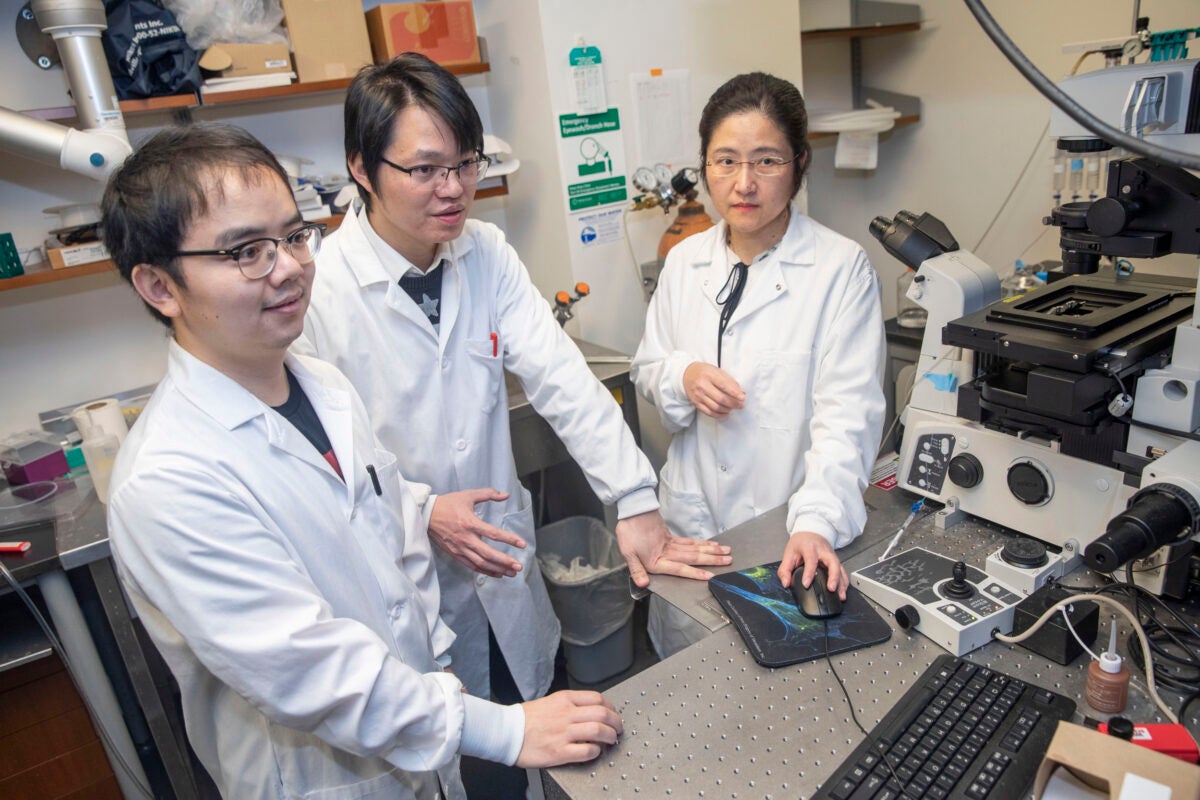
Taihong Wu (from left), Minghai Ge, and Professor Yun Zhang.


Ultimately, this change along with other changes in behavior increases genetic diversity within a population. It is interesting to think about how being infected by a pathogen can completely change and alter an organism's behavior. Maybe there are different pathogens out there that can be contracted that can increase a species fitness in the environment and make them a smaller target to their predators. This discovery can possibly lead to strengthening different species' fitness' by changing social behaviors that may have caused their species to go extinct previously.


Friday, April 8, 2022

How Can Plants Protect Themselves From Pathogens in Rain


    A recent study has revealed that when plants are exposed to rain, hair-like structures on the leaf surface called trichomes recognize the rain as a risk factor for causing disease and activate their immune system to prevent infections. These findings could contribute to the development of methods to protect plants from infectious diseases caused by rain.

    Although water is one of the key essentials for majority of plant life, there are also bacteria that come from these water sources which can harm the plants. Raindrops can contain pathogens, like bacteria, filamentous fungi, and viruses, which can cause disease in plants. Plants have their own immune systems, so when these plants detect pathogens, they express immune-related genes to prevent themselves from being infected. 

    A research team led by Professor Yasuomi Tada and assistant Professor Mika Nomoto of Nagoya University conducted a study using seedlings from Arabidopsis thaliana (common name: thale cress). They found that Ca2+ levels around the trichomes on leaf surfaces increase. 

    Professor Tada says that their findings may be able to artificially improve plants' defensive capabilities against diseases at any time and for any length of time.

Related Article: https://pubmed.ncbi.nlm.nih.gov/15085136/

Sunday, November 21, 2021

Animal Infections May Spread to Humans with an Increase in Deforestation


The loss of forests may increase human to nonhuman primate interactions. These interactions can increase the spread of diseases including COVID-19.  More than half of human pathogens are thought to be zoonotic and are transmitted to humans from animals.  

By looking at forests in Uganda, there is a close proximity between the rural communities and the forests.  This is causing limited distance and for both humans and animals to use the same resources.  Buffer zones have been suggested by authors to minimize these interactions.  This is important to prevent any future pandemics. 

Saturday, February 4, 2017

Saving the Rice!

Rice is a world wide popular crop that has been facing more danger than we thought. Recently, rice has been going through what is called rice blast- a serious fungal disease that can destroy rice crops. The pathogen that is known to cause the disease is Magnaporthe oryzae. The symptoms shown that a rice plant has rice bast is usually lesions across the plant and even the roots. 


In the past, a set of rice genes were studied and was known to have a high resistance to fungus. Yiwen Deng studied the rice in much more depth and found that PigmR held a  high resistance to the rice blast. Deng noted that if the gene PigmR is expressed to the seedlings, it could resist against rice blast though out its whole system. 

I have heard of rice blast before but never studied it in depth. As all plants can easily come across disease and its extremely hard to repair the plant after any kind of disease. Although were always one step closer to helping one organism, were always one step back again because these diseases change and we discover more. For the rice, it is incredibly interesting that researches have studied the genes of rice in deep depths and have found costless ways to help the rice blast problem. 


Thursday, February 5, 2015

Quick DNA Scans Could Ensure Food is Safe to Eat


It's nearly impossible to know exactly where your food came from before it's served on your dinner plate. Now, thanks to rapid DNA sequencing, consumers can find out if the food they're about to eat is what the supplier says it is, as well as if it contains any food borne illnesses. Fish and other seafood are the main focus; common contaminants include salmonella, campylobacter, and Escherichia coli. "Each year food borne illnesses caused by these microorganisms sicken 48 million Americans, hospitalize 128,000, and kill 3,000" (U.S. Centers for Disease Control and Prevention).

One trend on the rise is being called "food fraud". In a 2014 study, an international conservation organization discovered that one third of 1,215 seafood samples and 46 fish types from 674 retailers in 21 states were mislabeled! DNA sequencing could eliminate this potentially dangerous problem by using genome sequencing to check the authenticity of the food being sold and can also create databases of food borne strains.

Plans for the future include performing whole genome sequencing on 100,000 different types of common pathogens found in food. This technique lets scientists differentiate between strains of microbes and can stop outbreaks before it spreads. This project has already proven to be successful. Just last year the FDA was able to stop a Listeria outbreak that killed one and made 7 others sick. The strain was linked back to a single company which then stopped production. 

Another way food fraud can be prevented is through The International Barcode of Life (iBOL). This large project has put together a huge "genetic library" of all the life on Earth. Each specie in the database has it's own identifiable "barcode". This system has also been successful when the CDC used it to identify poisonous puffer fish that were being sold as non-poisonous pufferfish in the U.S. This helped put a stop to an incident dubbed "sushigate". Similar to this barcode system, one company called DNATrek is creating synthetic bar codes that can be applied directly to food so that they can be scanned to see where they came from. It's possible that one day these scans could be completed with the wave of your cell phone over your food. 

I found this article interesting because I think checking the authenticity of food and checking for foodborne pathogens is extremely important, especially in today's world. Consumers don't really know where their food comes from or the potential harm it can cause.


Friday, November 22, 2013

Transgenic Salmon and the use of genes from the Zebrafish to better protect these cultured fish from diseases and pathogens.


The article, "Isolation of the Atlantic salmon β-actin promoter and its use to drive expression in salmon cells in culture and in transgenic zebrafish," portrays how genetic roles with salmon aquaculture are continuously growing. Researchers are working towards successful genetic improvement of the fish. Many scientists study which genes are in control of disease protection or which genes can be enhanced to enlarge the size of the fish. Transgenic salmon have recently been introduced to the world of aquaculture. Those genes that control the growth hormones in the salmon are altered to be more receptive and therefore pump more of this hormone into the fish. This will increase the size, as stated before, and furthermore increase the production of the salmon crop. To salmon famers this sounds like a dream come true. However, the general consensus of the human population is not as confident with consuming transgenic salmon. This feeling of doubt is not uncommon since there is still minimal evidence of the effects, if any, on human life after they eat these salmon.


I personally feel that introducing genes from another organism into the salmon populations, controlled in cultures, is a smart idea, but with multiple outcomes. I agree with the general consensus of the public,  and demand more answers before this becomes an everyday occurrence in salmon aquaculture. There are so many "what if" questions that come from mixing genetics of different species. Therefore research must be conducted to test not only how the new genes will effect the fish, but also how ingesting the fish will affect the humans who eat them. 


Source: http://fx5ly8ju5l.search.serialssolutions.com

Below is a link to another article which provides more information about the Zebrafish:
http://www.academia.edu/528432/Zebrafish_as_a_model_organism_for_nutrition_and_growth_towards_comparative_studies_of_nutritional_genomics_applied_to_aquacultured_fishes

Wednesday, April 3, 2013

The Link Between Natural Selection and Inflammatory Disease

Medicalnewstoday recently released an article discussing the possible correlation between the current health problem of inflammatory disease and the possibility that the human body developed this disease through the process of natural selection.

It has been demonstrated that some of the genetic variants that make a person more susceptible to inflammatory diseases such as multiple sclerosis, Chrohn's Disease, and rheumatoid arthritis may in fact have been beneficial to our ancestors.

During the time period when bacterial and viral pathogens claimed many lives, the inflammatory response was utilized and developed as a mechanism of self defense.  Now that our society has access to antibiotics and cleaning products that kill potentially pathogenic invaders, the inflammatory response that kept people alive in the past is now no longer needed as much and is beginning to become more of a problem by causing autoimmune disorders.

So far, it has been discovered that there are 21 places on the human genome that bear a "signature" for both natural selection and susceptibility to inflammatory disease.