Showing posts with label denisovans. Show all posts

Wednesday, November 24, 2021

Only a Tiny Fraction of our DNA is Uniquely Human

 Diverse-group-of-stylish-people -standing-together.-Society-or-population-social-diversity - WeAreTechWomen  - Supporting Women in Technology

Within this article, it discusses that there is only 1.5-7% of our DNA which is uniquely human and are scattered throughout a genome containing genes involved in brain development and function, leading to the conclusion that brain evolution was essential for making humans human. Researchers examined every spot of DNA in 279 peoples genomes to grasp a better image of the human genome and differ wether DNA came from Denisovans, Neandertals or was inherited from a common ancestor of humans and those long-lost relatives.About half of the human genome contains regions where people got DNA from Neandertals or Denisovans. This study highlights how interbreeding with other hominid species influenced the human genome several times. Only minor changes to DNA affecting one or more DNA bases — the molecule's information-carrying components  were analyzed. Given that humans and Neandertals split up relatively recently , including DNA that only humans have added to their genomes might result in a greater estimate of exclusively human DNA.  Researchers may learn that part of what appears to be distinctively human DNA was carried by those ancient cousins when more genomes from Neandertals, Denisovans, and other extinct hominids are decoded.

Friday, May 3, 2019

The First Denisovan Fossil From Outside Siberia Has Been Found in China


In 2016, Jean-Jacques Hublin, paleoanthropologist and director of the Department of Human Evolution at the Max Planck Institute of Evolutionary Anthropology in Leipzig, Germany, was emailed by archaeologist Dongju Zhang about a highly unusual hominin mandible found in a cave on the Tibetan Plateau in Xiahe, China. The photos she attached stunned Hublin. This fossil was quite complete and clearly nonmodern. It wasn’t long after that they met in Leipzig and began planning their collaboration and recruiting a team of specialists for a study on this strange fossil.

On May 1st of this year, Hublin, Zhang, and their team published the results of their study in the journal Nature. Their analysis confirmed that it belonged to the mysterious branch of hominins known as Denisovans, which were first identified in 2010. Never before had a bone fragment from a Denisovan been found outside a single cave in the Altai Mountains of Siberia.

Moreover, this is the most complete fossil of one ever discovered, as all the previous ones, including the recently uncovered skull piece I reported on in an earlier article, have been small and fragmented. The Xiahe jaw will help scientists tremendously, as now they will have a reference specimen to compare currently unidentified fossils to. Until this point, the anatomy of Homo denisova has been almost entirely unknown and speculative. This finding will thankfully add another eye-opening piece to the puzzle.

Hublin and his team were able to identify the fossil as Denisovan thanks to the work of his PhD student, Frido Welker, who had figured out that ancient proteins can be preserved much longer than ancient DNA, and therefore they could be used to map hominin groups in the absence of the latter material. Genome sequencing of Denisovans and their famous “sister” hominin, Neandertals, allowed the researchers to suppose the structure of these proteins and subsequently flesh out the separate branches. In the case of the Xiahe jaw, there was no ancient DNA, but the teeth yielded some proteins. These were then analyzed and matched using the aforementioned technique. The results were clear, this Tibetan fossil was a Denisovan.

Monday, April 29, 2019

The First Confirmed Hominin Hybrid Has Been Discovered


Denisova 11, as she is called, was an approximately 13-year-old girl who lived around 90,000 years ago in the Altai Mountains of Siberia. What is so fascinating about this girl is that she is clear evidence for interbreeding between species in the genus Homo (humans). She is indeed about half Denisovan and half Neandertal, two early members of the genus that are related to Homo sapiens.

Viviane Slon, a researcher at the Max Planck Institute in Leipzig, Germany, performed DNA analysis six times on Denisova 11's piece of limb bone that had been found. She simply could not believe the results of the analysis the first time and had thought she made a mistake. However, each successive test came to the same conclusion. This young girl had a Neandertal mother and a Denisovan father. Moreover, they discovered that her father in fact had a Neandertal ancestor of his own. This was further confirmation of how common hybridization must have been in early hominins.

So far, only Denisova 11 and four other individuals belonging to the species Homo denisova have been uncovered by the bone fragments that they left behind in a single cave in the Altai Mountain range. As I have previously reported, the species was first identified in 2010, when DNA sequencing of the toe bone of an individual called Denisova 3 led scientists to confirm the existence of an entirely new group of humans.

Svante Pääbo, the director of the Max Planck Institute of Evolutionary Anthropology, has stated that due to the fact that Neandertals originated in western Eurasia and that Denisovans originated in the east, they likely did not meet very often. But based on these latest findings, Pääbo and many other scientists now believe that when the two species did come face to face, mating between them was far more common than was ever previously thought.

The idea that Denisovans, Neandertals, and Homo sapiens were producing hybrids for possibly hundreds of thousands of years is supported by genetic studies of modern populations. The DNA of people living in Europe and Asia today is on average 2% Neandertal. The DNA of people living in Melanesia today is on average 5% Denisovan, with other varying amounts found in the rest of southeast Asia and Oceania.

The genomes of all these humans studied, ancient and modern, reveal that hybrids were not uncommon throughout our shared history on this planet.

Sunday, April 21, 2019

Scientists Find the First Confirmed Denisovan Skull Fragment

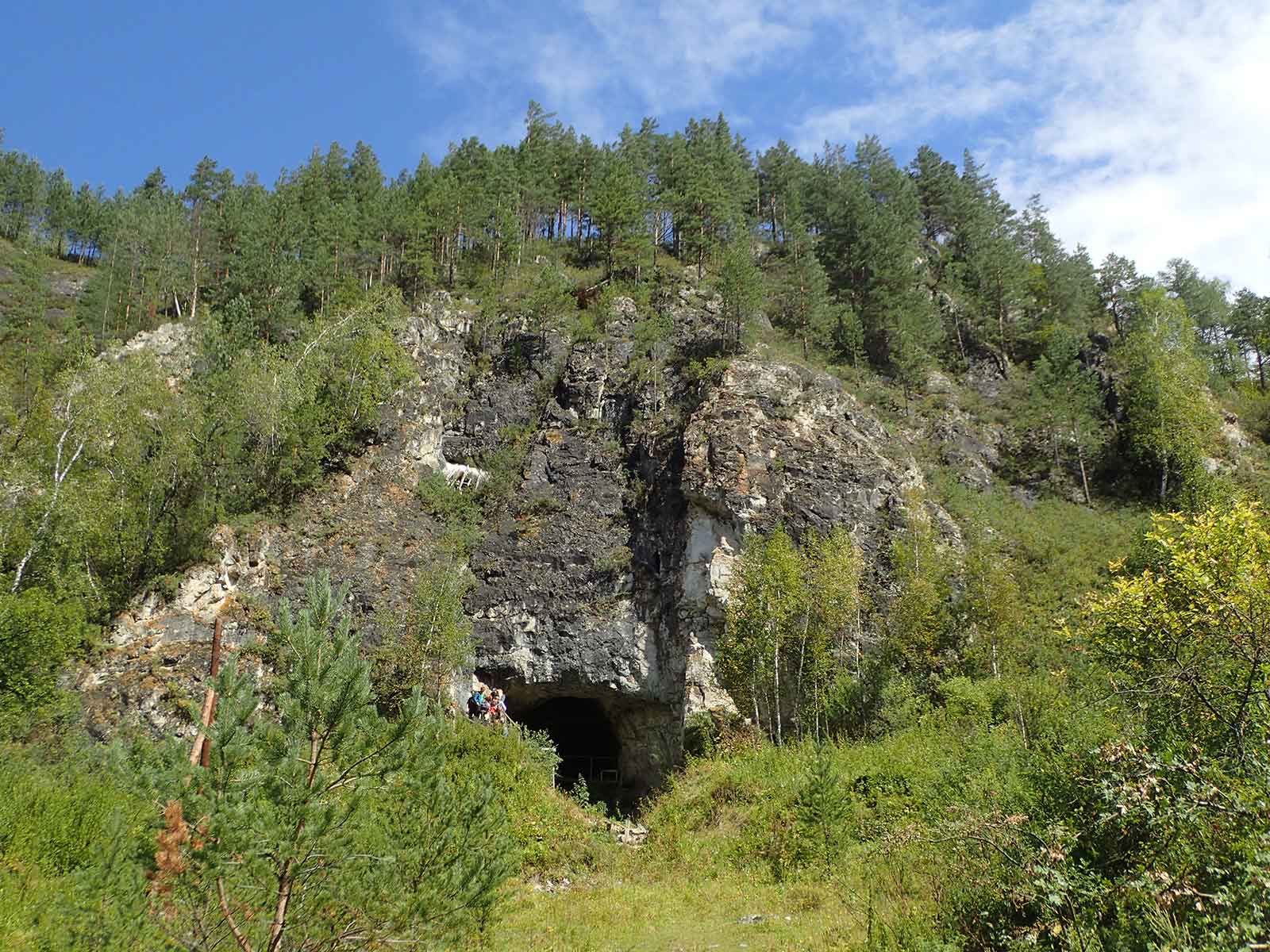
Denisova Cave, Altai Mtns., Siberia
Within a cave in the Altai Mountains of Siberia, a piece of a skull that made up the back of a parietal bone was discovered. Using DNA analysis techniques, researchers have confirmed that this bone fragment is in fact part of an individual who belong to the species Homo denisova. These archaic humans are more casually called Denisovans, and they are closely related to Neandertals (Homo neanderthalensis) - the both which are somewhat less closely related to our species, Homo sapiens. This bone fragment belongs to only one of five separate Denisovan individuals that have been discovered yet, all within the same cave in Siberia.

While its DNA has been confidently identified, the true age is unknown because it is too old to radiocarbon date. Additionally, this fragment is quite small and too incomplete, and so it cannot be used to determine whether other hominin skeleton fragments found are Denisovan or not. The only way these can also be identified is through DNA analysis, which is often difficult to do on samples so ancient.

With the sequencing of both the Neandertal and the Denisovan genomes, in 2010 paleogeneticist Svante Pääbo and his team were about to make an astounding discovery about modern people across the globe when they compared their DNA to these archaic humans. They found that 2.5% of the DNA of modern Europeans and Asians has been inherited from Neandertals, and that around an additional 5% of the DNA of modern Melanesians has been inherited from Denisovans. This was clear evidence that our ancestors had socialized and interbred with other species of humans living at the same time in prehistory.

Today, anthropologists and geneticists are still waiting to find a more complete portion of a Denisovan skeleton. The hominin’s genome has much to say about who it was but seeing a complete skeleton will allow the world to visualize them. This can provide many other clues to how they lived and acclimated to their world. For now, they will have to continue to rely on the few Denisovan skeletal fragments unearthed in Siberia.

Saturday, April 20, 2019

Three Distinct Denisovan Lineages Have Been Revealed

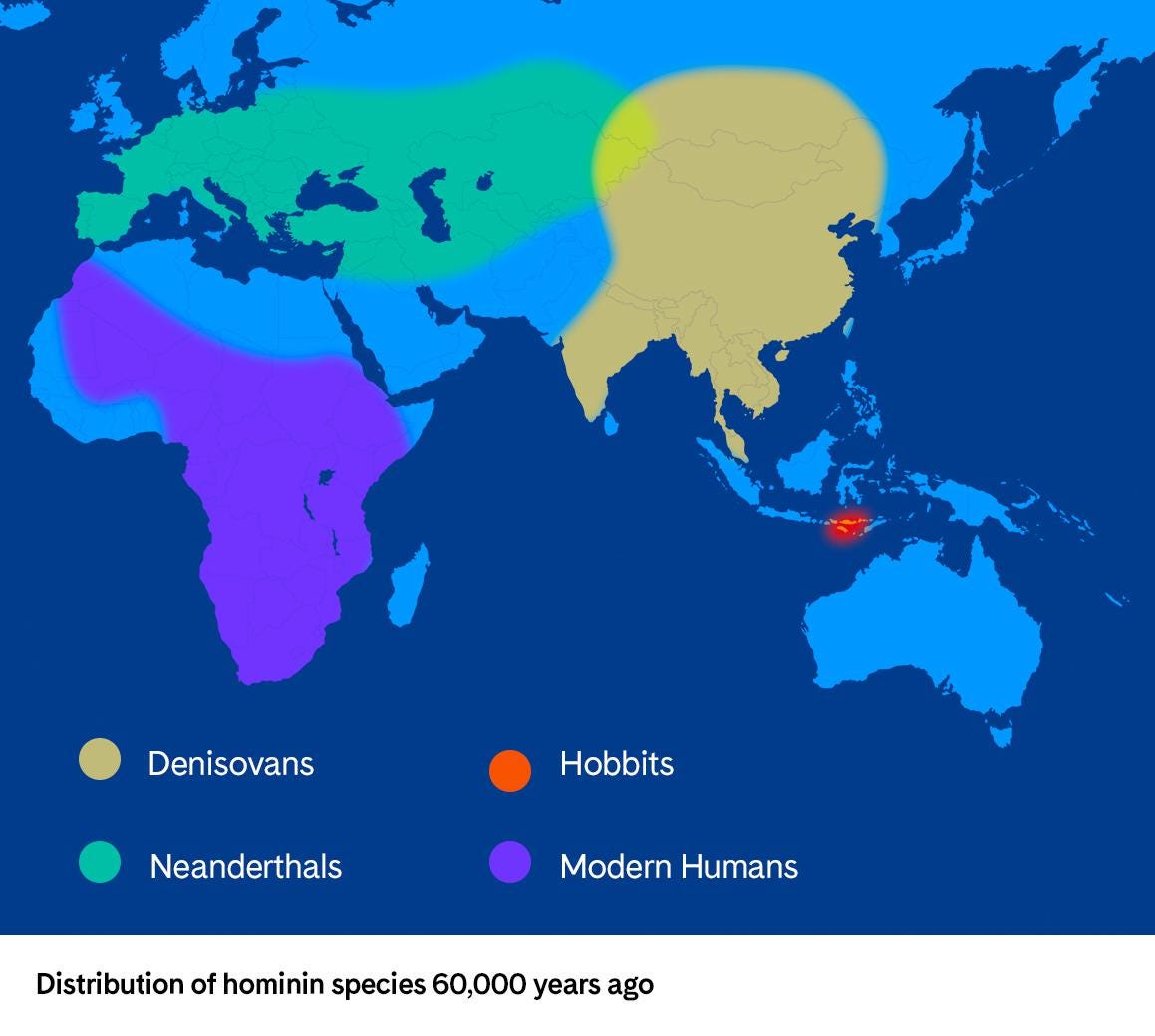
Map of four different species of the genus Homo, "Humans"
A new study has proven that the hominins discovered in 2010 that we have been referring to as Denisovans have much greater genetic diversity than scientists previously thought, constituting three separate lineages. One of these groups is so different from the other two, it could be considered a new species entirely.

An international team of researchers has analyzed the genomes of 161 modern humans from islands across Southeast Asia and New Guinea and have concluded that they have DNA that has been inherited from independent and diverse populations of Denisovans. It was in 2018 that it was first uncovered that more than one lineage existed. Now we know that the family tree of Homo denisova is increasingly complex.

Drawing on modern people’s DNA, the scientists realized that these hominins interbred with their Homo sapiens cousins in two different waves. The two interbreeding events have created distinct genetic patterns that can still be identified in the people of Oceania and East Asia today.

The specimens that were found in a cave in Siberia’s Altai Mountains are the only Denisovan skeletal fragments known to science. The lineage of these individuals is being called D0, while the other two are D1 and D2. The group that is closely related to the Altai line has DNA that is found in modern East Asians. The other group – more recently discovered – is very divergent from the Altai line and its DNA is found across modern Oceania and much of Asia. In fact, it is as genetically dissimilar to the Altai Denisovans as it is to Neandertals.

Thus, many scientists are calling for this group to be given their own name, as they may truly comprise a separate species from Homo denisova. Moreover, based on their analysis, the researchers propose that interbreeding between Homo sapiens and Homo denisova took place as recently as 15,000 years ago. If this date is accurate, the implications are shocking. This would mean that Denisovans are the last hominin species related to modern humans known to have died out.

Tuesday, November 1, 2016

Evidence For Possible Unknown Human Relative Found in Modern Human DNA


     We all know that the Neanderthals and Denisovans are the closest relatives to the Homo sapiens (Modern Human) species. However, genetic evidence in Melanesians (Aboriginal Australians, and natives in New Guinea and neighboring islands) hint that there is a possible third extinct hominid relative.


     While many Neanderthal fossils were found in Europe and Asia, and the Denisovans were discovered from DNA from a finger bone and teeth found in a cave in Siberia, the third possible extinct hominid DNA may been preserved in human DNA, and not in fossil evidence, as reported by statistical geneticist Robert Bohlender on October 20 at the annual American Society of Human Genetics meeting. In 2012, a research team suggested that there were also people in Africa carrying DNA from an extinct hominid ancestor. Less than a decade ago, it was even discovered that early humans mixed with other hominid species. Bohlender and his research team concluded that a third hominid group may have bred with the human ancestors of the Melanesians.

   Eske Willerslev and his research team also came to a similar conclusion. They conducted an experiment in which they collected saliva samples from volunteers for DNA sequencing. The DNA examined was from 83 Aboriginal Australians and 25 natives from Papua New Guinea highlands. The researchers found Denisovan-like DNA, but was found to be different and possibly from another hominid species. Willerslev speculates that this DNA can be from Homo erectus or from the extinct Hobbits hominid species, but he is not a hundred percent sure.

  According to evolutionary geneticist Mattias Jakobsson, researchers don't know much about the Denisovan's genetic diversity. He believes that it was possible that a different branch of Denisovans could have been the group that mated with the Melanesians' ancestors. There geneticists like Elizabeth Blue, that believe that the genetic evidence found from Neanderthals and Denisovans is limited. Denisovans may have been spread around the world and have had genetic diversity. If they weren't however, then the genetic evidence could have come from another extinct species.

     I think that it's fascinating how evolutionary evidence could be found in modern human DNA, and not just in fossils. I hope that after further research, scientists would be able to confirm if this genetic evidence came from another distinct hominid species or just another branch of Denisovans. I also think that this evidence can help us learn more about human evolutionary history, along with that of other hominids.

Links:
https://www.sciencenews.org/article/dna-data-offer-evidence-unknown-extinct-human-relative

http://www.nature.com/nature/journal/v538/n7624/full/nature18299.html?cookies=accepted

https://ep70.eventpilot.us/web/page.php?page=IntHtml&project=ASHG16&id=160122719

Monday, October 3, 2016

Genes Help Monkeys Stay High

            Rhinopithecus bieti, or colloquially known as the Yunnan snub-nosed monkey to people from Tibet, are a very interesting group of monkeys. Living over 4,000 miles above sea level, it is a wonder as to how they are able to acclimate themselves to not only the weather but also the altitude. So how do these monkeys remain at such high altitudes?
        
            The answer to that question may lie in the snub nosed monkey’s genes. In a genetic study of the monkeys’ DNA, it was determined that there were 19 major gene variations that contribute to the monkey’s ability to thrive at such high altitudes. As the only non human primates to live at such high elevation there must have been many things that contributed to their selection for these genes.
            Through reconstruction of the evolutionary history of these snub nosed monkeys, researchers determined that episodes of climate variation may have shaped these monkeys to what they are today. One of the major genes involved in the monkey’s ability to inhabit such high elevations is the ADAM9 gene (See genome sequenced here). Interestingly enough, there are versions of this same gene located in yaks and chickens found in Tibet. In relation to the selection of genes, the ADAM9 gene was most likely selected for its ability to allow these animals to live in such low oxygenated conditions. Similar to these monkeys, the people of Tibet also have adaptations to the high elevation of Tibet inherited from their extinct relatives known as the Denisovans. The genetic variant that has been examined to be the cause of this adaptation is known as EPAS. Thanks to genes and many years of selection, the snub nosed monkey and many others, including humans, have been able to acclimate themselves to high altitudes where the oxygen levels are scarce.
            As someone who enjoys hiking up large mountains, I think the gene like the ADAM 9 would be something that could help me personally to climb higher mountains without having to waste time acclimating to the altitude. Perhaps in the future, the ADAM 9 gene could be isolated and potentially sequenced to find a similar allele in normal human beings like me. In that way, potentially, regular people could climb higher and higher like these snub nosed monkeys or even Denisovans.  

Sunday, April 10, 2016

Pacific Islanders Inheriting DNA from Ancient Humans


New research has shown that a group of Pacific Islanders, known as Melanesians, have acquired genes from two different species of ancient humans. The study, led by geneticist Benjamin Vernot and colleagues at the University of Washington, tested DNA from 35 Melanesians, focusing on DNA from 27 unrelated people within the group. They also sampled DNA from about 1,500 different modern-day people from all over the world. The researchers compared all of the DNA samples to the DNA of two stone age hominid species, the Neanderthals and Denisovans, that they obtained from fossils. The results showed that Melanesians inherit 1.5 to 4 percent of their DNA from Neanderthals and 1.9 to 3.4 percent from Denisovans. Some of the inherited genes include ones that affect a hormone that raises blood sugar levels and the breakdown of fats, and genes that affect metabolism and the immune system.

These findings can provide much information about our early hominid ancestors. Researchers are still not sure how Denisovans evolved, but earlier studies suspect that they once lived in Southeast Asia and that is where Melanesians ancestors once mated with them during one period. Vernot believes that early humans and Neanderthals have mated during at least three periods, and estimated this by comparing the two hominid species' DNA sequences with other people all over the world.

I believe that this research can help scientists unlock more secrets of the ancient world and it can possibly be used to help better modern-day mankind. Maybe we could find out what led to the extinction of these species and use this information to make sure that the same doesn't happen to us. I also think it would be truly interesting to know more about our "relatives" because much of their lives is a mystery to us and this is just one of the many pieces to the puzzle.

Wednesday, March 30, 2016

Ancestors of Modern Humans Interbred With Extinct Hominins, Study Finds


The new study expands on a series of findings in recent years showing that the ancestors of modern humans once shared the planet with a surprising number of near relatives — lineages like the Neanderthals and Denisovans that became extinct tens of thousands years ago.
Research later indicated that all three groups — modern humans, Neanderthals and Denisovans — shared a common ancestor who lived roughly 600,000 years ago. And, perhaps no surprise, some ancestors of modern humans also interbred with Denisovans.
The best explanation for these patterns, the scientists concluded, was that the ancestors of modern humans acquired Neanderthal DNA on three occasions.
Original Article:http://www.nytimes.com/2016/03/22/science/neanderthals-interbred-with-humans-denisovans.html?rref=collection%2Fsectioncollection%2Fscience&action=click&contentCollection=science&region=stream&module=stream_unit&version=search&contentPlacement=3&pgtype=sectionfront

Tuesday, November 20, 2012

Is There a Denisovan in Your Family Tree?

Credit: Max Planck Institute for Evolutionary AnthropologyAccording to Scientific American, researchers from the Max Plank Institute (M.P.I.) for Evolutionary Anthropology in Germany have discovered that modern humans may have interbred with Denisovans hundreds of thousands of years ago. While Denisovans – like Neanderthals – have died out, traces of their DNA can be found in contemporary humans. Researchers at the M.P.I . have said that up to 6% of modern Pacific Islanders’ DNA may be of Denisovan origin.

Very few remains of Denisovans have been discovered. Two Denisovan teeth and one finger bone were discovered in a Siberian cave. Although there is not much DNA in the finger bone, a new method – one that uses single-stranded DNA instead of the traditional double-stranded DNA – was used to sequence the DNA. Dr. Svante Pääbo of the M.P.I. said that he and his research team were able to sequence the DNA within the finger bone 30 times.

These Denisovan samples, however, are not the only ancient samples to be sequenced. Researchers plan to use this technology on older samples in hopes of making new discoveries. Hopefully, findings from future research will give more of an insight into human evolutionary history.

Studying human evolutionary history is interesting because it tells a story that all people share. In a society that often focuses on dividing people into groups, it is amazing to hear stories about a common history.