Showing posts with label homo denisova. Show all posts
Friday, May 3, 2019
The First Denisovan Fossil From Outside Siberia Has Been Found in China
In 2016, Jean-Jacques Hublin, paleoanthropologist and director of the Department of Human Evolution at the Max Planck Institute of Evolutionary Anthropology in Leipzig, Germany, was emailed by archaeologist Dongju Zhang about a highly unusual hominin mandible found in a cave on the Tibetan Plateau in Xiahe, China. The photos she attached stunned Hublin. This fossil was quite complete and clearly nonmodern. It wasn’t long after that they met in Leipzig and began planning their collaboration and recruiting a team of specialists for a study on this strange fossil.
On May 1st of this year, Hublin, Zhang, and their team published the results of their study in the journal Nature. Their analysis confirmed that it belonged to the mysterious branch of hominins known as Denisovans, which were first identified in 2010. Never before had a bone fragment from a Denisovan been found outside a single cave in the Altai Mountains of Siberia.
Moreover, this is the most complete fossil of one ever discovered, as all the previous ones, including the recently uncovered skull piece I reported on in an earlier article, have been small and fragmented. The Xiahe jaw will help scientists tremendously, as now they will have a reference specimen to compare currently unidentified fossils to. Until this point, the anatomy of Homo denisova has been almost entirely unknown and speculative. This finding will thankfully add another eye-opening piece to the puzzle.
Hublin and his team were able to identify the fossil as Denisovan thanks to the work of his PhD student, Frido Welker, who had figured out that ancient proteins can be preserved much longer than ancient DNA, and therefore they could be used to map hominin groups in the absence of the latter material. Genome sequencing of Denisovans and their famous “sister” hominin, Neandertals, allowed the researchers to suppose the structure of these proteins and subsequently flesh out the separate branches. In the case of the Xiahe jaw, there was no ancient DNA, but the teeth yielded some proteins. These were then analyzed and matched using the aforementioned technique. The results were clear, this Tibetan fossil was a Denisovan.
Labels:
archaeology,
denisovans,
DNA,
fossil,
genome,
Genome sequencing,
hominins,
homo,
homo denisova,
homo neanderthalensis,
homo sapiens,
humans,
neanderthals,
paleoanthropology,
paleogenetics
Monday, April 29, 2019
The First Confirmed Hominin Hybrid Has Been Discovered
Denisova 11, as she is called, was an approximately 13-year-old girl who lived around 90,000 years ago in the Altai Mountains of Siberia. What is so fascinating about this girl is that she is clear evidence for interbreeding between species in the genus Homo (humans). She is indeed about half Denisovan and half Neandertal, two early members of the genus that are related to Homo sapiens.
Viviane Slon, a researcher at the Max Planck Institute in Leipzig, Germany, performed DNA analysis six times on Denisova 11's piece of limb bone that had been found. She simply could not believe the results of the analysis the first time and had thought she made a mistake. However, each successive test came to the same conclusion. This young girl had a Neandertal mother and a Denisovan father. Moreover, they discovered that her father in fact had a Neandertal ancestor of his own. This was further confirmation of how common hybridization must have been in early hominins.
So far, only Denisova 11 and four other individuals belonging to the species Homo denisova have been uncovered by the bone fragments that they left behind in a single cave in the Altai Mountain range. As I have previously reported, the species was first identified in 2010, when DNA sequencing of the toe bone of an individual called Denisova 3 led scientists to confirm the existence of an entirely new group of humans.
Svante Pääbo, the director of the Max Planck Institute of Evolutionary Anthropology, has stated that due to the fact that Neandertals originated in western Eurasia and that Denisovans originated in the east, they likely did not meet very often. But based on these latest findings, Pääbo and many other scientists now believe that when the two species did come face to face, mating between them was far more common than was ever previously thought.
The idea that Denisovans, Neandertals, and Homo sapiens were producing hybrids for possibly hundreds of thousands of years is supported by genetic studies of modern populations. The DNA of people living in Europe and Asia today is on average 2% Neandertal. The DNA of people living in Melanesia today is on average 5% Denisovan, with other varying amounts found in the rest of southeast Asia and Oceania.
The genomes of all these humans studied, ancient and modern, reveal that hybrids were not uncommon throughout our shared history on this planet.
Sunday, April 21, 2019
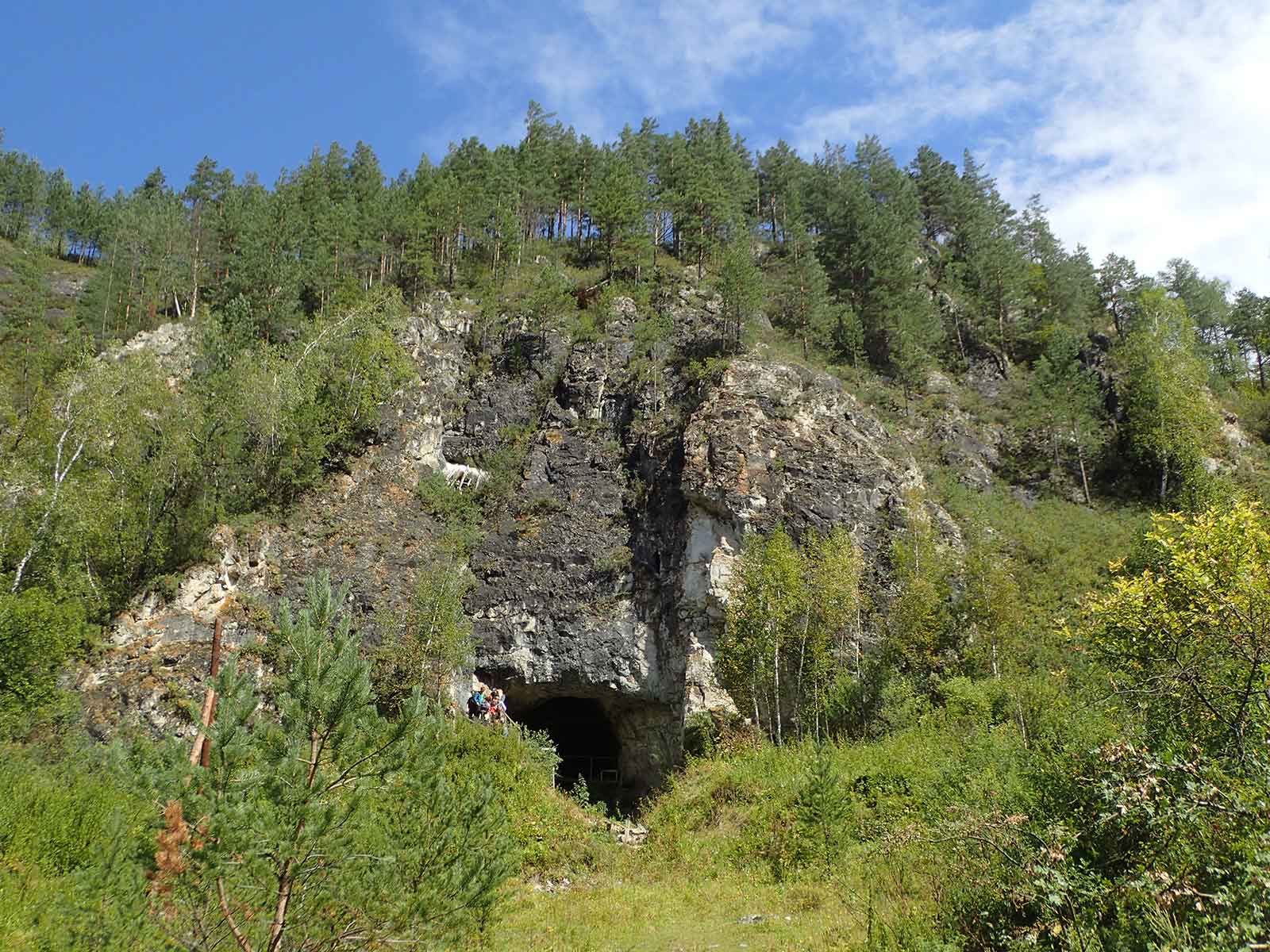
Scientists Find the First Confirmed Denisovan Skull Fragment
![]() |
| Denisova Cave, Altai Mtns., Siberia |
While its DNA has been confidently identified, the true age is unknown because it is too old to radiocarbon date. Additionally, this fragment is quite small and too incomplete, and so it cannot be used to determine whether other hominin skeleton fragments found are Denisovan or not. The only way these can also be identified is through DNA analysis, which is often difficult to do on samples so ancient.
With the sequencing of both the Neandertal and the Denisovan genomes, in 2010 paleogeneticist Svante Pääbo and his team were about to make an astounding discovery about modern people across the globe when they compared their DNA to these archaic humans. They found that 2.5% of the DNA of modern Europeans and Asians has been inherited from Neandertals, and that around an additional 5% of the DNA of modern Melanesians has been inherited from Denisovans. This was clear evidence that our ancestors had socialized and interbred with other species of humans living at the same time in prehistory.
Today, anthropologists and geneticists are still waiting to find a more complete portion of a Denisovan skeleton. The hominin’s genome has much to say about who it was but seeing a complete skeleton will allow the world to visualize them. This can provide many other clues to how they lived and acclimated to their world. For now, they will have to continue to rely on the few Denisovan skeletal fragments unearthed in Siberia.
Saturday, April 20, 2019
Three Distinct Denisovan Lineages Have Been Revealed
![]() |
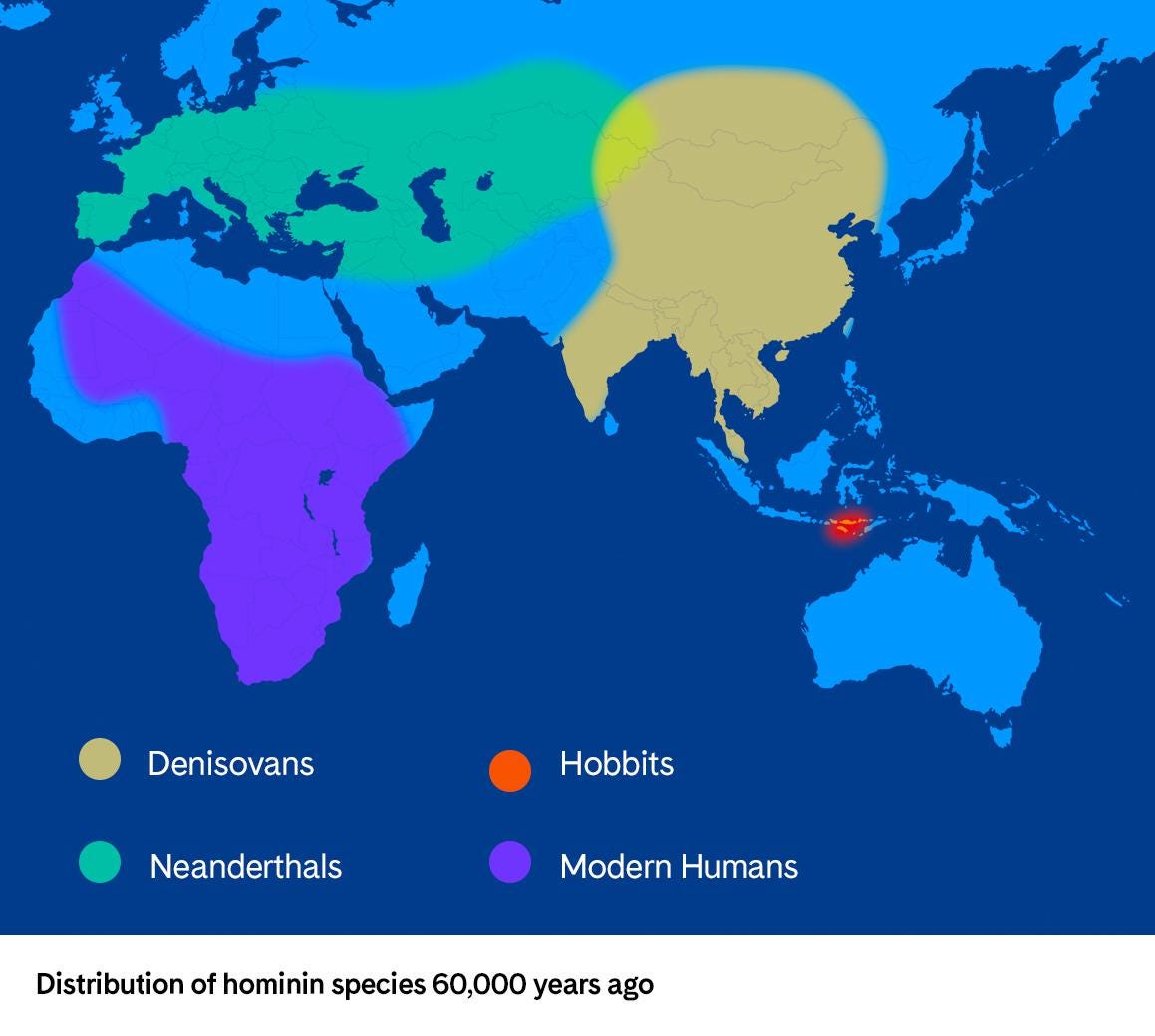
| Map of four different species of the genus Homo, "Humans" |
An international team of researchers has analyzed the genomes of 161 modern humans from islands across Southeast Asia and New Guinea and have concluded that they have DNA that has been inherited from independent and diverse populations of Denisovans. It was in 2018 that it was first uncovered that more than one lineage existed. Now we know that the family tree of Homo denisova is increasingly complex.
Drawing on modern people’s DNA, the scientists realized that these hominins interbred with their Homo sapiens cousins in two different waves. The two interbreeding events have created distinct genetic patterns that can still be identified in the people of Oceania and East Asia today.
The specimens that were found in a cave in Siberia’s Altai Mountains are the only Denisovan skeletal fragments known to science. The lineage of these individuals is being called D0, while the other two are D1 and D2. The group that is closely related to the Altai line has DNA that is found in modern East Asians. The other group – more recently discovered – is very divergent from the Altai line and its DNA is found across modern Oceania and much of Asia. In fact, it is as genetically dissimilar to the Altai Denisovans as it is to Neandertals.
Thus, many scientists are calling for this group to be given their own name, as they may truly comprise a separate species from Homo denisova. Moreover, based on their analysis, the researchers propose that interbreeding between Homo sapiens and Homo denisova took place as recently as 15,000 years ago. If this date is accurate, the implications are shocking. This would mean that Denisovans are the last hominin species related to modern humans known to have died out.
Subscribe to:
Posts (Atom)