Showing posts with label personalized medicine. Show all posts

Monday, April 20, 2026

Can Genetically Reprogrammed Gut Bacteria Help Treat Disease?


        Recent research suggests that genetically reprogramming gut bacteria may offer a new way to treat disease. Scientists are studying how the human microbiome (community of bacteria living in the digestive system) can be modified to perform beneficial functions in the body. Instead of targeting human genes directly, this approach focuses on engineering bacteria to help improve health.

        Researchers are exploring ways to alter certain bacteria so they can produce helpful molecules, reduce inflammation, or deliver treatments directly in the gut. Because gut bacteria interact closely with the immune system, metabolism, and digestion, modifying these organisms may help treat conditions such as inflammatory diseases, metabolic disorders, and other chronic illnesses.

        This research is significant because it represents a different approach to genetic medicine. Traditional gene therapy often focuses on changing human cells, but this method uses genetically modified bacteria as a potential treatment tool. In some ways, these bacteria could act like living medicines by performing functions inside the body over time.

        The importance of this research is that it may lead to treatments that are more targeted and less invasive than some current therapies. Instead of relying only on medications that treat symptoms, scientists may be able to use engineered bacteria to influence disease processes at a biological level.

        Overall, this research highlights how genetics is expanding beyond human DNA and into the study of the microbiome. As scientists continue to understand how gut bacteria affect health, genetically reprogrammed microbes may become an important part of future treatments and personalized medicine.


Source: 

https://news.berkeley.edu/2026/03/05/reprogramming-our-gut-bacteria-could-be-key-to-fighting-disease/


Additional Link: 

https://my.clevelandclinic.org/health/body/25201-gut-microbiome


Thursday, November 23, 2023

Most of today’s gene therapies rely on viruses

 Most of today’s gene therapies rely on viruses

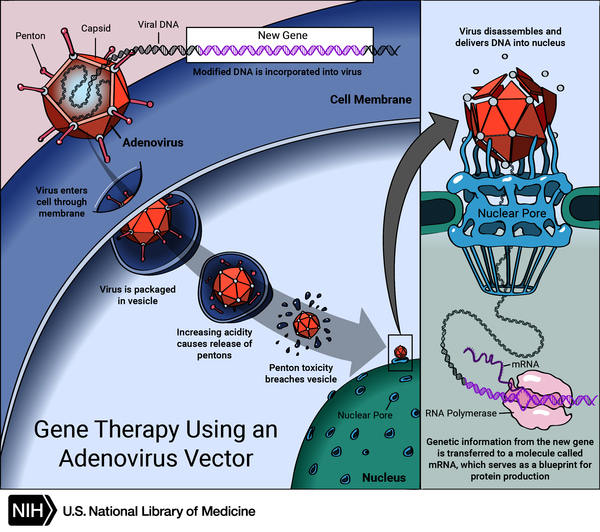
    This article details the case of 10-year-old Will Ungerer, who has Duchenne muscular dystrophy and received an experimental gene therapy at age 5 where functional gene copies are introduced in the patient’s cells to replace or supplement defective or absent genes. Due to this therapy, he had significant improvements in his physical abilities such as climbing stairs. Although gene therapy is effective there are many challenges such as safety concerns, delivery methods, and the high costs of treatment. “The FDA has approved seven other gene therapies for rare genetic diseases, all since 2017,” showing that ongoing clinical trials and regulatory processes make it hard for gene therapy to get approved. The second article discusses some potential benefits of gene therapy such as treating inherited disorders like cystic fibrosis and certain cancers, with some therapies already FDA-approved for conditions like Leber congenital amaurosis and blood cancers. However, they can also carry risks such as cancer and allergic reactions, leading to FDA approval for some gene transfer therapies and ongoing research into genome editing.

    Gene therapy represents a significant breakthrough in medical science, offering hope for patients with genetic disorders like Duchenne muscular dystrophy. The ability of gene therapy to introduce functional gene copies directly addresses the root cause of many genetic diseases, leading to great improvements in patients suffering from physical disabilities. However, the challenges related to safety, delivery methods, and especially the high costs pose significant barriers to its widespread adoption and accessibility. The FDA's cautious approach in approving gene therapies, while ensuring patient safety, may slow the availability of these potentially life-altering treatments; however, those measures are necessary for the future of personalized medicine. I believe that more money should be invested in research aimed at improving gene therapy since every patient is different and the best treatment is one that is targeted to a patient’s specific genes.

https://www.sciencenews.org/article/gene-therapy-virus-crispr-editing-disease

https://www.nhlbi.nih.gov/health/genetic-therapies/benefits-risks


Friday, April 28, 2017

Personalized Cancer Vaccines

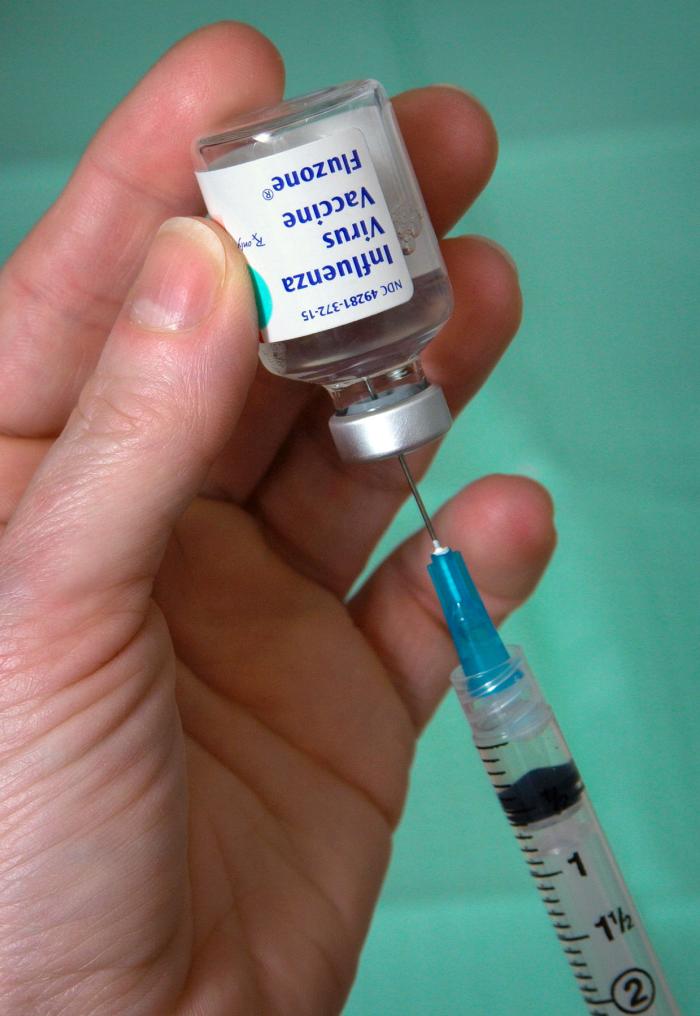
Flu vaccine. Hopefully future research will allow for individualized vaccines against cancer (photo from Wikimedia Commons)
   Although advances such as the human papillomavirus vaccine (HPV) have worked to prevent the onset certain strains of cancer, treating cancer itself is a more difficult task. Over the years, researchers have strived to create treatments tailored specifically to the patient's needs. Now, they are one step closer.
    This article highlights several recent studies that suggest the possibility of tailoring cancer treatment specifically to patients. In the past, failed vaccines targeted specific cancer proteins that were present across people with the same type of cancer. However, now work has been done to include multiple mutated genes (neoantigens) from a specific patient's tumor, in hopes of priming their immune system to fight off the cancer. In one of the studies, a patient's tumor was removed, sequenced, and the neoantigen sequences were predicted using a computational system.
    Although promising, these studies were originally designed to test the safety of such techniques. However, hopefully further studies can one day verify this as an effective means to treat cancer. This pertains to class because it suggests an application for sequencing DNA in order to create mutated proteins (through transcription and translation).

Sunday, April 23, 2017

Knockout Genes In Human Population


Image result for population genetics
An example of genetic variance across different regions of the world (picture from Wikimedia Commons)
      In the quest to figure out how specific genes work in laboratory mice, creating "knockout" mice is usual the way to go. In this practice, a specific gene is targeted and eliminated to see how it affects its functioning. For obvious reasons, creating "knockout" humans is not a feasible way to study the effects of missing genes in humans.
      Recently, there has been a push by researchers to look for the effects of naturally occurring knockout humans. One such study focuses specifically on individuals from Pakistan. This study notes the prevalence of knockout humans as a result of consanguineous mating practices in a group of Pakistanis participating in a long-term study of heart disease and diabetes. Researchers were intrigued to find that the absence of some genes seemed to have no negative affects on their health; furthermore, researchers concluded that such knockouts help explain why some drugs are more effective than others in terms of a person's individual genome.
     Overall, there is now multiple calls for a Human Knockout Project to document such findings in a single database. As the picture above helps illustrate, genes vary across populations; thus specific drugs may have varying efficiency in their modes of action based on the overall genetic composition of a population. Hopefully such a database drawn from large population studies would lead to a more personalized medicine approach to treating certain illnesses. This is relevant now, especially with population genetics being the subject of our current lectures.


Monday, December 7, 2015

Personalizing Cancer Treatment with Help from 'Virtual Tumors'

"In a bid to help cancer care become more personalized, researchers are developing computer simulations of tumors to predict how an individual patient's cancer is likely to react to particular drugs."

Using computer simulations, or "virtual tumors," researchers from the University of Iowa College of Dentistry and a private company Cellworks Group Inc. have begun to develop a method that would lead to individualized treatment of cancers.


Immunotherapy drugs target the "immune checkpoints" that cancer cells often override, allowing the cancer to thrive in a patient's body without attack from the immune system. Unfortunately, many of these drugs have a fairly low response rate in patients (<20%). By making drugs specific to the genetic make up of an individual's tumor cells, researchers believe they can increase their effectiveness.

To make the drugs specific, genetic information from a patient's cancer cell must be loaded into the simulation and a response must be predicted. Then, live cells with the same genetic make up are grown in a lab and the drug is tested on them to see if the predicted reaction occurs on living cells. If the response in the live cells occurs the same way as in the simulation, the treatment will work for the patient. If not, more work will need to be done in order to align the model with the lab-produced cells.

Personalized treatments seem to be a current hot topic in medicine, and for good reason. The more personalized the treatment, the better the prognosis for the patient.

Wednesday, February 11, 2015

Genome Sequencing

According to Dr. Robert Klitzman in his article in the NY Times, DNA Testing is becoming a growing trend. Screening one's genome for a mutation(s) used to consume a large amount of money and only showed limited amounts of information. Now, a person's entire genome can be searched for a cringing sum of $5,000 (the cost was originally a whopping $1 billion). The personalized medicine initiative Barack Obama presented will undoubtedly require more and more genome sequencing. There are many patients today getting their genome searched for mutations so they can learn the risk they have of contracting with a certain disease or disorder, or if their children have that risk.

Sequencing the genome and using personalized medicine can potentially save many lives. Many doctors are already recommending DNA testing so they can give further advice to their patients. Some people are even getting the tests done for the fun of it;whereas others want to check their genome to rid themselves of fear of any risk of disorder.

I think DNA testing has the potential to eliminate or prevent incurable diseases. The testing itself cannot do much but give information, however the information is valuable and can give doctor; the right direction to look in for diagnosing their patients. Getting tested for the fun of it seems a little unnecessary if a person is already healthy and has no next of kin with a disorder or disease. However, for patients with life threatening disorders like cancer or a person who is in a family with a high risk of inheriting cancer (or any other hereditary disease) should undergo testing. It will provide them with piece of mine and possibly a cure with the aid of personalized medicine.

Additional Link: Medicine Just For You

Thursday, December 4, 2014

Individual Genetic Information Used to Develop Tailor-made Nutrition

Nutrigenomics is a growing field of study today. Since people react differently to the same foods, studying individuals' genetic make up will help nutritionists to develop better diets to achieve the patients' goals. This one- on- one nutrition recommendation is called Personalized Nutrition, a a branch of Personalized Medicine. 

The researchers of University of Toronto conducted an experiment with 138 healthy young adults and split them into two groups. The control group was given dietary recommendations without genetic information. The experimental group,however, was given low sodium dietary recommendation based on their genetic information. They had been informed they carried a gene linked to sodium intake and high blood pressure. Progress was tested after three and twelve months. There was no change in the health of the control group. The experimental group on the other hand showed significant improvement in health.


Personalized nutrition is great news for the general population. A good amount of population today in developed countries, such as in America, struggle with a healthy diet and weight, which can contribute to serious illness. 


Friday, November 21, 2014

Stratified Medicine to Improve UK National Health Service


Stratified Medicine, also known as Personalized Medicine, is medicine specifically tailored for an individual.  The medicine works off the genome sequence of individuals (being everyone has a unique genome) allowing for more efficient drugs with fewer side effects, if any.  Doctors can use a person’s genome to determine diseases caused by mutations.  In addition to being able to diagnose a patient, genomes have the potential to inform doctors what drugs work.  It is with this information Stratified Medicine gets to shine.  Knowing how drugs will work on person will increase the chances of finding the right drug sooner and overall increase the number of lives saved.


A survey of UK health professionals shows increased interest in the use of non-cancer stratified medicine for.  Patients have also shown interest, believing it gives patients access to treatments they otherwise wouldn't have.  The medicine has already made significant impact on the UK’s National Health Service, without being used for cancer.  The potential of using stratified medicine in conjunction with advance cancer treatments is vast.  However, there are some problems with implementing stratified medicine as the norm.  While there is an increased interest among health professionals, they agree the health system would have to change to support the use of stratified medicine.  The change might be slow but the use of stratified medicine could advance the medical world further.


The UK has a very special opportunity to advance their health care system, and set the example for the rest of the world.  I personally hope they can make the change to incorporate stratified medicine.  It will allow the world to see how useful (or useless) it could be and see if it is worth utilizing.  I see the use of these types of drugs to be the advancement of the medical world, with large potential to save numerous lives.

Wednesday, February 19, 2014

Students Exploring Own Genetic Data Improved Class Knowledge


A study performed by Stanford University Medical Center showed that students who studied their own genetic data faired better then those who studied random genetic data. These students improved their knowledge of class materials by an average of 31 percent compared to those who did not undergo genetic testing. Kelly Ormond, co-author of the study and associate professor of genetics said, "There is always a lot of interest in whether personalized learning can influence education. ... What our study shows is that it might have benefits for some self-selected students, and is worthy of cautious consideration."

Keyan Salari, MD, PhD, a former student of Stanford created the idea after exploring his interest in his own genetic testing and saw the educational benefits. By exploring your own genome, one can learn their health risks and what responses to drugs that might be predicted. "For instance, I learned I might have a higher risk for age-related macular degeneration. That led me to read and learn a lot more about the genetics of that disease than I probably would have otherwise," said Salari. Encouraging students to explore their own genome could help improve their knowledge of genetics in general.

The study also showed that 83 percent of the students who underwent personal testing were pleased with their decision. 70 percent of those who underwent the testing reported a better understanding of human genetics. A survey given after the course asked students if they had made any behavioral changes based on their findings in which some reported changes. Although in face-to-face study with the same students, no behavior changes were reported six months after the course was taken.


Studying your personal data can definitely help spark interest in a topic. Not only will it be beneficial to obtaining valuable personal knowledge but by exploring your own genome you could also choose healthy lifestyle choices by knowing what you’re susceptible to. Personally I feel that by studying my own genome rather then a random individuals, I would much more interesting in learning the subject simply because it’s beneficial to me to explore the stories hidden within my genome. It would influence me to develop a deeper understand had I otherwise studied random information. I would believe that by being more involved in studying my own data I would retain that knowledge better than I would have by studying randomly generated data out of a textbook.


Related Article Link: http://www.genomeweb.com/clinical-genomics/stanford-med-student-study-suggests-genotyping-option-improved-learning-personal

Monday, November 19, 2012

Genetic Link Between Kidney Defects and Neurodevelopmental Disorders

new study conducted by Columbia University Medical Center, headed by Dr. Gharavi, shows that there is a link between kidney defects and mental illnesses. The study tested 522 children with malformed kidneys and 17% of them carried a CNV that contributed to their kidney disorder. CNV's, short for copy number variations, are extra copies or deletions of DNA that are just large enough to hold several genes. When CNV's are present, the affected gene occurs in a higher or lower dose than normal which can cause health disorders. The CNVs discovered in the study were also linked to developmental delays and mental illnesses, and 1 in 10 of the children had one. Dr. Gharavi said "Though it remains unclear why kidney malformations and neurodevelopment are linked in some cases, it is possible that the same genes involved in kidney development are involved in brain development." From this research they have concluded that nearly 10 percent of children who are born with kidney defects also have large  alterations in their genetic makeup which are linked with neurodevelopmental delay and mental illness.


"This changes the way we should handle these kids," said kidney specialist Ali  Gharavi. "If a physician sees a child with a kidney malformation, that is a warning sign  that the child has a genomic disorder that should be looked at immediately because of the risk of neurodevelopmental delay or mental illness later in  life," he said. This newly discovered linkage can help the start of personalized medical care. Eventually, an evaluation for genomic alterations will be part of the standard clinical workup and patients can recieve a more precise diagnosis. The underlying genetic defect of the patient will dictate what approach to take and what specific medication will work best for that patient.

I think this new dicovery is exactly where we need to be heading to improve our medical treatments. This research helps us group patients with kidney malformations not only into one big group but also into smaller subgroups also based on possible mental disorders. If we can do this for many different diseases then in the future doctors will be able to look at a person's own potential risk for certain illnesses. I think that this new study is intersting because it shows that personalized medicine is in our near future.

Thursday, April 12, 2012

Genetics and the Future of Medicine

In an issue of Cell, Snyder, molecular geneticist at Stanford University in Palo Alto, California, and his team of 40 researchers published detailed results of Snyder's blood tests which included biochemical data showing the status of his body's immune system, metabolism and gene activity. Snyder analyzed his blood over a 14 month period 20 different times to find the links at different time points between the 3.2 billion nucleotides of DNA in his genome and more than 3 billion fluctuations in his blood molecules such as proteins, metabolites, microRNAs, cytokines, antibodies, glucose, and gene transcripts.  Daniel MacArthur, a genomics researcher at Massachusetts General Hospital in Boston, says the "fascinating study" is much more informative than simply looking at someone's static genome sequence. (Snyder's group decoded his at the beginning of the project.) "The nice feature of this study is that it profiles many of the dynamic molecular changes that our body experiences in response to environmental stresses."

Snyder feels with the technology available today we are not practicing medicine at the level it should be. The blood tests done today can test for 20 things max, and he feels that inorder to get a better picture we should be able to test for thousands of things and he has proved it that it is possible with the technology out there.   


At the first blood draw, Snyder had a cold and the scientists were able to track how the rhinovirus affect the human body biochemically in more detail than ever before. After the initial sequencing of his DNA, Snyder found that he had predisposition for type 2 diabetes, but since no one his family had diabetes and was at a healthy weight he didn't take it too seriously. However, they started paying close attention to biomarkers related to diabetes, insulin and glucose pathways and when later he became infected with respiratory syncytial virus his glucose levels went up dramatically almost immediately. He believes that even though he had a predisposition to diabetes, the viral infection was the trigger. Currently there is no connection between viral infections and type 2 diabetes, but Snyder believes that this type of analysis will allow us to find many missing links and believes this to be the future of medicine.  Last summer he co-founded a company in Palo Alto, Personalis, which aims to help clinicians make sense of genomic information.

I think with this study shows how genetics will be becoming an intergral part of medicine in both preventing and treating diseases.