Sunday, November 20, 2022
Brain Stimulation Could Limit the Impulse to Binge Eat
Tuesday, April 19, 2022
Study Discovers Possible Genetic Link to Suicide Attempts
A news report from KSAT.com discusses a study done in November 2021 about how suicide attempts have a genetic link to them, and not just a genetic link of mental illness. Unfortunately, suicide is a leading cause of death in America and attempts are even higher than ever. In 2020 alone, 45,000 died by suicide and over a million attempts, meaning that every 11 minutes an American attempts to end their life. While this specific cause of death has been attributed to mental heath and their disorders, researchers at Mount Sinai in New York tried to identify a genetic cause independent of psychiatric disorders, and their findings were unheard of.
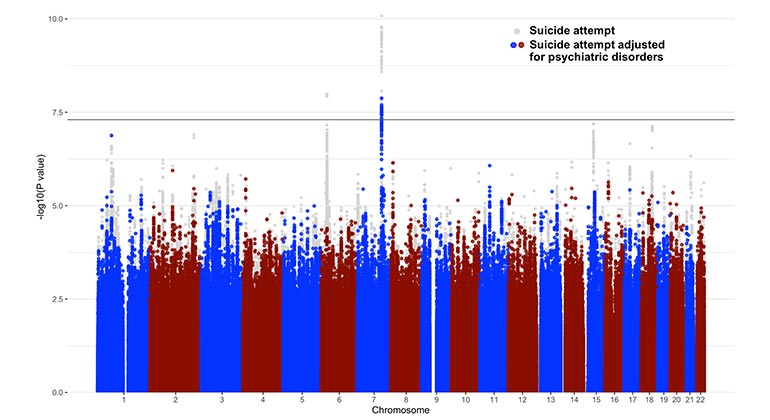
The study consisted of a genome-wide study of 500,000 people, 30,000 of which had attempted suicide, which is about 6% of the study's population. This association study was conducted by the International Suicide Genetics Consortium, and focused on looking at similarities among the human genome for those who had attempted suicide. During the study, evidence was found that the suicide attempts were consistent with psychiatric disorders and the genes associated with a higher risk of those diseases, but another result was discovered as well.
Chromosome 7 has had a lot of interest in the medical community as it is the chromosome for cystic fibrosis, polydactyly, deafness, and many other health conditions. The researchers found that there was a region located on Chromosome 7 that contain variants which could increase a person's risk for attempting suicide. The region identified on Chromosome 7 is also linked to non-psychiatric issues like insomnia and risky behaviors. This discovery paves the way for further research into this region as well as a more in-depth look at other chromosomes to determine if there are other genetic variations related to suicide independently of psychiatric disorders.
This study provides a great insight in helping find a scientific way to help prevent suicide. By looking into the genome and finding a specific region that is common in the people who have attempted suicide can lead into possible treatments or even provide a reason as to why certain people are more inclined to attempt suicide. Suicide is a horrible health problem that has affected millions of Americans and it is especially common among teenagers and young adults. This research could possibly help look into the reasoning for that along with mental health resources in order to make sure death by suicide decreases.
Related Articles
Wednesday, October 9, 2019
Genetic Study Points to Metabolic Roots of Anorexia Nervosa
Supporting Article: researchers-explore-the-genetics-of-eating-disorders-65237
Through the biggest research on anorexia nervosa eating disorders, it was discovered that there are eight different genetic markers for the disorder. There is connection between AN and a locus overlapping six genes on chromosome 12 (Am J Psychiatry, 174:850–58) which is a chromosome that is linked to other disorders such as autoimmune diseases, and diabetes 1. Leading to the confirmation that the disorder has both psychiatric and metabolic origins. The disorder "claims more lives than any other psychiatric disorder. The condition affects up to 2 percent of women and 0.3 percent of men worldwide." psychiatrists have always struggled to find a treatment for the disorder due to its branched causes.
In a breakthrough discovery, it was found that the disease is linked to the body’s ability to metabolize sugars and fats (insulin-glucose metabolism) and is related to high levels of physical activity. It was also found that characteristic single-nucleotide polymorphisms (SNPs) GABRG genes—which code for receptors involved in neural signaling that anorexia shares with several other psychiatric disorders, such as obsessive compulsive disorder, major depressive disorder and schizophrenia. Researchers have established that AN is 50 percent to 60 percent heritable. How the disorder works is that it allows the body to live without food longer than normal. This helps scientists to understand the disorder more and take metabolism and the patient's family history and genome into consideration when they work on a treatment plan for their patients.
I find these articles interesting as it changes no only the way psychiatrists view the disorder but how the patients, their family, and society views the disorder as well. Finding a biological tie to the disorder allows the patient to feel better about themselves and relieves some of the shame, excessive self-criticism and guilt they experience. It helps the society understand the disease more and know that this is a biological as well as it is a psychiatric disorder and not just a diet that an individual chooses.
Tuesday, December 13, 2016
MicroRNA: The Cure to Schizophrenia Voices?
While running the mouse model, scientists have identified microRNAs that can be served as useful for creating new anti-psychotic drugs with reduced side effects. MircoRNAs are non-coding RNA molecules that generally involved in regulating and silencing gene expression. The specific microRNA that is of particular interest to researchers is miR-338-3p. This specific microRNA regulates the manufacture of protein D2 dopamine receptor (DRd2) in which have a major role in auditory hallucinations. According to Dr. Zakharenko, auditory hallucinations that are typical in schizophrenia is related to high levels of Drd2 in the auditory thalamus.
Through the mouse modeling, the researchers have discovered that individuals with 22q11 deletion syndrome are missing Dgcr8 genes in which is essential for the production of microRNAs. Because of the reduction of Dgcr8 genes based on this study, this leads to an increase in DrD2, thus causing auditory hallucinations demonstrated from schizophrenia. Further results have concluded that by replenishing microRNAs, the Drd2 levels decreased thus restoring normal functioning within the auditory thalamus, thus leading to a cure to auditory hallucinations. This is an important breakthrough for anti-psychotic drugs. By using a natural process and the concepts of microRNA, it can serve a new basis for how drugs for treating mental disorders are made. In particular, the benefits of microRNA is that it can lead to more effective interventions with limited side effects. With such an important discovery, this research can pave the way to tacking other mental disorders using the same concept. It will be very interesting to see how this research will progress and be beneficial in terms of psychiatric and medical research.
Wednesday, May 4, 2016
Genetic Variants in Psychiatric Illnesses
Tuesday, April 12, 2016
Marijuana Addiction Linked to Genetics
I found it interesting that the CSMD1 gene was also associated with schizophrenia, because I have heard that smoking a lot of marijuana can lead to psychiatric disorders, such as schizophrenia. It is important to be cautious about these drugs because no one knows whether or not becoming marijuana dependent is in their genes, so trying it one time can lead to a lifetime of addiction and complications. I also find it interesting that calcium signaling can lead to substance-abuse disorders, because it is not what I would expect. I would like to get genetic testing done so I can see what my risk levels are for these types of disorders as well as other health problems, because a lot can be determined simply from examining your DNA.
Thursday, March 31, 2016
Scientist's Eliminate Core Symptom of Schizophrenia in Mice
Wednesday, March 30, 2016
Hunting the Genetic Signs of Postpartum Depression With an iPhone App

Saturday, January 30, 2016
Scientists Move Closer to Understanding Schizophrenia's Cause
Tuesday, December 15, 2015
Mutation in Shank3 Gene Can Lead to Different Psychiatric Disorders
The scientists interested with the current research on Shank3 engineered mice to have the two different mutations of the Shank3 gene; one in which the protein was truncated and caused schizophrenic behavior and the other in which the absence of the Shank3 protein caused autistic behavior. The mice also shared many common behaviors but also possessed the hallmark behaviors of their respective disorders. By activating the mutations in different parts of the brain at different stages of development researchers were able to narrow down the brain circuits these mutations effected. The autism mutation exerted its effects early in development, primarily in the region of the brain known as the striatum, these region is responsible for coordinating motor planning, habitual behavior and motivation. The schizophrenia mutation exerted its effects later in development, suggesting that the truncated protein can function sufficiently early in development. However as development continued the truncated proteins interfered with the synapses of the cortex, where executive function occur.
The brain is by far the most complex organ in our bodies, it is remarkable to think that essentially a pile of jelly is responsible for all of the thought, behavior, emotion, and movement that occurs in everyday life. As if the brain isn't complex enough to understand, psychiatric disorders and the causes of those disorders are equally as complex. The research being conducted by this group of scientists is aiming to understand the potential cause of these psychiatric orders and to also understand the brain circuits these defective proteins effect in order to tailor treatments for individuals affected by these disorders.
Wednesday, September 23, 2015
5 Disorders Share Genetic Risk Factors, Study Finds
This study began in 2007 and included 60,000 people worldwide. Of these 60,000 people who were involved with the study, 33,332 were affected by mental illness and 27,888 that were not. Researchers examined the DNA from each participant searching for any variations. This study found four DNA areas that conferred a slight risk of psychiatric disorders. Two have been identified as genes that are part of the calcium channel. It is not clear what the other two genes are involved in or what they do.
I found this article to be interesting. The study that was preformed did produce good results however, I think further research is still required. Especially on the two genes that researchers are not sure of what their function is, maybe they are the key to creating a better treatment for psychiatric illnesses.
Thursday, November 21, 2013
New Genetic Risk Factor Discovered for Schizophrenia and Bipolar Disorder
A team from The Feinstein Institute for Medical Research have discovered a factor in NDST3 that is likely to lead to schizophrenia and bipolar disorder. The risk factor was isolated using DNA from scizophrenic individuals as well as healty adults. The variant changes only a single letter, but can lead to devastating psychiatric illness. Bipolar and schizophrenia have long been hypothetically linked, and this new discovery combined with others further strengthens that theory (see the second link below).
These articles resonate with me, since an isolated case of schizophrenia occured in my ancestry. While no one in my immediate family is known to have the disease, it's nice to know that we will eventually be able to test for these defects in our progeny. They are serious conditions, so any insight into their origins and methods is cetainly useful.
http://www.sciencedaily.com/releases/2013/11/131119112815.htm
http://www.sciencedaily.com/releases/2013/08/130811150815.htm
Thursday, April 11, 2013
5 Disorders Share Genetic Factors, Study Finds
The group studied families and identical twins, and found a few abnormal disruptions of chromosomes that were linked to psychiatric disorders. In one set of twins, one twin had schizophrenia while the other had bipolar disorder. Dr. Jonathan Sebat chief of the Beyster Center for Molecular Genomics of Neuropsychiatric Diseases gave his opinion by saying,
“No one had systematically looked at the common variations…in DNA.” “We didn’t know if this was particularly true for rare mutations or if it would be true for all genetic risk.”
In addition, the new study found four DNA regions that presented a small risk of psychiatric disorders. Researchers haven’t yet discovered the risk of the first two DNA regions. The other two regions are part of calcium channels, which are used when neurons send signals to the brain. This is exciting news because there are drugs on the market that block calcium channels. The problem is that the researchers are not sure if it will work and be safe for the consumers.
Friday, March 15, 2013
Un Poco Loci: Genetic Ties to Mental Disorders
After analyzing the genomes of more than 30,000 people each with one of the these five psychiatric disorders, and almost 28,000 people with no mental health issues, scientists found that single-nucleotide polymorphisms (SNPs) at four loci displayed variations seen in people with the five psychiatric conditions.
Scientists say knowing that these psychiatric conditions share genetic risk factors could help doctors better diagnose and treat these conditions.
“Our results provide new evidence that may inform a move beyond descriptive syndromes in psychiatry and towards classification based on underlying causes,” said Jordan Smoller of Massachusetts General Hospital who worked on the study."
More information on the actual study can be found at The Lancet.
What I find fascinating about this article is that from outside of the view of genetics these disorders already seem to have some relations to one another. If you have ever met a person with any of these disorders you may see certain parallels in their expressions that mimic other mental disorders. Probably the most obvious at least to myself, would be the sense of confusion all must feel. But to now see these disorders are displayed on shared loci give us a bigger picture on the smallest of scales of genetic disposition rather than just a “loose screw”.