Largest Ever Study of Genetics Gives Clues to Who's at Risk
Saturday, November 11, 2023
Largest Ever Study of Suicide Genetics Gives Clues to Who's at Risk
Monday, October 23, 2023
Genetic Study On Suicide Sheds Light On At Risk Populations
Recent genome-wide association studies (GWASs) have shown that there are 12 gene variants across diverse ethnic backgrounds that may be linked to an increased risk of attempting suicide. These genes were linked to other detrimental health conditions such as lung and heart disease, chronic pain, depression, bipolar disorder, and attention-deficit/hyperactivity disorder (ADHD) among many others. A cumulative effect of both mental and physical conditions was found to increase the odds of someone attempting suicide; however, because someone has any number of these conditions does not mean that they would attempt suicide, just that they are considered more at risk. These genes were also found to have other functions such as repairing damaged DNA, managing cellular stress, and communicating with the immune system, which makes sense as these processes are targets of antipsychotic and antidepressant drugs and are highly expressed in the brain in general. The study also found that those that have family members that have attempted suicide are at a higher risk as well. Overall, this study provides insight on what genes could be analyzed to assess risk of suicide attempt could open new avenues for treating those at risk.
While there is little doubt that those with mental disorders would be at a higher risk of attempting suicide, one must consider if the genes are all there is to blame. With tragic global news more widely available than ever, and non-genetic stimuli than ever contributing to increases in ADHD diagnoses, one must consider the affect of environmental factors, including others not mentioned. While genetic sequencing could provide additional insight to who may be at risk, it would be irresponsible to medicate someone who may exhibit genetic risk factors if they are perfectly healthy otherwise. I believe genetic sequencing could be used to determine risk, but mental evaluations should be periodically conducted to ensure that otherwise healthy people are not being excessively medicated.
https://www.usnews.com/news/health-news/articles/2023-10-04/largest-ever-study-of-suicide-genetics-gives-clues-to-whos-at-risk
https://ajp.psychiatryonline.org/doi/10.1176/appi.ajp.21121266
Tuesday, April 19, 2022
Study Discovers Possible Genetic Link to Suicide Attempts
A news report from KSAT.com discusses a study done in November 2021 about how suicide attempts have a genetic link to them, and not just a genetic link of mental illness. Unfortunately, suicide is a leading cause of death in America and attempts are even higher than ever. In 2020 alone, 45,000 died by suicide and over a million attempts, meaning that every 11 minutes an American attempts to end their life. While this specific cause of death has been attributed to mental heath and their disorders, researchers at Mount Sinai in New York tried to identify a genetic cause independent of psychiatric disorders, and their findings were unheard of.
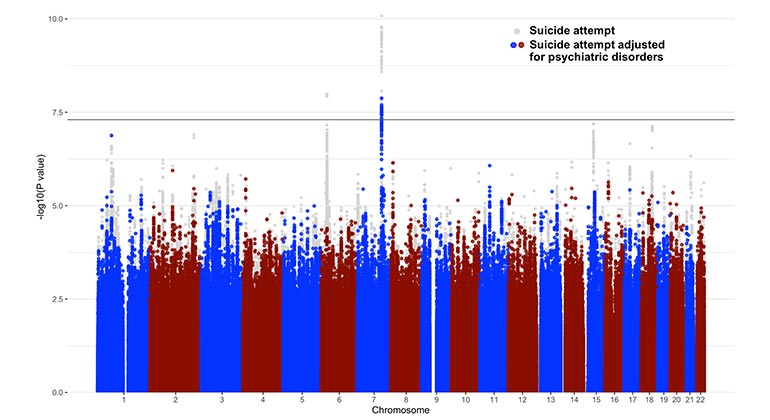
The study consisted of a genome-wide study of 500,000 people, 30,000 of which had attempted suicide, which is about 6% of the study's population. This association study was conducted by the International Suicide Genetics Consortium, and focused on looking at similarities among the human genome for those who had attempted suicide. During the study, evidence was found that the suicide attempts were consistent with psychiatric disorders and the genes associated with a higher risk of those diseases, but another result was discovered as well.
Chromosome 7 has had a lot of interest in the medical community as it is the chromosome for cystic fibrosis, polydactyly, deafness, and many other health conditions. The researchers found that there was a region located on Chromosome 7 that contain variants which could increase a person's risk for attempting suicide. The region identified on Chromosome 7 is also linked to non-psychiatric issues like insomnia and risky behaviors. This discovery paves the way for further research into this region as well as a more in-depth look at other chromosomes to determine if there are other genetic variations related to suicide independently of psychiatric disorders.
This study provides a great insight in helping find a scientific way to help prevent suicide. By looking into the genome and finding a specific region that is common in the people who have attempted suicide can lead into possible treatments or even provide a reason as to why certain people are more inclined to attempt suicide. Suicide is a horrible health problem that has affected millions of Americans and it is especially common among teenagers and young adults. This research could possibly help look into the reasoning for that along with mental health resources in order to make sure death by suicide decreases.
Related Articles