Showing posts with label histone. Show all posts

Monday, April 22, 2019

Regenerating Plants and World Hunger


At Tokyo University, Professor Sachihiro Matsunaga and his team of researchers may have determined how to regenerate plant tissue. The idea comes from trying to revert cells from their specialized state known as unipotent cells back to what’s known as pluripotency (think stem cells). The team at Tokyo University tried to reverse these unipotent cells in the plant Arabidpsis thaliana. They modified histone proteins throughout the entire genome and came to the conclusion that once histone is demethylated, this allows for plants to be regenerative.  These histone modifications aimed to demethylate histone H3 by the enzyme LDL3.
Image result for arabidopsis thaliana


According to a separate article on plant regeneration, it’s also possible for plants regenerative capabilities to speeded up as well by supplying hormones. Is it then possible to combine both of these techniques to be able to constantly have plants regenerate tissue? If so, this could open up a ton of possibilities to increase our food supply and hopefully come closer to ending world hunger.

Saturday, April 15, 2017

Gene Regulation of Humans and Sponges


According to new research at the University of Queensland, humans and sponges have a lot in common. The study found that sponges gene regulation is as complex as humans. Gene regulation is the process that refers to when and how genes are activated. Histones are proteins that are packaged within the genetic material and help to determine whether a gene is turned off or on. The discovery of histones in Amphimdeon queenslandica, or sponges, shows that this mechanism was “present at the evolutionary dawn of multicellular animals and across animal species’ (Science Daily, 2017). 


Saturday, November 21, 2015

Dad's Experiences Affected You, Even Before You Were Born

shutterstock_237183229
 
 
New studies have found a link between a father’s experiences and a change in an unborn child’s genome. Most human traits, such as weight, height, intelligence, etc., are partly inherited. However, researchers have taken a growing interest in epigenetics to explain heritability. Epigenetics refers to the information in the genome over and above DNA sequence. Modification of a father’s epigenetics during his lifetime can potentially be passed down to his offspring. Certain environmental influences, such as nutrition and age, can influence the epigenetics of a father that can be passed down to children, possibly creating health consequences later in life. Effects on the father’s sperm and histone proteins around the DNA seem to be the result of some environmental causes. A study at McGill University used genetic engineering in mice to alter one on the histone proteins (KDM1A histone lysine 4 demethylase) involved in epigenetics. Results showed influence in the health and development of the mice over generations.

This topic immediately caught my attention. I always believed genetic influence only came from the genetics we were born with. I did know, however, the life choices of the mother during pregnancy had an effect on the child’s healthy and development, but I never knew that the father’s life experience can affect the child genome. From previous schooling, I was always taught that experiences are not passed down to offspring. From this study, I now know certain experiences can have an effect on the father that can alter the genome of a child.


Saturday, October 17, 2015

Behaviors in Life May Impact Grandchildren

[A grandfather playing with his grandchild]

Research has shown that the health implications of a man's alcohol use, tobacco exposure and other behaviors can affect the health and development of offspring, even before conception. Numerous studies have indicated that a child's health may be affected by the environment and life behaviors of their father.Sarah Kimmins, of the Department of Animal Science at McGill University in Canada, notes that scientists know very little about what drives this association. Sarah Kimmins investigated whether proteins called histones - a component of sperm that is transmitted during fertilization - play a role in heritability. 

Sarah Kimmins and her team created mice in which the biochemical information on the histones was modified during the formation of sperm - a process that can occur with certain environmental exposures. The team then went on to analyze the development and survival of two generations of offspring. The team found that the offspring were not only prone to birth defects, but also they had abnormal skeletal formation and reduced survival. More importantly, these affects were seen across two generations. These findings suggest that something other than DNA - the alteration of histones - play a role in the health and development of offspring. 

I found this article very interesting because I had always thought DNA was the main source of one's development. I had no idea histones could also play a part in development. This is only one study that suggests something other DNA plays a part in development, but there will be many more that will get the same results. This article got  me thinking about other genetic materials that could have a hand in development. 

Link to article here 

Monday, April 6, 2015

DNA doesn't control all inherited traits


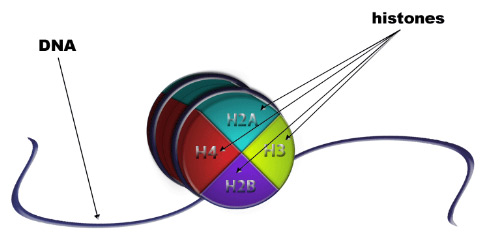
New research demonstrates that characteristics passed through generations are not only decided by DNA. Scientists studied proteins known as histones, which act as spools around which DNA is wound. Histones are responsible for controlling whether or not genes are switched on.

Researchers at the University of Edinburgh carried out experiments in a yeast with similar gene control mechanisms to humans. When changes were introduced to a histone that caused it to switch off nearby genes,, the effect was inherited by following generations of yeast cells.

This research is important and quite interesting because it shows that changes in the histone spools are passed through generations. This also demonstrates that DNA is not solely responsible for all inherited traits.

My Article
Related Article

Sunday, April 5, 2015

Dna can't explain all inherited traits.

     DNA is thought to be the one thing that designates genes and traits that a person may have. Researchers have discovered that this may not be the case. It turns out that histones, which are not part of DNA, but can control whether or not a gene is turned on or off. These studies have shown that changes that occur in these proteins are passed on to offspring and therefore influence whether or not a trait is passed on. This goes to show that DNA is not the sole thing responsible for passing on genes.
     This research will help to understand how certain traits are passed on, or if environmental factors play a role in which genes are passed on to offspring. Scientist used yeast to show how this works. They made changes to a histone protein in the yeast which made nearby genes turn off. The next generation of yeast had these same genes switched off, which were inherited from the parent generation. This is just the beginning, there is much more research that has to be done to understand exactly how these genes are passed on through these proteins, but in the end this will further our understanding of heredity.


Article:DNA can't explain all inherited biological traits, research shows
Ref1: Histones

Thursday, April 2, 2015

DNA Can't Explain All


     Scientists from the University of Edinburgh's School of Biological Sciences, have studied proteins found in cells also known as histones.  They are not part of the genetic code but act as spools which DNA is wound.  Histones are known to control whether the gene is switched on or not.  Researchers have found that naturally occurring changes to proteins, which affect how they control genes can be sustained from one generation to the next.  This influences which traits are passed on.  
     The finding demonstrates that DNA is not solely responsible for how characteristics are inherited.   This can improve research and how and when this method is naturally occurring in nature.  It will aid in understanding particular traits or other health issues.  It may also provide information into the changes of histone proteins caused by environmental conditions like stress or diet.  
     Scientists tested the theory by carrying out experiments in a yeast with similar gene control mechanisms to humans.  They introduced changes to a histone by mimicking those that occur naturally.  This causing it to switch off other nearby genes.  The inheritance patterns were reflected in subsequent generations of the yeast.  I think this is a huge advance to genetics.  We are constantly gaining more knowledge on inheritance.  


Saturday, March 21, 2015

DNA Packaged Like Yoyo


Scientists recently reported in Cell that DNA's sequence causes it to be coiled and uncoiled much like a yoyo. "We discovered this interesting physics of DNA that its sequence determines the flexibility and thus the stability of the DNA package inside the cell," said Gutgsell Professor of Physics Taekjip Ha, who is a member of the Carl R. Woese Institute for Genomic Biology at the University of Illinois. He goes on to say how many people thought this should have been known decades ago but that there are still surprises in the physics of DNA being discovered. 

We know that a string of DNA is coiled around histones to create nucleosomes. Then these nucleosomes are braided together into strings that are woven into chromosomes. Scientists assumed that when DNA was uncoiled from these nucleosomes that the two ends were symmetric, meaning that the DNA would uncoil like the untying of a shoe. However, University of Illinois researchers found that DNA is actually asymmetric, making it like the string wrapped around a yoyo. Pulling one end of the DNA would tighten the coil while pulling the other would cause it to uncoil like a yoyo.

The physics of this nucleosome packaging is determined by the DNA's sequence which makes the strand of DNA flexible enough to be stable to compact DNA and dynamic so the strand can be uncoiled and read to make proteins. The research showed that it is easier for the cell's protein making machinery to read from the "weak" end of the nucleosome that uncoils more easily. It is now thought that genetic mutations related to diseases, like cancer, alter the stability of the nucleosome. Professor Ha now plans to use next generation sequencing to determine the flexibility of an entire genome and hopes to create the first genome-wide map of physical properties.

I thought this information was very interesting to learn since it seems like something that we should have known for a much longer time with the technology we have available today. Also, this shows how their is always evolving information just waiting to be discovered. Furthermore, I think that by developing a way to make certain strands of harmful DNA the "stronger" end, so that the "weaker" end is coded, we could possibly stop certain diseases. 

Wednesday, October 15, 2014

EPIGENETIC CHANGES CAUSED BY BINGE DRINKING LEAD TO INFLAMMATORY RESPONSE IN LIVER


Research from the University of Missouri school of Medicine found that epigenetic protein changes can lead to treatments for alcohol-related liver diseases when caused by binge drinking. High blood pressure, heart disease, stroke, cancer and digestive problems are also caused from binge drinking: five or more drinks for a man and four or more drinks for a woman in a two-hour period according to the National Institute of Alcohol Abuse and Alcoholism. This statistic shows how prevalent binge drinking is in the U.S. today. 


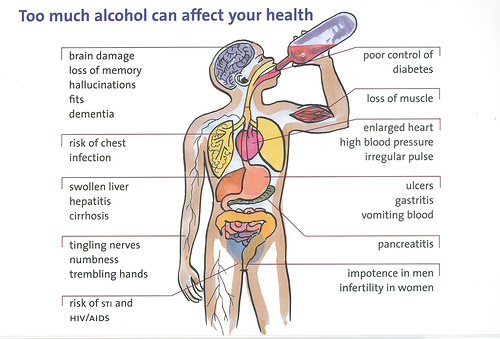
Shivendra Shukla explained that binge drinking causes epigenetic modifications in histone structures in the liver. Epigenetic modifications are the changes in genes that are not caused by changes in the DNA sequence or genetic code. Shukla further found that binge drinking will cause unnatural changes in histones, which are proteins that organize the DNA strands that surround them and they help the DNA function correctly. The changes in histones affect how the genetic code of an individual is interpreted and regulated. Shukla continued by saying how the negative affect binge drinking has on histones will initially cause inflammation and damage cells as they form, and cause cirrhosis and cancer. Shukla stressed that binge drinking does not only affect the liver and should not only be associated with the liver since the liver can send out damaging signals to other systems in the body. 


Binge drinking is an ever growing public health concern not only in the U.S., but globally. This problem is not going away and I believe that it is important to stress the many negative affects that result from alcohol abuse. Studies like the one Shuka performed can lead to future treatments for alcohol-liver damage; however, getting the word across that this is a very serious matter can help limit binge drinkers and alcohol abuse. 

Article: http://www.medicalnewstoday.com/releases/283683.php

Related Article: http://pubs.niaaa.nih.gov/publications/arcr343/293-305.htm

Friday, November 22, 2013

Could be more to know about the world of Epigenetics than previously assumed...


As time pushes onward, humans are constantly obtaining more information about how the body works and how our traits are passed from generation to generation. This article gives insight to the world of Epigenetics, which scientists have previously believed to be set in stone. However, as researchers backtrack and take a closer look, epigentics is not as simple as we assumed. This article mentions how we have viewed the DNA sequence as an independent of the epigenetic mechanisms (that which are responsible for controlling the gene expressions and are heritable). Further reading of this article will allow the readers to be able to see just how complex the transcription of the DNA can be. Some of the transcription ways are straightforward, but others occur at different rates or times which can all effect the output of the process. I feel that is is important that researchers keep investigating what controls our traits, that way we can learn how to better ourselves and the future generations to come. 


Below is a link to another article, also giving details about epigentics: 

Friday, April 20, 2012

Dieting While Pregnant Can Cause Epigenetic Gene Changes

A recent study published in the FASEB journal have shown connections between diet and nutrition during pregnancy and the likelihood of the offspring getting type II  diabetes or suffer from obesity. It has been found that dieting during the time of pregnancy, especially during the final stages, as well as having twins can affect the offspring's ability to control and handle blood glucose levels. THese connections are both interesting and important for research because they are epigenetic, or not inherited from the parent to the offspring.


These changes occur during the fetal changes and are caused by behavior in the mother. This is leading to a knew saying, "We are what our mothers ate" since a mothers diet is now being connected to these epigenetic changes. These changes are not changes in the sequence of DNA, but an alteration of structure or histone/protein arrangement in the DNA molecules.

Sunday, March 18, 2012

Researchers Find an Epigenetic Culprit of Memory Decline

In HHMI, Dr. Li-Huei Tsai and her team have recently published a mouse model study suggesting that Alzheimer’s disease has epigenetic origins:  her team's studies conclude that a single overactive enzyme is responsible for disabling the expression of other proteins required for neuron functionality.

The primarily culprit seems to be protein HDAC2, an enzyme which belongs to the histone deacetylase family.  A well-studied form of gene regulation is histone acetylation, wherein histones which are enrapt with DNA strands are acetylated.  Aceytlation of the lysine groups on histone tails neutralizes their positive charges, causing a relaxation in binding of the histones to their nucleosome partners.  As a result, transcription factors have an easier access to genes in acetylated regions.  An overactive histone deacetylase such as HDAC2, which deacetylates regions of DNA-histone complex,can thus dramatically reduce the expression of  related key genes necessary for the functionality of any biological processes, in this case neuron functionality.

The study suggests that inhibition of HDAC2 in mouse models resulted in control and experimental groups performing uniformly better in cognitive tests as opposed to their uninhibited HDAC2 counterparts.  Also, post-mortem autopsies of mouse models known to have degenerative disease states have elevated levels of HDAC2.  However, the scientists noted that although inhibition of HDAC2 restored neuron functionality, the rate of neuron cell death remained higher in mutants than in wild-type.  Dr. Tsai suggests that inhibition of HDAC2 'wakes up' malfunctioning neurons that would otherwise be operational; HDAc2 regulation, however, seems for now to be unlinked to increased neuron cell death.
Histopathologic image of senile plaques seen in the cerebral cortex of a person with Alzheimer's disease of presenile onset. Silver impregnation.