Showing posts with label heredity. Show all posts

Wednesday, December 10, 2025

Improved Stomach Cancer Treatments

Many may not realize that not all stomach cancers are created equal and that they can vary significantly. This variation may lead to requiring differing treatments based on the type and severity of the cancer. 

4 specific genes have been discovered that clue in on how stomach cancers can progress and develop, according to a recent study presented at the Digestive Disease Week conference. Researchers found that mutations in BRCA2, CDH1, RHOA, and TP53 were strongly linked to more aggressive forms of gastric cancer and poorer patient outcomes.

In the study, scientists analyzed tumor samples from 87 patients who had undergone surgery and chemotherapy. About one-third of these patients carried mutations in this four-gene combination, and those individuals were found to significantly be more likely to experience cancer recurrence or reduced survival. These findings highlight that certain genetic signatures can act as early warning signs for how deadly a tumor may become.

This discovery offers hope for more personalized treatment plans, rather than what is typically done currently where all stomach cancers are treated relativley the same despite their differences. This discovery can prevent using aggressive treatments on those that do not need it, and also provide better plans for those who do need it.

While promising, these results are still considered preliminary and much further research is still needed before being able to widley use this information in a clinical setting. 

News Article Source: https://www.usnews.com/news/health-news/articles/2025-04-25/four-gene-combo-might-predict-lethality-of-stomach-cancer

More on Stomach Cancer: https://www.cancer.org/cancer/types/stomach-cancer/about.html


Monday, November 24, 2025

Why Autism Has a Genetic Side That People Don’t Always Talk About


    When people talk about autism, they sometimes focus only on behavior or the social side of things, but I’ve been learning that genetics actually plays a big role too. I read a study that looked at thousands of families and found that autism has a strong hereditary component, meaning certain traits can be passed down genetically (Grove et al., 2019). That honestly made a lot of sense to me. I’ve known families where multiple people were neurodivergent in different ways, and it never felt like just coincidence. The study pointed out that autism isn’t caused by one single “autism gene,” but rather a mix of many genetic factors that each contribute a small piece. That idea really stuck with me. It shows how complex and diverse autism actually is, and why it looks different in every person.


    Another thing that stood out to me was how genetics interacts with the environment. A second study explained that genetic variations influence how the brain develops, but environment and life experiences can shape how those traits show up (Sandin et al., 2017). I liked that idea because it makes autism feel less like a strict category and more like a blend of biology and lived experience. It also reminded me that being neurodivergent isn’t something a person “chooses” or something caused by bad parenting, which is a harmful stereotype people still repeat. Understanding the genetic side helped me appreciate how naturally varied human brains are. To me, it’s a reminder that neurodivergence isn’t a flaw. It’s just another way of being human, and a lot of that uniqueness starts in our DNA.


References


Grove, J., Ripke, S., Als, T. D., Mattheisen, M., Walters, R. K., Won, H., … & Børglum, A. D. (2019). Identification of common genetic risk variants for autism spectrum disorder. Nature Genetics, 51, 431–444. https://doi.org/10.1038/s41588-019-0344-8


Sandin, S., Lichtenstein, P., Kuja-Halkola, R., Larsson, H., Hultman, C. M., & Reichenberg, A. (2017). The heritability of autism spectrum disorder. JAMA, 318(12), 1182–1184. https://doi.org/10.1001/jama.2017.12141

Sunday, November 13, 2022

Genes linked to learning disorders

 Dyslexia is a type of intellectual disability that affects one's reading and writing skills. Diagnosed individuals may struggle processing sounds, spelling, and transferring information from written to spoken form and vice versa. This not only interferes with academic success, but also with day to day life reading signs or writing emails. It appears to be a hereditary disorder, but until recently, there was not anymore information about the cause.

Michelle Luciano and her team at the University of Edinburgh sought to find more concrete genetic causes for dyslexia. They conducted a study that compared the genomes of over a million people to see if there were noticeable difference between those with dyslexia and those without. They were able to find 42 variants that were significantly found much more in those with dyslexia. There did not appear to be any difference in these variants between sexes, ages, or ethnicity. These traits seem to only have small effects when acting alone which is common for polygenic traits - implying that the genetic basis of dyslexia is very complex. 

I think this research is both fascinating and important. Learning more about the genetic causes for intellectual disorders could ultimately help mend the academic gap that many students find themselves in. Often times the school does not have the resources or training to properly accommodate students with learning disabilities. As a result there academic progress slows down or get put on hold and the older a student gets, the harder it is to catch back up. However, if we are able to prescreen embryos and babies for things like dyslexia, we could immediately implement the techniques need to limit the effect on their reading and writing. Focusing on it from a young age will make them more likely for success in secondary and higher education.

Monday, July 29, 2019

Genetic Study Points to Metabolic Roots of Anorexia Nervosa


The article, “Genetic Study Points to Metabolic Roots of Anorexia Nervosa”, by Nicoletta Lanese discusses the recent insight into the genetic markers of anorexia nervosa. The data collected became part of one of the biggest studies on the eating disorder that has ever been made. It has become more evident that there is a lot more to anorexia nervosa than previously thought. The disorder has psychiatric and metabolic origins. 
Through the study, I found two very interesting discoveries. The first is that anorexia nervosa shares single-nucleotide polymorphisms with other psychiatric disorders. These include obsessive compulsive disorder, depression, and a few others. The second is the disorder’s relation to metabolism. Certain gene variants indicate that anorexia nervosa may stem from one’s metabolism functioning differently. Apparently, the part of the body that signals when we are hungry, does not work properly. As a result, those with anorexia nervosa might just be able to physiologically starve themselves longer. 
Another article by Amy Lewis called “Researchers Explore the Genetics of Eating Disorders” offers more facts. The scientist Cynthia Bulik has worked with the Center of Excellence for Eating Disorders. In a study on twins, Bulik and her team found that anorexia nervosa is 50 to 60 percent heritable. She was also responsible for the studies in 2017 that are mentioned earlier concerning anorexia nervosa’s link to other psychiatric problems. Going forwards, she hopes to understand more about all of the eating disorders. The center has begun an initiative to look into binge eating on a genetic basis as well. 
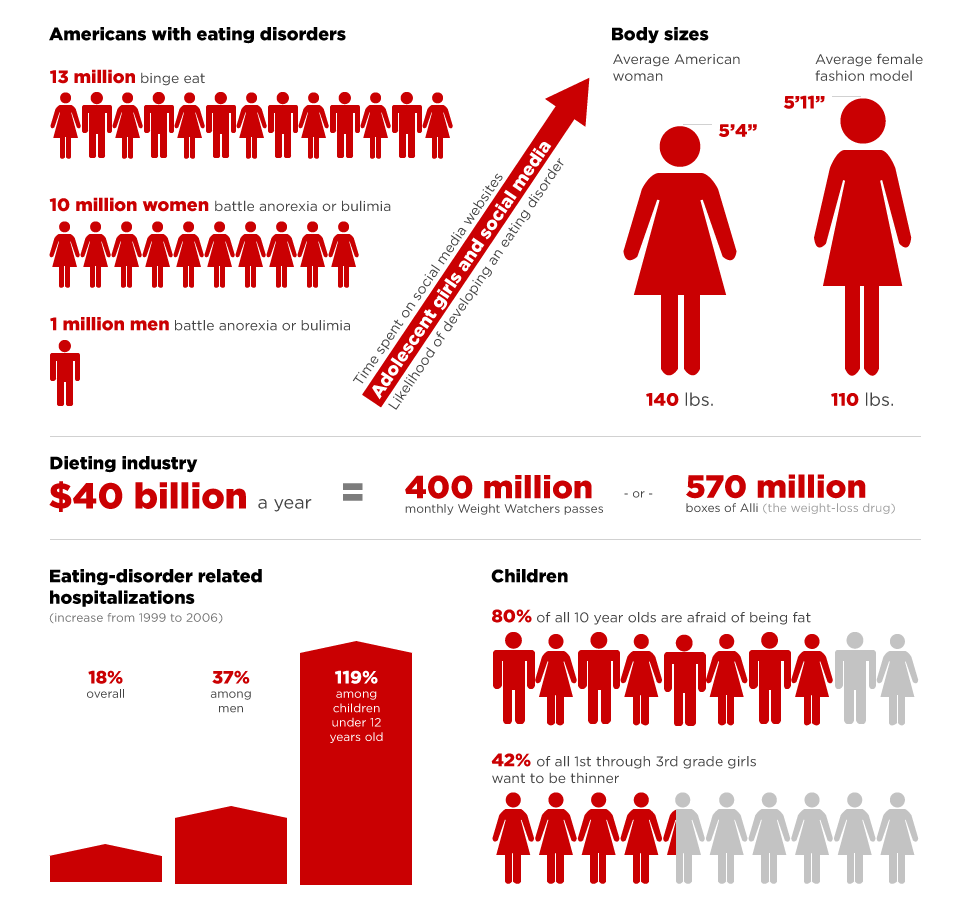
Above is an image depicting some statistics on the severity of eating disorders. Genetics could be key in lowering these statistics drastically. 

The subject of eating disorders is an extremely important topic of research. Genetics allowed us to learn this new information. Without the field, we would not be able to make the same leaps and bounds in understanding the devastating disorder. Anorexia nervosa is the deadliest of the eating disorders currently. It affects a lot of younger individuals especially of high school and college age. For this reason, the subject was very interesting. Looking into the genetics of eating disorders can help us to understand more about how they work, how to treat them, and even who is at a higher risk.

Monday, October 15, 2018

Studying the Genetic Basis of Sleep Patterns in Fruit Flies


Humans have a very distinct differentiation in the required amount of sleep people need to function for the following day. This variation in humans is not unique, and even Drosophila melanogaster exhibit variations in sleep patterns as well. The ability to understand the genetic basis of sleep could help to identify molecular mechanisms that are essential in heredity of this trait. Researchers published an article on the website Genes|Genomes|Genetics, where researchers described a collection of inbred fruit flies that exhibit extreme sleep behaviors that would help them to ultimately determine the genetic basis of sleep needs.

A previous research study had created a population of fruit flies that showed long sleeping and short sleeping traits. Researchers worked with flies from the Drosophila Genetic Reference Panel (DGRP), which is a population of more than 200 inbred lines room Raleigh, North Carolina. Basically, DGRP is a library of fruit flies that have polymorphisms of complex traits. Researchers chose five longest and five shortest sleeping lines from the DGRP an allowed them to randomly cross for 21 generations to produce an outbred population. Using artificial selection, the researchers produced two long sleeping and two short sleeping populations.

From these populations, the new article highlights the researchers creating an inbred lines. Inbred ines are important in genetic studies because it reduces genetic variation. To create the inbred lines, the researchers selected a male and a female from each population and mated them and then selected one male and female fro the progeny to propagate the line. This process repeated for 20 generations and created a total of 39 inbred lines and these were called the Sleep Inbred Panel.

Simple demonstration of the process carried our by the scientists using inbreds

Night sleep of the inbred lines ranged from one hour to almost twelve hours, which demonstrates that the extreme phenotypes of sleep times were maintained in the inbred lines. Phenotypes were similar to the parental populations which demonstrates that inbreeding reduces genetic variability. The only variation between the new flies and the parent flies was due to the short sleeping population, which may have had a lower fitness than the other flies. Overall, the authors identified SNPs and genomic variations with sleep phenotypes that dates back to the DGRP inbred lines.

This research in fruit flies can help researchers determine variation in sleep cycles and sleep processes in humans. Perhaps there is a genetic connection between preference of sleep, like those who enjoy sleeping more in the morning or those that enjoy sleeping more at night and waking up earlier. Going a step further, finding the genetic connection to sleep patterns may help researchers identify the causes of sleep disorders and using some molecular genetics techniques could possibly cure those diseases. Personally, I am able to wake up earlier in the morning and also stay up late at night if possible, and seeing this research done on human genetics could just be an additional insight on how we function as humans and as a society in regards to sleep patterns.

Sunday, February 5, 2017

Life With Celiac Disease


Celiac disease is a hereditary disease dealing with the body’s villi getting damaged. Individuals with a parent, child, or sibling with the disease have a 1 in 10 risk of developing the disease themselves. While “disease” sounds scary or contagious, this disease, while rather annoying, is as simply defined as the inability to digest gluten and is not contagious. 


Gluten is a protein found in wheat, rye, and barley. This disease is not easily diagnosed as it is often mistaken for other disorders. One would think that in every case of celiac disease the individual would fall very ill after consuming the gluten protein but this is not always the case. When illness is shown after eating the protein researchers call it classic celiac disease. Non classic celiac disease is when individuals show a variety of health problems, such as infertility, joint pain, osteoporosis, skin rashes, and ADHD, but does not display any gastrointestinal problems. Researchers now state that non-classic celiac disease is more common than the classic form showing gastrointestinal issues. I personally believe that individuals will become more and more aware of this disease. It is not extremely rare, considering one in one hundred people do have it. I am seeing more “gluten free” tags and labels in restaurants, the grocery store, and even on makeup and hair products. I believe it is wonderful for the individuals that do have this disease they can be presented with stronger facts about the disease and have a larger variety of food and daily life products while living with it.

Tuesday, November 15, 2016

Coffee Consumption Linked to Variant Form of Gene


Researchers in Scotland have recently published results in Scientific Reports based on an experiment meant to observe the amount of coffee people drink daily, while looking at whether or not they have a certain variation of the gene PDSS2. PDSS2 has been linked to the breakdown of caffeine in the body, and a certain variation may cause the caffeine to break down more slowly which in turn allows a longer presence in the body, and ultimately less coffee consumption. The study was carried out in Italy and the Netherlands and people were surveyed based on the amount of coffee that they drank per day. Out of the 1000 people surveyed in Italy, it was discovered that the people who had the specific variation in the PDSS2 gene drank on average 1 less cup of coffee per day since the caffeine lasted longer in their systems. Out of the 1700 people surveyed in the Netherlands, the results were less significant but the findings were still that those with the variation drank slightly less coffee on average per day.

Image result for coffee

The scientists hypothesized that the PDSS2 gene may work by blocking the expression of the certain enzymes that are meant to break down caffeine. By affecting this process, the caffeine is able to stay in the system longer, creating less of a desire and need to drink more coffee in order to feel its effects. Although the scientists admit that more research needs to be done on the topic, this study provides a good foundation to understanding how certain genes may work. If we are able to study genes and their variations in this way, we will be more prepared on how to fix certain medical issues when they arise because it all starts at the basic level of what is in our DNA. Millions of people worldwide claim that they are "addicted" to coffee, but what if it has something to do with, and can be manipulated through, genetics and heredity? This topic is very important to our understanding of variations of genes and through further research may yield some very interesting results.

Link: http://www.livescience.com/55880-coffee-consumption-dna-genes.html

Monday, December 7, 2015

Genetics and Obesity:


Obesity has been a very common point for the United States for decades. The United States obesity rate is far too high, and a large amount of that is contributed to genetics. There are several diseases regarding obesity, a few examples are Prader–Willi syndrome, Albright hereditary osteodystrophy,  and ulnar-mammary syndrome, all three are autosomal dominant disorders. There are many loci in which each disorder is present.While there is widespread acceptance that hereditary factors might predispose to human obesity, it is frequently assumed that such factors would influence metabolic rate or the selective partitioning of excess calories into fat. However, it is notable that, thus far, all monogenic defects causing human obesity actually disrupt hypothalamic pathways and have a profound effect on satiety and food intake. Along with the genetic  predisposition to obesity, many individuals also have environmental predispose to obesity, which only compounds the patients problem making them eat more and more. 

Saturday, November 14, 2015

Discovery of a Blindness Gene

 Within the past two decades, scientists have successfully identified and isolated a revolutionary gene--a gene that contributes to blindness. This defective gene, known as RP3, resides on the X chromosome, and the blindness trait is mostly expressed in young men. The normal function of this gene is not yet fully known; however, mutations in RP3 are known to result in retinitis pigmentosa disease and blindness. Retinitis pigmentosa is defined as a hereditary eye disease that causes degeneration of the retinal cells. 70% of all cases of retinitis pigmentosa are linked back to the mutated RP3 gene.

RP3 affects mostly men, causing them to become blind by the age of thirty. Symptoms develop in early childhood. If a boy has trouble seeing anything at night or begins to see with tunnel vision, this indicates a possibility the individual contains a defected RP3 gene. Keep an eye on your young male children.

I am amazed at the discovery of RP3. An average of 1 in 2000 people suffer from blindness; and since the gene, a major cause, has been discovered, a treatment may be devised within the upcoming years. For now, scientists can only genetically determine an individual's susceptibility.


Link to article: Gene Linked to Blindness

Other Article: Diseases and Conditions


Sunday, April 5, 2015

Dna can't explain all inherited traits.

     DNA is thought to be the one thing that designates genes and traits that a person may have. Researchers have discovered that this may not be the case. It turns out that histones, which are not part of DNA, but can control whether or not a gene is turned on or off. These studies have shown that changes that occur in these proteins are passed on to offspring and therefore influence whether or not a trait is passed on. This goes to show that DNA is not the sole thing responsible for passing on genes.
     This research will help to understand how certain traits are passed on, or if environmental factors play a role in which genes are passed on to offspring. Scientist used yeast to show how this works. They made changes to a histone protein in the yeast which made nearby genes turn off. The next generation of yeast had these same genes switched off, which were inherited from the parent generation. This is just the beginning, there is much more research that has to be done to understand exactly how these genes are passed on through these proteins, but in the end this will further our understanding of heredity.


Article:DNA can't explain all inherited biological traits, research shows
Ref1: Histones

Thursday, March 19, 2015

More Like Dad Than Mom

A baby holding his father's hand
It is widely known that mammal offspring get an equal amount of genes from both parents, however a new study proves that more DNA from the father is used in comparison to the mother. This was shown in an article in Science Daily. Dr. Fernando Pardo-Manuel de Villena, a genetics professor, explained that scientist had already known that nearly 100 genes were inherited more from one parent as opposed to the other (this is called the "parent-of-origin effect"). This new study proves that there are thousands of genes have this effect.

A major reason why this research could be done, and with such success, is due to the Collaborative Cross, which is yields the the largest mouse population with a widely diverse gene pool. Due to the genetic variation in this population, these mice can be used for this study because it closely resembles the human population. This study concluded that a a large percentage of genes was indeed inherited from the father.

This research can potentially answer a lot of genetic questions when it comes to heredity. It is fascination to think that while one could very much resemble their mother, that they still utilize a majority of their father's genes.

Additional Article

Monday, April 14, 2014

Wolf-Dog Hybridization Common in Caucasus Region

In a recent article, which discusses a study published in the Journal of Heredity, researchers have found that hybridization of wolves with shepherd dogs in the Caucasus Mountains of Georgia is more common than what it was thought to be. Dr. Natia Kopaliani, Dr. David Tarknishvili, and colleagues from the Institute of Ecology at Ilia State University in Georgia and the Tbilisi Zoo have found that recent ancestry in about ten percent of sampled wolves and dogs. From their sampled population, two to three percent were linked as first-generation hybrids. Shepherd dogs studied were local breeds from the area that were used to guard livestock from predators, such as wolves.
Researchers fear that this hybrid species may lack fear of humans as there has been an increase of attack on humans and cattle since the 2000's. To confirm their results, researchers examined mitochondrial DNA and microsatellite markers. Microsatellite markers are used to study hybridization due to their ability to mutate easily and because of the fact that they are highly variable even within a single population. More about the wolf-dog hybrid species can be read here.

Sunday, April 29, 2012

Synthetic Genetic Material?

Scientists in Cambridge, UK have created a compound called "XNA". It is similar to DNA and RNA, essentially replacing the deoxyribose and ribose with some other molecule. According to researchers, some of the XNA's created are actually more stable than our own naturally occurring nucleic acids. Certain speculations point to potential uses in drugs, therapies, and laboratory testing. There is possibly a way to make synthetic life from XNA's; a topic that will surely generate controversy in the future. Perhaps new genetic therapies that involve these synthetic molecules will open new doors into the realm of genetics that have never been explored before.


Most importantly, since scientists can manipulate and create these XNA's as they desire, it can help scientists to understand the processes of DNA and RNA more closely. These two nucleic acids are the essence of life, and if they can be understood better, there may be no boundaries to what can now be achieved in a laboratory.  Understanding our own genetic code more closely can potentially benefit mankind in amazing ways.