Showing posts with label Hybridization. Show all posts

Monday, November 21, 2016

Studies on Human Genome Determine Why There is Little Neanderthal DNA in Modern Day Humans

Modern-day humans contain up to 4% of NeanderthalDNA in their genome. They shared a common ancestor with Neanderthals up until about half a million years ago. Humans and Neanderthals started to interbreed tens of thousands of years ago, producing human-Neanderthal hybrids. Over time, the prevalence of Neanderthal DNA has steadily decreased over human generations until it has reached its current amount.

The reasons as to why scientists believe this interbreeding occurred and why Neanderthals do not exist to this day is because of the small population sizes of Neanderthals. Because they originally tended to live in harsher climates than humans, population sizes were smaller to cope with the extreme conditions. This resulted in a higher amount of interbreeding in Neanderthal populations, leading to less gene variation and a lower chance of natural selection.


The scientists of this study used mathematical equations to predict how allele frequencies of Neanderthal DNA inthe human genome changed over time. They suspect that while the chosen alleles may be neutral in Neanderthals, they may pose a greater threat to hybrids, resulting in high mortality rates. Therefore, offspring of any surviving hybrids would have a greater chance of survival if the hybrid parent mated with a human, decreasing the amount of harmful Neanderthal DNA in the offspring. This repetition of surviving hybrids mating with humans, and the resulting offspring also mating with humans, lowered the frequency of Neanderthal alleles in generations over time. When the hybrids reproduced with humans, there was greater gene flow and any disadvantages from the Neanderthal DNA could be effectively bred out over time. The breeding habits and survival rates of different generations of hybrids and their offspring would result in the varying degrees of prevalence of Neanderthal DNA in modern day humans. This study is important in understanding the origins of modern-day humans and how we came to be.

Thursday, October 6, 2016

Animal hybrids may hold clues to Neandertal-human interbreeding

It has long been thought that lineages between species were rigid lines that do not connect with other living species and that mating between species is impossible.  Recent studies show that human evolution may have been a river stream of  inter connected lineages that interbred rather than the conventional theory that our lineage was a tree with individual lines leading to each species.  After comparing modern day non-African human DNA with DNA from Neandertal fossils, it was found that 1.5 to 4 percent of Neandertal DNA still exists in our genome.  There is also evidence of interbreeding between humans and another ancient hominid known as the Denisovans.  Evidence of these interbreeding relationships can be found in human skulls that have been found in caves that share a resemblance to the skulls of our ancient hominid relatives.
Drawing comparing human skull to Neandertal skull.
Some scientists believe that these ancient skulls may be the evidence of hybrids that are the product of human and hominid mating.  Species that diverged from a common ancestor within a few million years still have the capacity and similar DNA to still be able to reproduce.  To further observe this, scientists have experimented with hybridizing species that exist today and comparing the results they get with those of the cave skulls they have found.  Yellow and olive baboons were interbred to see how the resultant generations would appear and what traits would be exhibited.  The results showed that hybridization blurs the lines between species and makes it harder to detect differences among the species.  Due to this, a theory has come up that Neandertals were not physically pushed to extinction by being out-competed by humans, but rather they slowly began to fade away by interbreeding with humans and leaving their mark in our DNA. 

Sunday, March 8, 2015

Hybridization of American Black Ducks and Mallards

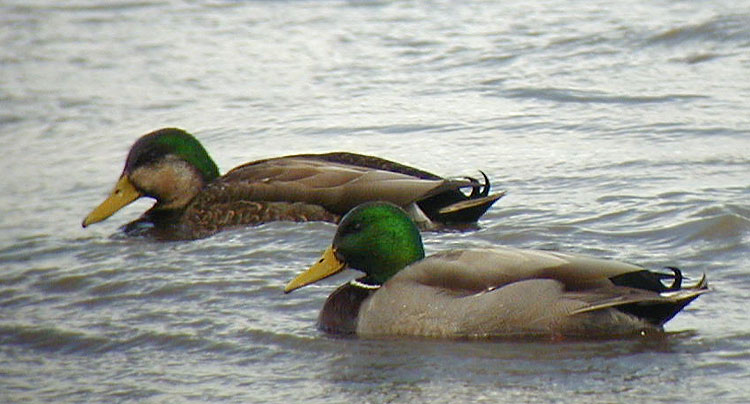
Anas platyrhynchos, also known as the Mallard, is a species of duck that is known to hybridize with many other duck species such as the Northern Pintail, Anas acuta, the American Black Duck, Anas rubripes, and many others. The American Black Duck has been suffering population declines for decades now due to over-hunting and habbitat loss. While they are still one of the most abundant species on the marsh, researcher has been done to determine the purity of the bloodlines. Currently at the Edwin B. Forsythe National Wildlife Refuge in Galloway, New Jersey research is being complied to shed light on this subject. Black Ducks are trapped and blood samples are taken to be analyzed. Some speculate that the Black Duck population, while visually appearing "fine', may be in serious trouble due to the inbreeding. More research needs to be done into the extent of the hybridiztion problems that the Mallards are causing, but the general population can contribute if they so choose. Mallards were originally kept as game birds and "pets" so if hunters were to focus more on these birds than other native birds, populations of natural species would be likely to increase overt time. This link gives many of the species that Anas platyrhynchos has hybridized with for reference.

Saturday, February 28, 2015

Hybridization of Blue-winged Warblers and Golden-winged Warblers


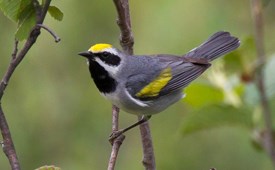
   The Golden-winged Warbler, Vermivora chrysoptera, is warbler species that lives in North America, specifically in the northern states of the US and parts of southern Canada in the summer months. This bird then migrates to the northern countries of South America where it winters. The Golden-winged Warbler, due to its preference of early transitional habitat areas, has lost habitat to human development or humans lack of forest management. Its preferred habitat, which consist of early transitional species, is maturing and then is being protected by government agencies for conservation. However, the conservation of these areas leaves them untouched and allows them to mature into forests, which is not habitat suited for Golden-winged Warblers. This forces these birds to share this transitional area with the Blue-winged Warbler, Vermivora cyanoptera. 
This habitat sharing has lead to hybridization and two new species have emerged from it, the Lawrence's Warbler and the Brewster's Warbler. This causes problems because genetic lines between the two warblers become crossed and do not remain pure. In order to protect the future generations of the Golden-winged Warblers lands must be set aside that will consistently be maintained for the preferential habitat of each bird species independently. This will ensure its longevity and prevent further hybridization between these two species.  
   I found this article very interesting. It reenforces my belief in habitat management as well as habitat conservation. These two warblers show that conservation and management are not separate entities but rather go hand in hand.  

Monday, April 14, 2014

Wolf-Dog Hybridization Common in Caucasus Region

In a recent article, which discusses a study published in the Journal of Heredity, researchers have found that hybridization of wolves with shepherd dogs in the Caucasus Mountains of Georgia is more common than what it was thought to be. Dr. Natia Kopaliani, Dr. David Tarknishvili, and colleagues from the Institute of Ecology at Ilia State University in Georgia and the Tbilisi Zoo have found that recent ancestry in about ten percent of sampled wolves and dogs. From their sampled population, two to three percent were linked as first-generation hybrids. Shepherd dogs studied were local breeds from the area that were used to guard livestock from predators, such as wolves.
Researchers fear that this hybrid species may lack fear of humans as there has been an increase of attack on humans and cattle since the 2000's. To confirm their results, researchers examined mitochondrial DNA and microsatellite markers. Microsatellite markers are used to study hybridization due to their ability to mutate easily and because of the fact that they are highly variable even within a single population. More about the wolf-dog hybrid species can be read here.