Showing posts with label ducks. Show all posts

Monday, April 3, 2017

The Curse of the Labrador Duck


https://blogger.googleusercontent.com/img/b/R29vZ2xl/AVvXsEiurJfrOxPbdfQ1mg9yZdYR3EeveDojcMb-G72q75N5k9N-PCzP6n9DZQ3UXxzzwfKExP9k3Poc-0bGcdkuLAa-PTZE2LaduMLnf_0ldHYEJLdo3ZICtr8vm7hC49bHu0EW4SHSKLpG3y8/s1600/Labrador-Duck.jpg


The Curse of the Labrador Duck is a book about the quest of Glen Chilton, who is bound to discover the genome of the Labrador duck. The Labrador duck is North America's first bird species to go extinct after the European migration in the 1800's. The last specimen was harvested in 1875 and the last Labrador duck was reportedly seen in December of 1878. Chilton runs into many problems on his quest for the genome, mainly the lack of DNA. There is only 55 specimens known left in existence, all of which are taxidermy, which leaves nothing but feathers and skin to study. He searched the globe to find other forms to study the ducks, but nothing's true. All of the eggs that were thought to be Labrador ducks turn out to be other species of duck, mostly mallard and red breasted merganser. Today no one knows much about the Labrador duck let alone the genome, without further investigation and DNA to examine, the mystery of the Labrador duck may remain a mystery forever.

This is a fascinating book that covers mystery behind a species that very little is known. With minimal specimens to look at and no quality DNA samples to study the mystery will not be resolved. Some biologists hypothesize about the duck not being its own true species, saying it is simply a cross between a Steller's eider and a common eider. This is a valid hypothesis, except that the two species have completely different ranges and are only found on opposite sides of the nation. The truth behind the Labrador duck may be never known, but it is a mystery that will capture the minds of many biologists and water fowlers alike.


Tuesday, March 28, 2017

Genetic Structure of Avian Influenza Viruses from Ducks of the Atlantic Flyway of North America


https://wwwnc.cdc.gov/eid/article/12/11/06-0652-f1

Original Article

Further Information


Ducks, like most wild avian species are hosts to a pool of influenza A viruses. Even though scientists have a growing number of avian influenza virus (AIV) genome sequences, their understanding of the genetic structure and transmission in waterfowl in North America is still limited. The Atlantic flyway, located on the eastern shore of the United States, is lacking on knowledge about AIV. To further their knowledge, scientists analyzed 109 AIV genome sequences from waterfowl from the Atlantic flyway to determine their genetic structure, observe gene flow compared to other birds in various locations along the flyway.. The experiment included 25 AIVs from ducks gathered in Newfoundland, Canada, and 84 duck AIVs dispersed throughout Atlantic flyway. High amounts of diversity of viral genes and genomes were identified in the 109 samples tested. Transmission between continents were very small, roughly 2%, while the rate of transmission between North American flyways is much more abundant, roughly 75% of the genes could be linked to genes found in the other three North American flyways, namely the Mississippi, Central, and Pacific flyways.


The take home message of this article is that AIV, like most avian viruses, are spread through close contact and proximity. It is expected that most of the genes and genomes would be similar or linked in a specific flyway since most ducks migrate within species and stay in relatively close proximity as they travel up and down the flyway. The reason the rate between contents are so low is because the only time the two birds are in contact during mating, this only happens in some species, or if a flock is blown off course by a strong trade wind.


Sunday, March 8, 2015

Hybridization of American Black Ducks and Mallards

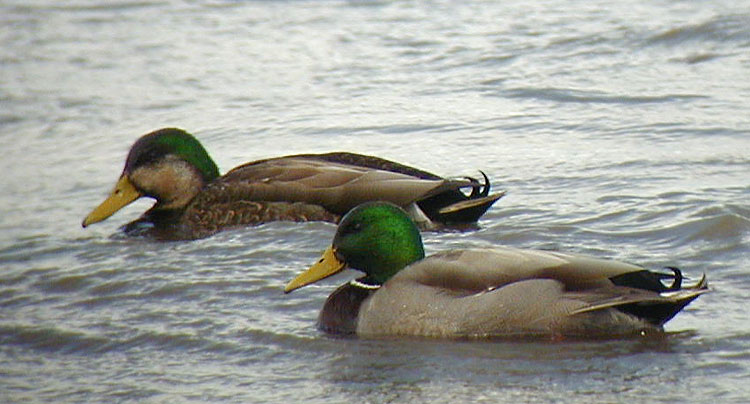
Anas platyrhynchos, also known as the Mallard, is a species of duck that is known to hybridize with many other duck species such as the Northern Pintail, Anas acuta, the American Black Duck, Anas rubripes, and many others. The American Black Duck has been suffering population declines for decades now due to over-hunting and habbitat loss. While they are still one of the most abundant species on the marsh, researcher has been done to determine the purity of the bloodlines. Currently at the Edwin B. Forsythe National Wildlife Refuge in Galloway, New Jersey research is being complied to shed light on this subject. Black Ducks are trapped and blood samples are taken to be analyzed. Some speculate that the Black Duck population, while visually appearing "fine', may be in serious trouble due to the inbreeding. More research needs to be done into the extent of the hybridiztion problems that the Mallards are causing, but the general population can contribute if they so choose. Mallards were originally kept as game birds and "pets" so if hunters were to focus more on these birds than other native birds, populations of natural species would be likely to increase overt time. This link gives many of the species that Anas platyrhynchos has hybridized with for reference.