Showing posts with label x chromosome. Show all posts

Monday, October 27, 2025

Genetic Insights into Why Depression Affects Women More Than Men

       In a recent study done by Dr. Jodi Thomas at the School of Biomedical Sciences at The University of Queensland, it has been found that major depressive disorder (MDD) impacts almost twice as many women as it does men. Researchers findings in the study with over 200,000 men and women with MDD start to unpack the underlying causes of MDD in both sexes. They categorized genetic effects into three separate groups: shared effects present in both sexes, sex-dependent effects that differ in magnitude or direction, and sex-specific effects present in only one sex. Their analysis revealed that women carry about 13,200 genetic variants linked to MDD while men have only 7,100, suggesting that women might bear a higher genetic burden (including 6,100 variants potentially unique to females). Additionally, three genomic regions were identified as major only in women, supporting the presence of sex-specific genetic influences.

The study also focused on genetic correlations between MDD and metabolic traits like body mass index (BMI) and metabolic syndrome. These correlations were stronger in women, consistent with clinical observations that women with MDD more often experience metabolic symptoms. With this, researchers recorded limitations in statistical power, meaning that not all causal genetic regions could be definitively identified. In addition, genetic correlations between men and women with MDD were slightly lower than expected, underscoring possible differences in cohort characteristics. This suggests that twin studies and GWASs may capture distinct aspects of genetic risk.


    Ultimately, the study highlighted a noteworthy variant on the X chromosome in men, mapping to the IL1RAPL1 gene, which is involved in memory and has been associated with several other traits but not previously with MDD. While the role of this gene in male depression is still unclear, it provides a promising opportunity for further research. Overall, the study harps on the importance of sex-stratified analyses to comprehend the biological function of MDD and points to the need for more data collection and further investigation into molecular mechanisms that mediate sex-dependent and sex-specific genetic impacts.


Sources:

https://www.nature.com/articles/d41586-025-03374-0

https://www.nature.com/articles/s41467-025-63236-1

https://www.mayoclinic.org/diseases-conditions/depression/symptoms-causes/syc-20356007


Thursday, October 23, 2025

Genetics of Color-Blindness


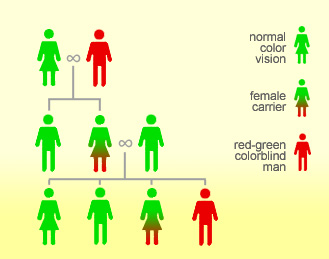
Color vision deficiency is primarily a genetic condition caused by mutations in the OPN1LW, OPN1MW, and OPN1SW genes, which are responsible for producing the light-sensitive opsin pigments in the retina's cone cells. Each gene corresponds to a specific type of cone: L cones for red, M cones for green, and S cones for blue. The most common forms, red-green color blindness, are linked to the X chromosome. Mutations in the OPN1LW or OPN1MW genes on the X chromosome disrupt red or green perception, which explains why these conditions are much more common in males, who have only one X chromosome. Blue-yellow color defects, which are rarer and affect both sexes equally, result from autosomal dominant mutations in the OPN1SW gene. The most severe form, blue cone monochromacy, occurs when mutations prevent both the L and M cones from functioning, leaving only S cones active and causing very poor visual acuity and color vision.

The genetic explanation for color vision deficiency is a fascinating example of how our biology directly shapes our perception of reality. It's particularly interesting how the inheritance patterns are a direct consequence of the genes' locations. The X-linked recessive pattern for red-green deficiency perfectly explains its strong male bias, making it an excellent case study in genetics. It's also striking to me how the severity of the condition depends on which combination of genes is affected; losing just one type of cone (L or M) leads to a common and "manageable" red-green deficiency, while losing both (as in blue cone monochromacy) reduces your color vision far more. This direct link between specific genetic errors and specific sensory outcomes makes color blindness a powerful illustration of molecular genetics in action.

References: 

1. MedlinePlus. “Color Vision Deficiency: MedlinePlus Genetics.” Medlineplus.gov, 1 Jan. 2015, medlineplus.gov/genetics/condition/color-vision-deficiency/.

2. Wong, Bang. “Color Blindness.” Nature Methods, vol. 8, no. 6, 2011, p. 441, https://doi.org/10.1038/nmeth.1618.


‌


Tuesday, November 29, 2022

Rat Species Has No Y Chromosome!

Amami Spiny Rat

A team of researchers at Hokkaido University in Japan has figured out how a species of rat is able to survive and reproduce despite not having a Y chromosome. The rat species they studied was the Amami spiny rat (Tokudaia osimensis), a rodent native to the island of Amami Ìshima in southern Japan. The species, also called the Ryukyu spiny rat, is unique in that males do not have a Y chromosome and females only have one X chromosome as well. Previous attempts to study the rat have not been able to reveal how males are able to develop within the population with no Y chromosome. Typically in mammals, a gene on the Y chromosome called SRY tells the organism's body to express male genes like the SOX9 gene for testes. Not having the Y chromosome scientists were stumped at how males could develop. Lead researcher, Asato Kuroiwa, and her colleagues at Hokkaido have now discovered the answer! The secret was looking at the autosomes, non-sex chromosomes, in the rat. On chromosome 3 they found that one copy had a duplicated region next to the SOX9 gene. The duplication increases the activity of the SOX9 gene and it is able to code for testes. This duplicated region effectively replaces the SRY gene on the Y chromosome and explains how males of this species are formed. If a rat has the duplication region it acts as a proto-Y and the rat will be a male, and if the duplication region is absent, it acts as a proto-X and the rat will be a female. Further work to explore this is limited as the rat is an endangered species but the research so far has shown an amazing trait inherited by this rat population. The researchers predict the trait appeared about 2 million years ago when the Amami spiny rats diverged from their ancestors with a Y chromosome. Kuroiwa believes that a mixed population existed initially on the island but then a natural disaster like flooding or rising seas left mostly rats without the Y chromosome and over time the rats reproduced and evolved into a new species with this trait. 

Personally, this was my favorite article to read so far about genetics. I find it incredible that a species can exist without a Y chromosome and that another chromosome was able to replace its function to make males. This is a really interesting example of population evolution, genetic drift, and speciation. I hope that these rats can be studied more to learn about this unique and interesting trait. 

Tuesday, March 29, 2016


Is Scoliosis Preventable? Considering Genetics' Impact

Scoliosis is a lateral curvature in the normally straight vertical line of the spine. If viewed from the side, the spine shows a mild roundness in the upper back and shows a degree of inward curvature in the lower back. When a person with scoliosis is viewed from the front to the back, their spine appears to be curved. Individuals with scoliosis often present an S-shaped or C-shaped curve. It is always questioned whether scoliosis is due to genetics. Familial studies that have been conducted on scoliosis have associated the X chromosome, as well as regions on chromosomes 6, 9, 16, and 17 with a strong linkage to scoliosis. Medical daily states that the exact gene linked to scoliosis is the POC5 gene. Scientist from the University of Montreal state this the exact gene responsible. 
It has also been determined that scoliosis has a higher incidence in first-degree relatives in comparison to second and third degree relatives. Although the genetic etiology of scoliosis is confirmed, it is not the only cause. Scoliosis can result from a combination of genetics and neurological, environmental and behavioral factors. Research conducted on scoliosis associated it with different white and gray matter characteristics in the brain responsible for processing position sense. A mutation in genes associates with somatosensory feedback to the central nervous also plays a role. An X-ray of the individuals back can be conducted to know if one has scoliosis. Also a test known as the “forward bending test”, which is performed by bending forward through your hips with your legs straight and allowing your spine to hunch forward is conducted. Scoliosis is a three-dimensional deformation. One most likely develops a rib hump and when a forward bending test is conducted one side of the back may appear higher than the other.

This kind of research is helpful in understanding where scoliosis originates and also how it is developed. Instead of it being a mystery to most, they can look at their family history and find out who has it and how likely they are or their children are to having scoliosis also. Also it is great to know that it is more than just genetics, that many other aspects play a role in the development of scoliosis. Knowing this information can probably help individuals prevent themselves from developing a severe case of scoliosis even if it is a family history. 


Tuesday, December 1, 2015

Gene Linked to Blindness is Found

After searching for more than a decade, scientists have isolated a gene for a disease that usually blinds the men who have a defective form of the gene by age 30.  The condition is a particularly severe form of retinitis pigmentosa, which affects some 100,000 Americans. The defective gene causes one of the most common forms of retinitis pigmentosa, accounting for about 10 percent to 20 percent of all cases. 
The discovered gene, RP3 might be able to help researchers create treatments. RP3 is one of three genes known to be on the X chromosome that cause the severe form of retinitis pigmentosa, which hits hardest in men. Mutations in the newly found gene cause about 70 percent of these severe cases. The two other genes have yet to be isolated.
Boys with a defect in one of these genes have difficulty seeing at night and develop tunnel vision. No cure for the condition is known, and the men usually become blind before middle age. After scientists better understand the normal function of the gene, they might be able to devise treatments for the disease, Dr. Wright said. Scientists should be able to devise a test to detect RP3 mutations, he added.
This kind of research is extremely important because researchers will now be able to find more ways to help those who suffer from colorblindness. 

Saturday, September 26, 2015

Why are calico cat predominantly female?

It is a well known fact that calico cats are mostly female; male calico cats do exist, but this can only happen if the cat has Klinefelter Syndrome, which will be explained later. The reason why only female calico cats is because of a concept called Sex-Linked Genes, a concept that certain traits are determined by the sex chromosomes of an organism.

This diagram shows the X and Y
chromosome relationship with fur
color. 
Fur color in cats is determined by the X chromosome, so in most cases, the genotype of the mother cat will determine what kind of fur color the offspring will have. Since male cats have one X chromosome and one Y chromosome, the male cat's color will be determined by the one X chromosome. For example, if the mother has a X chromosome that expresses orange fur, the son will have orange fur. If the mother has black fur, the son will have black fur.

This idea is more complex in daughter cats. If a daughter has two X chromosomes that express the same fur color, a process called Lyonization will occur. Lyonization is a process that occurs during the blastula stage of embryonic development, and arises randomly in each cell. In each cell, one of the X chromosomes is coiled into a Barr Body, leaving the remaining X chromosome of express the trait. For example, if a daughter has two X chromosomes that express black fur, then one of those chromosomes will become a Barr Body, and the other chromosome will express the black fur in the phenotype. Once again, this is only at the cellular level

Calico cats have two different kinds of X chromosomes- one that expresses black fur and one for orange fur. The cats will not express both of these traits in the same cell; instead, each cell will express only black fur or only orange fur. In Lyonization, both X chromosomes will be separated, and be accompanied by their own Barr Body. Afterwards, each cell will arise from either the X chromosome that expresses from orange fur, or from the X chromosome that expresses black fur. This results in various patches that occur throughout the body called a tortoiseshell coloration.

Male calico cats are the result of Kilnefelter Syndrome, which is when a cat has two X chromosomes and one Y chromosome. The two X chromosomes will be one that expresses orange fur and one that expresses black fur. The only problem with this process is that the male calico cats become unfertile.


Wednesday, September 16, 2015

X Chromosome Inactivation

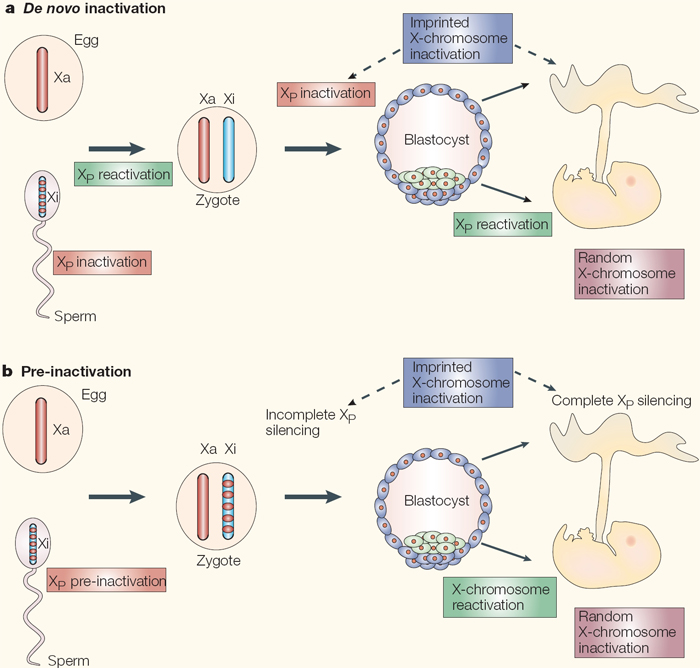
During embryonic development, one copy of a woman's X chromosome is inactivated randomly. This leaves one active X chromosome with over 1,000 genes to work its magic in development. X chromosome inactivation occurs in many female mammals, including cats. This inactivation of the other X chromosome occurs in domains, long pieces of DNA that cluster together like knots. These domains are co-regulated. Scientists have noted that it is very likely that many diseases are linked to incorrect inactivation among domains. Typically, these domains are inactivated from the center of the chromosome to the ends. Recently, Hendrik Marks expressed his hopes to uncover why one X chromosome is selected over the other for inactivation. He states that this discovery could help scientists prevent X-linked diseases, such as fragile X syndrome or Rett syndrome. Marks and other molecular biologists are working on figuring out if certain parts of the inactive X chromosome can be reactivated in order to help treat various diseases.

A two-panel diagram shows two models of X-chromosome inactivation: the de novo activation model and the pre-inactivation model. In the de novo inactivation model, the paternal X chromosome is inactivated and reactivated multiple times before fertilization and in the early stages of development until final random X-chromosome inactivation occurs in the embryo. In the pre-inactivation model, the paternal X chromosome is pre-inactivated before fertilization and undergoes complete silencing in the extraembryonic cells and random X-chromosome inactivation in the embryonic cells.
The research being done by many scientists, including Marks, can prove to be very important to the health of many women around the world. If one day scientists are able to silence specific, disease causing genes on the X chromosome, the chances of having an X-linked disease will be decreased dramatically. I believe that the research being done by Marks and his partners is a remarkable stepping stone into understanding how to prevent X-linked diseases.

To read the original article, click here.
A similar article that better explains the process by which the X chromosome is inactivated can be found here.

Friday, December 5, 2014

Financial Behavior Linked to Genes?


ABOVE: MAOA gene located on "p" or short arm of the x chromosome

Research on genetic survey data done at the University of California and London School of Economics connected a gene to credit-debt. Having this MAOA gene at a "low" version meant that a person was more likely to have credit-card debt than a person with "high" version. People with the "low" version of MAOA had a 7.8% more chance of coming across credit card debt. Monoamine-oxidase-A or MAOA is an enzyme that breaks down neurotransmitters including dopomine and serotonin (signal chemicals). The low reaction/stimulus time that this gene has on the individual has a higher chance to cause them to lose the impulse needed to pay bills on time.

However, this was not the first time the gene was studied before. The "low" version gene also indicates a higher chance of "lack of conscientiousness, impulsivity, and addictive behavior". About half the USA population has one or two alleles of the "low" version of this gene.

The research in this article that links a gene to credit card debt was at first a huge surprise to me because I thought such a imaginary concept such as credit and fiat money could never be connected to something so real as our human genome. Could this mean some financial institutions will find a loophole to sneak this information to judge their potential clients? As the law is now, they can not, and for good reason, but I can see the possible future of gene manipulation in children. I see that when parents can manipulate their offspring's genome, they can eliminate the MAOA gene from effecting their child's financial status and impulse/reaction time.
Original: http://www.scientificamerican.com/article/born-into-debt/
Supporting: http://neurocritic.blogspot.com/2009/11/genomarketing.html

Tuesday, November 25, 2014

Homosexuality and Genes


There are many suspected influences of homosexuality in humans. Some believe that sexual orientation is socially influenced and some believe that it is a choice to be homosexual. In a new study it is suggested that it is influenced by genetic information. This study was led by Alan Sanders and it is the largest of its kind.

Over 400 pairs of gay brothers, some twins, participated in a genetic analysis that focused on two region of the human genome. Samples of blood and saliva were collected from each of the participants. The only trait that all 818 men shared was being gay. Two genes were identified in influencing sexual orientation in men. One of the genes is located on the X chromosome, which is one of the chromosomes responsible for determining a person’s sex. The other gene that was found to correspond to sexual orientation in men was found on chromosome 8.

The goals of this study were to contradict the notion that homosexuality is a choice and to “refute” the belief that gay people can be treated to be straight. It was stressed that sexual orientation is determined by numerous different factors from the environment to genes. There is not one reason for homosexuality.


Article: http://economictimes.indiatimes.com/magazines/panache/sexual-orientation-not-a-choice-influenced-by-genetics-study/articleshow/45231147.cms

Related article: http://healthland.time.com/2012/12/13/new-insight-into-the-epigenetic-roots-of-homosexuality/

Monday, November 24, 2014

Genetic Influence on Sexual Orientation

Genetic Linkage study reveals possible genes relating to sexual orientation in men.  More specifically the study claims to have isolated the x chromosome and chromosome 8 as the most possible locations for genes regarding predisposition to homosexuality.  The study, published in Psychological Medicine, analyzed the genome of  908 individuals from 384 different families.  The only commonality between all of the subjects was there sexual orientation.  Genetic-linkage studies are somewhat outdated at this point in time.  Further research combining this studies data and a GWA, genome-wide association, study will hopefully further isolate the individual genes influencing sexual orientation in males.  
These studies are deeply rooted in controversy.  For some, the possibility that there may actually be specific genes that can influence an individuals sexual orientation lends truth to the argument that sexuality, be it homosexuality or heterosexuality or even asexuality, is not a choice.  In truth, human sexuality is a complex combination of social, political, cultural, and biological factors.  

Article: http://economictimes.indiatimes.com/magazines/panache/sexual-orientation-not-a-choice-influenced-by-genetics-study/articleshow/45231147.cms
Related Article:  http://www.medicaldaily.com/red-herring-gay-gene-and-how-sexuality-more-just-genetics-311120
Related Article:  http://news.sciencemag.org/biology/2014/11/study-gay-brothers-may-confirm-x-chromosome-link-homosexuality 

Thursday, November 20, 2014

Study suggests genetic link for male homosexuality

Gay Genetics_Hord.jpg

A study of gay brothers was conducted and supports the idea that genetic makeup may influence a males sexuality. After studying nearly 800 men, scientists feel that the genes are found on the X chromosome.This study found their data using DNA samples from saliva and blood.  The X chromosome is one of the sex chromosomes that determines our gender. Females have two X chromosomes while males have one X and one Y. There was small amounts of evidence that suggested genes on other chromosomes playing a factor but it has not been determined exactly which ones although some say it is chromosome 8. Some scientist not involved in this research project do not believe this data to be true such as Dr. Robert Green, a medical geneticist at Harvard Medical School who says the study is “intriguing but not in any way conclusive" others believe it is a step in the right direction to determining the causes of homosexuality. 

Thursday, May 1, 2014

The Y chromosome isn't going extinct after all!


            Previous research has suggested the Y sex chromosome, which only men carry, is decaying genetically so fast that it will be extinct in five million years. David Page, the director of MIT's Whitehead Institute, has spent the last decade trying to prove this wrong. He compares the Y chromosome of the Rhesus macaque, a monkey that diverged from our evolutionary ancestors about 25 million years ago.  When Page did this research he found that the Rhesus Y chromosome has not changed for 25 million years. On the other hand our chromosome has lost 3% of a small segment of the Y chromosome. A genetic professor Brian Sykes predicts the demise of the Y chromosome, in as little as 100,000 years in his 2003 book Adam's Curse: A Future without Men. But luckily men aren't going to be gone for a long time.


I really liked this paper just from the title alone. It drew me in and I had to read it. It was interesting to know that Page compared our chromosome to Rhesus monkeys and found similarities. Another cool fact was that the Y chromosome has 78 genes while the X chromosome has 800 genes attached to it. That fact blew my mind and hopefully yours as well.

Tuesday, April 29, 2014

The First Sex-Determining Genes


In a recent study, scientists at the Swiss Institute of Bioinformatics examined when X and Y chromosomes began to differentiate. These “sex genes”, the Y chromosome in particular, are ultimately responsible for all the morphological and physiological differences between males and females. The team examined male tissues from the testicles from different species of the three major mammalian lineages. They looked at humans, apes, rodents and elephants, which made up the placental lineage, opossums and kangaroos which are from the marsupial lineage, and egg-laying mammals known as the monotreme lineage. Rather than sequencing all of the Y chromosomes, the research team decided to compare the genetic sequences from male and female tissues and eliminated all common sequences between both sexes in order to keep only the sequences that corresponded to the Y chromosome. By taking this route the team created the largest gene atlas of the Y chromosome to date. The study established that the first “sex genes” appeared together in mammals around 180 million years ago. The sex-determining gene named SRY in placentals and marsupials had formed in the common ancestor also around 180 million years ago. The AMHY gene, accountable for the emergence of Y chromosomes in monotremes, appeared some 175 million years ago. Both of these genes emerged at nearly the same time but totally independent of one another. Although they found when these genes emerged it is still unclear what the nature of the sex-determination system in the common ancestors of all mammals was.


This study can stand as a basis for further research on what determines the development of the Y chromosome. It can fuel future research on what influences contributed to why an individual is born male or female. It can help reveal if these factors were even related to the sex chromosome or if they were environmental such as temperature. By laying the ground work and putting in over 29,500 computing hours and creating the largest gene atlas of the Y chromosome, this research may help answer these questions and many others relating to the sex genes.


Sunday, March 30, 2014

Females Protected From Autism, Study Shows

A study, discussed in Science Daily, shows that females are much more resilient to autism than men. The research shows that the mutation for autism and developmental delay in females is much larger in their genomes, suggesting that females are protected neural development disorder more so then males. Inherited mutations are much more likely to be passed from an unaffected mother than from a father. Together, this suggest females require more mutational load, or more mutational hits that are sever to push them over the edge.
When beginning this research a portion of the genome, called copy number variants (CNV), was examined in a group of boys and girls with autism. The CNV section of the genome had either large duplications or deletions of the region and was much larger in the girls than boys. When the CNV section become too large it endangers important genes for neural development that are near by and girls were three times more likely then boys to carry CNV that encompass these genes. Females with autism also carry a slightly more rare mutation that change a single DNA nucleotide which is much more dangerous because it impacts the function of the protein.


It is unclear if this research is gender bias, or simply a reflects a different diagnosis. Females tend to compensate for their symptoms in different ways and actions than males. The question left with the researchers is what part of brain development makes it that females are more protected than males. The only explanation so far is that males only have one X chromosome that is hypersensitive to mutations and several autism mutations are located on the X chromosome.
For more information on autism, visit Autism Speaks.

Friday, March 14, 2014

Critical Role of One Gene to Our Brain Development

Researchers at the University of Adelaide have confirmed that a gene linked to intellectual disability is critical to the earliest stages of the development of human brains. The gene is known as USP9X, has been investigated by Adelaide researchers for decades but only recently have they discovered the importance of the gene. Located on the X-chromosome, USP9X controls both the initial generation of the nerve cells from stem cells, and also their ability to connect with one another and form the proper networks. In a new paper published by the University of Adelaide's Robinson Research Institute in the American Journal of Human Genetics, explains how a mutations in the USP9X gene are associated with mental disabilities and that these mutations can be inherited from one generation to the next. This is the same gene that has also been found to stop the spread of pancreatic cancer just by reactivating it. 

This is a great step toward learning how the brain works. If we can continue to discover how the brain develops and what genes cause certain disorders, we can be able to cure many of these disorders that cause people to suffer everyday. Also, we are now seeing that USP9X is a very important gene for our development so if we continue to research this gene, who knows what else we can discover. 

Monday, March 4, 2013

Genes Linked to Homosexuality


This New York Times article written by Natalie Angier tells the story of newly found evidence that supports the theory that homosexuality is a gentetic mutation. Researches have pinpointed a region that lays on the X chromosone that is identical in brothers that are homosexual. This was done by collecting their DNA of 44 gay brothers and looking at the tip of their X chromosome. 33 of the brothers had identicical tips. Using linkage mapping researchers were able to look at the X chromosome closly using DNA markers to distinguish between the two brothers. Approximatly 3/4 of the brothers had inherited the identical DNA markers on their Xq28 region of the chromosome. Researchers do admit that they still have a lot of research to do and say homosexuality is too complex to be linked to only one gene. Genetisits hopwe to continue with their research to try and find more answers of homosexuality linked to our genes.


http://www.nytimes.com/1993/07/16/us/report-suggests-homosexuality-is-linked-to-genes.html?pagewanted=all&src=pm

This article also explains the significance the X chromosome in homosexuality

http://www.nytimes.com/1993/07/18/weekinreview/july-11-17-x-marks-the-spot-male-homosexuality-may-be-linked-to-a-gene.html?src=pm


Monday, November 19, 2012

Women More Likely To Get Rheumatoid Arthritis

According to an article on ScienceDaily, scientists at the Arthritis Research UK Epidemiology Unit at the University of Manchester have found the reason that women are three times as likely as men to develop rheumatoid arthritis. Rheumatoid arthritis is a disease in which the immune systems attacks the body's own tissues resulting in fluid build up within joints. The fluid build up causes inflammation and pain, and it can occur anywhere in the body. The disease is also a chronic disease, so it cannot be cured (source: arthritis.org).

The scientists used advanced technology and a large collection of samples to identify 14 new genes that can lead to RA in addition to the 32 other genes that have already been identified. Furthermore, the researchers have identified genes that are specific to the X chromosome, giving women a much greater chance of contracting the disease. This is in addition to the other non-genetic factors that play into getting the condition, such as pregnancy, smoking, and diet.

According to Professor Alan Silman, the medical director of Arthritis Research UK, this discovery is the first time that there has been a genetic association between RA and the X chromosome. So, why is this information so valuable? This finding has a great impact on treatments of arthritis. Dr. Stephen Eyre states that they have already found three genes that are targets for drugs. The other 43 genes have a potential for drug development. This would help the third of patients who do not respond well to current treatments.

This finding is a crucial step towards finding genes that cause other diseases and learning how to treat them as well. I believe that over time a cure for RA may be created, helping the 1% of the world's population that suffers from this disease. This could help extend research for all other areas of degenerative diseases and further advance the medical technologies we have today.

Saturday, April 14, 2012

Treatment for Blood Disease is Gene Therapy Landmark

Gene therapy hasn’t been always successful, however medical researches in Britain have had a successful gene therapy for the blood clotting disease called hemophilia B. It was done by injecting six patients that have disease with the correct form of defective gene. Hemophilia B has been around since Queen Victoria. Hemophilia B has a clotting agent known as Factor IX gene. If this gene goes bad and untreated then it can result in death. The disease occurs mostly in men since it lies on the X chromosome of which men have only one copy of and if women have it they can compensate with the other X chromosome. The trial had six patients where the doctors injected a virus into their veins. “The virus homes in on the cells of the liver, and the gene it carries then churns out correct copies of Factor IX.” (Nicholas Wade).  This would keep producing Factor IX, which would stop the blood clotting since it’s the good gene. This success had many faults and improvements over the years, but finally it worked. However, from the six patients two of them kept needing the treatment but they weren’t injected with the same virus again since the immune system was  able to attack it. I found this ironic since a virus actually helps prevent the disease from happening by giving out correct copies of the Factor IX....its actually pretty amazing how things work

Monday, March 26, 2012

Extra Female Genes Cause More Masculine

[caption id="attachment_4133" align="aligncenter" width="336" caption="Extra X chromosome leads to manlier men."][/caption]

According to newscientist and io9, an extra set of female genes appears to make males more masculine.  The discovery suggests that sex chromosomes play a role in directing behaviour that extends beyond the effects of hormones.  To find out if sex chromosomes play a role in sex-specific behaviours beyond dictating which hormones are present, Scientists took advantage of a mutation in mice that causes the sex-determining region of the male Y chromosome to jump to a non-sex chromosome.  The mice used were XX male and XXY male nice.  While these mice had the same level of testosterone as normal XY mice, they displayed more masculine sexual behaviours.  The finding tallies with research that suggests a female's second "inactivated" X chromosome may actually express a quarter of its genes. These could alter the expression of genes on other chromosomes, and might be partly responsible for behavioural differences between the sexes.  If a region of the X chromosome that is linked to sexual activity can be identified, its protein products could be a target for libido-boosting therapies.

In society, men are seen as being more sexually driven.  This may lead one to think that a man with an extra X chromosome would be more women like or less sexually driven.  I think this concept does seem a little ironic.  The extra X chromosome does the exact opposite of what many  would think.  It makes men more masculine.  This shows that the body works in complex ways.

Sunday, February 26, 2012

Humans are part Neanderthal

Scientists at the University of Montreal have discovered that humans have a small part of the X chromosome that was once carried by Neanderthals. Their findings are published in the journal Molecular Biology and Evolution. Leading scientist, Damian Labuda, says that interbreeding between Neanderthals and modern humans occurred between 30,000 - 50,000 years ago. Labuda found evidence of this idea about ten years ago, but wasn't completely sure until the Neanderthal genome was released in 2010. When comparing the modern human X chromosome to the Neanderthal X chromosome Labuda found that they shared DNA in all populations except sub-Saharan African. The related gene between modern humans and Neanderthals only codes for a protein, but this could be the first step in finding more similar DNA. The most important idea to come from this research is that this is proof that not only did Homo sapiens interact with Neanderthals, but they most certainly interbred.