When expecting a baby, the most frequent question that pops into the expecting-parents minds is: Is it a girl, or a boy?
At a certain stage in the trimester, doctors can usually give a confident answer to that question. However, 1 in 1,000 babies are born with some gender ambiguity. Many doctors are unable to determine the sex of the child when it looks like the baby has a penis but there is little or no scrotum. This confuses doctors because they are unsure if thy are seeing a boy with undescended tests, or a girl with an enlarged clitoris. Some newborns are even born with external genitals of a boy but have the female ovaries inside.
Excitingly however, researchers are getting closer to determining the gene that can disrupt the normal development of male genitals. Knowing this information helped discover that the action of that gene is responsible for reversing the sex of the fetus, from male testes and a penis, to a vagina and ovaries.
This gene, the maleness gene, is called the SRY gene. It's found on the X chromosome, and it is powerful enough to override the Y chromosome, and take its place. However, when studied in patients there were many contradictions to what they thought they knew. May scientists are now realizing that sex determination is a lot more complicated than they thought.
Showing posts with label male sex gene. Show all posts
Saturday, September 24, 2016
Wednesday, March 11, 2015
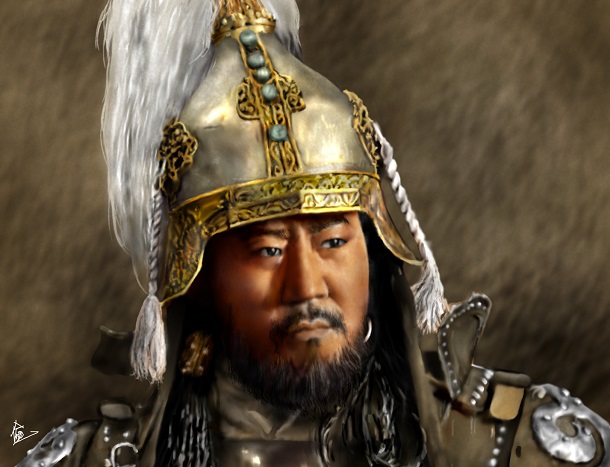
Are you a Descendant of Genghis Khan?
Known as the creator of the Mongol Empire, the genes
of Genghis khan and his tribesman's are prevalent in Asian men today. The Y chromosome,
which is the sex-determining chromosome for males, can only be passed down from
father to son. In typical cases, the markings on these chromosomes do not last
for more than a couple of generations. However, researchers have found recent
markings on the Y chromosome that date back to the time of the Mongolian war leader.
In a study of 5,321 men from areas such as the Middle East and Korea, more than
11 common markers were found and 37.8% of all the men who were studied had
genetic traits that linked back to the eleven dynasty leaders.
How
is this possible? Khans major conquests were not only territorial but also in
the field of woman. Traveling often and on horseback, Khan had relationships with
woman around the empire. This resulted in the passing on his DNA to the
children that came out of these affairs. It is believed that one of Khans sons,
had forty of sons of his own, and then his grandson also had twenty-two more
sons. Because the Khan men were not monogamous, they were able to produce a
large amount of offspring in a short amount of time.
Having
learned about Khan in history classes, I knew that Khan had many offsprings. However, it was amazing to hear that e his genes are still prevalent in society
today. This brings up the question as to whether men who carry the same
Y-chromosome markings as Khan share any genetic pre-dispositions.
Article: http://www.washingtonpost.com/news/speaking-of-science/wp/2015/03/10/millions-of-modern-asian-men-can-trace-their-lineage-to-11-powerful-leaders-including-genghis-khan/
Secondary Article: http://www.biography.com/people/genghis-khan-9308634#genghis-khans-death
Tuesday, April 29, 2014
The First Sex-Determining Genes
In a recent study, scientists at
the Swiss Institute of Bioinformatics examined when X and Y chromosomes
began to differentiate. These “sex genes”, the Y chromosome in particular, are ultimately responsible for all the morphological and physiological differences
between males and females. The team examined male tissues from the testicles from
different species of the three major mammalian lineages. They looked at
humans, apes, rodents and elephants, which made up the placental lineage,
opossums and kangaroos which are from the marsupial lineage, and egg-laying
mammals known as the monotreme lineage. Rather than sequencing all of the Y
chromosomes, the research team decided to compare the genetic sequences from
male and female tissues and eliminated all common sequences between both sexes
in order to keep only the sequences that corresponded to the Y chromosome. By
taking this route the team created the largest gene atlas of the Y chromosome
to date. The study established that the first “sex genes” appeared together
in mammals around 180 million years ago. The sex-determining gene named SRY in
placentals and marsupials had formed in the common ancestor also around 180
million years ago. The AMHY gene, accountable for the emergence of Y chromosomes
in monotremes, appeared some 175 million years ago. Both of these genes emerged
at nearly the same time but totally independent of one another. Although they
found when these genes emerged it is still unclear what the nature of the
sex-determination system in the common ancestors of all mammals was.
Related Link: http://www.biology-online.org/2/6_sex_chromosomes.htm
Labels:
male sex gene,
sex determination,
SRY gene,
x chromosome,
Y Chromosome
Saturday, December 1, 2012
Deletion of One Gene Causes Sex Reversal
Researchers from the Institute of Molecular Biology (IMB) in Mainz have discovered a gene that initiates the development of male sex organs. The researchers' finding uncovers a signaling device, which acts early in development to determine the gonads in males. This discovery sheds light on the genetic network that controls how embryos develop as males or females.
When testing on mice the researhers found that the deletion of one gene, Gadd45g, made the male's external genitalia match that of females. Then when they looked at the internal reproductive organs the male's also looked identical to the females. So the deletion of this one gene, Gadd45g, caused a complete sex reversal in the male mice. Christof Niehrs, Director Professor at IMB, said, "when breeding Gadd45g mutant mice we were puzzled why we got only females, until we discovered that some of these females actually carry a Y-chromosome." The scientist furthered showed that the Gadd45g gene controls the Sry gene by signaling it to work or not. The Sry gene is the know master regualtor of male sex expression. They think the Gadd45g gene regulates Sry by binding to p38, a key signaling protien, and activating the transcription factor Gata4. Once active, this factor binds to the Sry gene and ultimately turns it on. "This study both identifies a new role for Gadd45g and suggests a novel signaling pathway that could have important implications for research into disorders of sexual development."-Medical News Today.
I think this article is interesting because it shows how perfect DNA copying has to be, becuase the deletion of just one gene could have a huge effect. It makes me wonder if the scientist's discovery could be applied to human sex determination though. I do think it's cool that their discovery also shows how narrow the timeframe is in an embryo for sex organs to develop correctly.
When testing on mice the researhers found that the deletion of one gene, Gadd45g, made the male's external genitalia match that of females. Then when they looked at the internal reproductive organs the male's also looked identical to the females. So the deletion of this one gene, Gadd45g, caused a complete sex reversal in the male mice. Christof Niehrs, Director Professor at IMB, said, "when breeding Gadd45g mutant mice we were puzzled why we got only females, until we discovered that some of these females actually carry a Y-chromosome." The scientist furthered showed that the Gadd45g gene controls the Sry gene by signaling it to work or not. The Sry gene is the know master regualtor of male sex expression. They think the Gadd45g gene regulates Sry by binding to p38, a key signaling protien, and activating the transcription factor Gata4. Once active, this factor binds to the Sry gene and ultimately turns it on. "This study both identifies a new role for Gadd45g and suggests a novel signaling pathway that could have important implications for research into disorders of sexual development."-Medical News Today.
I think this article is interesting because it shows how perfect DNA copying has to be, becuase the deletion of just one gene could have a huge effect. It makes me wonder if the scientist's discovery could be applied to human sex determination though. I do think it's cool that their discovery also shows how narrow the timeframe is in an embryo for sex organs to develop correctly.
Subscribe to:
Posts (Atom)