Showing posts with label Color Blindness. Show all posts

Thursday, October 23, 2025

Genetics of Color-Blindness


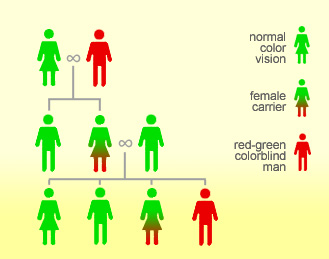
Color vision deficiency is primarily a genetic condition caused by mutations in the OPN1LW, OPN1MW, and OPN1SW genes, which are responsible for producing the light-sensitive opsin pigments in the retina's cone cells. Each gene corresponds to a specific type of cone: L cones for red, M cones for green, and S cones for blue. The most common forms, red-green color blindness, are linked to the X chromosome. Mutations in the OPN1LW or OPN1MW genes on the X chromosome disrupt red or green perception, which explains why these conditions are much more common in males, who have only one X chromosome. Blue-yellow color defects, which are rarer and affect both sexes equally, result from autosomal dominant mutations in the OPN1SW gene. The most severe form, blue cone monochromacy, occurs when mutations prevent both the L and M cones from functioning, leaving only S cones active and causing very poor visual acuity and color vision.

The genetic explanation for color vision deficiency is a fascinating example of how our biology directly shapes our perception of reality. It's particularly interesting how the inheritance patterns are a direct consequence of the genes' locations. The X-linked recessive pattern for red-green deficiency perfectly explains its strong male bias, making it an excellent case study in genetics. It's also striking to me how the severity of the condition depends on which combination of genes is affected; losing just one type of cone (L or M) leads to a common and "manageable" red-green deficiency, while losing both (as in blue cone monochromacy) reduces your color vision far more. This direct link between specific genetic errors and specific sensory outcomes makes color blindness a powerful illustration of molecular genetics in action.

References: 

1. MedlinePlus. “Color Vision Deficiency: MedlinePlus Genetics.” Medlineplus.gov, 1 Jan. 2015, medlineplus.gov/genetics/condition/color-vision-deficiency/.

2. Wong, Bang. “Color Blindness.” Nature Methods, vol. 8, no. 6, 2011, p. 441, https://doi.org/10.1038/nmeth.1618.


‌


Wednesday, April 19, 2017

The Camouflage Game

When looking at the picture above, to left the is how we would perceive the color of the image because we have three different cone cells in our eyes making us trichromatic. To the right is how dichromats would see it because they only have two types of color receptors, this includes a vast variety of animals. Researchers from the University of Exeter wanna know why so many animals are dichromatic and how color vision affects animals abilities to detect camouflaged prey. To conduct this research comparing our trichromatic vision to that of the dichromat the researchers had 30,000 individuals take part in a computer game where they were shown photographs and had to find camouflaged nightjar birds or nets containing eggs. The game produced photos that were either in their normal color or in a version that imitated the limited colors seen by dichromatic vision of predators. It is thought that there must be some sort of evolutionary advantage to seeing in just two primary colors as opposed to the way we see because so many animals have the red-green color blindness along with the fact that colors are thought to interfere with animals ability to detect camouflaged prey. When the data was collected from the game the researchers were surprised to find that trichromasts found the nightjars and eggs faster than the stimulated dichromats. However, they then found that there was a huge difference in how the dichromats improved over the course of the game and how much their capture times were affected by different camouflage types. This is something that I have always wondered about because I find it bewildering how effective not only the camouflage is but how well predators can seek out those prey who are so well disguised when we would have a hard time spotting them.

Article:https://www.sciencedaily.com/releases/2017/04/170413084644.htm
For more information on trichromacy: http://anthro.palomar.edu/primate/color.htm

Tuesday, December 1, 2015

Gene Linked to Blindness is Found

After searching for more than a decade, scientists have isolated a gene for a disease that usually blinds the men who have a defective form of the gene by age 30.  The condition is a particularly severe form of retinitis pigmentosa, which affects some 100,000 Americans. The defective gene causes one of the most common forms of retinitis pigmentosa, accounting for about 10 percent to 20 percent of all cases. 
The discovered gene, RP3 might be able to help researchers create treatments. RP3 is one of three genes known to be on the X chromosome that cause the severe form of retinitis pigmentosa, which hits hardest in men. Mutations in the newly found gene cause about 70 percent of these severe cases. The two other genes have yet to be isolated.
Boys with a defect in one of these genes have difficulty seeing at night and develop tunnel vision. No cure for the condition is known, and the men usually become blind before middle age. After scientists better understand the normal function of the gene, they might be able to devise treatments for the disease, Dr. Wright said. Scientists should be able to devise a test to detect RP3 mutations, he added.
This kind of research is extremely important because researchers will now be able to find more ways to help those who suffer from colorblindness. 

Sunday, October 11, 2015

Cure for a Rare Form of Color Blindness Steps Closer with Gene Insight

[A close-up of a human eye]

Researchers have uncovered insights into two genetic mutations that may be a cause of a rare form of color blindness called achromatopsia, and is paving the way for a cure. Achromatopsia is a rare, inherited disorder that affects 1 in 33000 people in the US. This condition is triggered by abnormalities in the retina - a layer of tissue at the back of the eye containing cells that are sensitive to light. People with this disorder will experience partial or total loss of color vision, as well as sensitivity to light, As of right now, there is no cure for achromatopsia, but the use of red - colored lenses reduces the sensitivity to light and also boosts visual functioning. 

Karina Guziewicz, of the School of Veterinary Medicine at the University of Pennsylvania, and colleagues began their study by analyzing the vision of a German Shepherd dog whose owners were concerned about its vision. The team analyzed five genetic mutations that were known to play a part in how light signals are sent from the eye to the brain, a process called phototransduction. As a result, the team identified a mutation in a gene called CNGA3 that was responsible for the dog's vision loss. The team analyzed dogs that had similar symptoms to the German Shepherd, and found a different mutation on the same area of the CNGA3 gene. The team notes that the mutation found in the German Shepherd has been found in humans, so dogs can be a valuable model to study achromatopsia. 

I thought this article was very interesting, I would never have thought to study dogs for this disease. I hope this team, or the many other scientists out there, finds a cure for this disease  as it is harmful. A person with this disease will be sensitive to light, and a absence of color vision. I hope a cure is made in the future to combat this disease.

Link for the article here 

Wednesday, October 7, 2015

Researchers Are Getting Closer to the Cure of A Rare Form of Color Blindness

     A new study from PLOS ONE provides an exciting breakthrough in two genetic mutations that could be the cause of achromatopsia, a rare form of color blindness. This breakthrough could possibly lead to the cure. If affected by this rare disorder, one would become partially or completely color blind and also experience light sensitivity, a result from abnormalities in the retina. The closest thing we have to a cure are red-colored lenses that are able to reduce light sensitivity and aide visual functioning.
[A close-up of a human eye]The study, most recently done at Temple University and the University of Pennsylvania, uses animal models. This study in particular was in a German shepherd dog that showed the human chromatopsia mutation in it’s CNGA3 gene. Gustavo Aguirre, a professor and coauthor of the study stated, “The song displayed a classical loss of cone vision; it could not see well in daylight but had no problem in dim light conditions,” after studies to identify which genetic mutations caused this vision loss, the researchers could not find the one that caused the poor pup’s loss of vision. 
The team pressed on and studied five genetic mutations that are known variables in phototransduction. They were able to identify a gene mutation in CNGA3 that was responsbile for the dog’s vision loss. Labrador retrievers were also studied and had similar symptoms to the German Shepherd, this is the first of these mutations being identified in dogs, but not in humans, which makes them great models to study human achromatopsia.
The team then identified small changes in protein sequences from a supercomputer where they learned that the two mutations in the CNGA3 affected the cyclic nucleotide channel function. 
Researchers say this provides new information and steps leading to a possible gene therapy to cure this condition in both dogs and humans!! 
I think it's really cool we are able to study a condition in dogs that also affects humans, you don't see that everyday!


For more on this article click here!      
Related article

Friday, March 27, 2015

Hope For Those Suffering From Colorblindness

 Dalton, who was treated for red-green color blindness, enjoys a feast
    Colorblindness, although it may appear like a small inconvenience to the majority of people who do not suffer from the disorder, it is severely life altering. Many career paths require proper color vision, for example fire fighters, electricians, and pilots. Even daily activities, like driving in the dark are extremely dangerous for individuals from colorblindness. This disorder controls the lives of over 10 million Americans. Due to the fact it is a X-linked gene, it predominates in males. It only affects 0.5% of females, however 8% of males. This trait causes confusion between blue and yellow or red and green. 
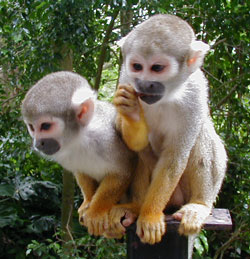
    One couple, Jay and Maureen Neitz have been excelling in their efforts to cure people of color blindness. Using gene therapy directed at the retina, new genes are administered that respond to color. These scientist together have practiced their techniques and surgically cured a squirrel monkey of colorblindness. Unfortunately, this method they established six years ago is too risky for human patients. Consequently, a nonsurgical treatment is demanded and researched by a team at the University of California. Their method of delivering new genes to the retina is through injections into the vitreous humor. This is a clear gel filling most of the eyeball, inevitably establishing it’s structure. Researchers claim this treatment method will reach human patients within a couple years.
    Gene therapy treatment research is skyrocketing. I cannot conceptualize the quantity of cures for genetic disorder scientist will safety establish in the coming years. In particular, colorblindness is an important genetic disorder to cure, because it affects the life's of even those without the disorder. Imagine a time you ran a red light because you saw a green arrow, now imagine how many people confuse these red and green lights due to their genetic predisposition. Many life's will benefit from this up and coming treatment.
Am I colorblind? Help me figure out my vision problem
Unaffected individuals see the number seventy four, while this of red-green deficiencies identify the number as twenty-one. Absence of a number foretells full color blindness  
For the original news article or additional tests  click here.

Monday, October 14, 2013

Colorblindness in Monkeys Cured

Researchers from Washington and Florida University used gene therapy to cure two squirrel monkeys of colorblindness. Colorblindness is very common in human beings, it affects about 3.5 million people in the US, 13 million people in India, and 16 Million people in China. Though colorblindness affects a large amount of people it is mostly found in men which causes them to be unable to distinguish red and green hues. Gene therapy is mostly used for disorders involving cone cells in adults which are vital for vision. With this information scientist decided to add red sensitivity to cone cells that were unable to or had difficulty picking up red colors. Once the red sensitivity was added to the monkeys cone cells the monkeys were than given similar colorblindness test that are given to humans, the color dotted circles with varying color and shaped dots inside. It took 5 weeks for the scientists start seeing improvement in the monkey color recognition, but when the monkeys began choosing the correct colors they were rewarded for their correct choice. With in one year the monkey were able to distinguish 16 different hues.


The biggest concern for researchers was how safely this procedure could be done in humans. Researchers from Florida University developed a gene transfer technique that used a non-harmful virus to assist in the transport of corrective genes to the desired protein location, they also wanted to use cone pigments that produce red and green in the retina. Researcher are also hoping that this gene therapy will be able to cure common types of blindness.

I choose to write about this article because I though it was interesting that researchers would fix colorblindness in monkeys and then use that information to help fix colorblindness in humans. I also read the article to find out if anyone who is colorblind said they would get the procedure done to fix their colorblindness.

http://phys.org/news172325926.html