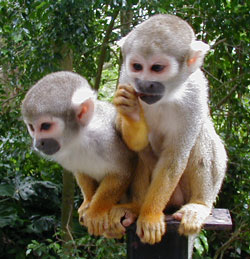
Researchers from Washington and Florida University used gene therapy to cure two squirrel monkeys of colorblindness.
Colorblindness is very common in human beings, it affects about 3.5 million people in the US, 13 million people in India, and 16 Million people in China. Though colorblindness affects a large amount of people it is mostly found in men which causes them to be unable to distinguish red and green hues. Gene therapy is mostly used for disorders involving cone cells in adults which are vital for vision. With this information scientist decided to add red sensitivity to cone cells that were unable to or had difficulty picking up red colors. Once the red sensitivity was added to the monkeys cone cells the monkeys were than given similar colorblindness test that are given to humans, the color dotted circles with varying color and shaped dots inside. It took 5 weeks for the scientists start seeing improvement in the monkey color recognition, but when the monkeys began choosing the correct colors they were rewarded for their correct choice. With in one year the monkey were able to distinguish 16 different hues.

The biggest concern for researchers was how safely this procedure could be done in humans. Researchers from Florida University developed a gene transfer technique that used a non-harmful virus to assist in the transport of corrective genes to the desired protein location, they also wanted to use cone pigments that produce red and green in the retina. Researcher are also hoping that this gene therapy will be able to cure common types of blindness.
I choose to write about this article because I though it was interesting that researchers would fix colorblindness in monkeys and then use that information to help fix colorblindness in humans. I also read the article to find out if anyone who is colorblind said they would get the procedure done to fix their colorblindness.
http://phys.org/news172325926.html