Showing posts with label sex linked traits. Show all posts

Saturday, September 26, 2015

Why are calico cat predominantly female?

It is a well known fact that calico cats are mostly female; male calico cats do exist, but this can only happen if the cat has Klinefelter Syndrome, which will be explained later. The reason why only female calico cats is because of a concept called Sex-Linked Genes, a concept that certain traits are determined by the sex chromosomes of an organism.

This diagram shows the X and Y
chromosome relationship with fur
color. 
Fur color in cats is determined by the X chromosome, so in most cases, the genotype of the mother cat will determine what kind of fur color the offspring will have. Since male cats have one X chromosome and one Y chromosome, the male cat's color will be determined by the one X chromosome. For example, if the mother has a X chromosome that expresses orange fur, the son will have orange fur. If the mother has black fur, the son will have black fur.

This idea is more complex in daughter cats. If a daughter has two X chromosomes that express the same fur color, a process called Lyonization will occur. Lyonization is a process that occurs during the blastula stage of embryonic development, and arises randomly in each cell. In each cell, one of the X chromosomes is coiled into a Barr Body, leaving the remaining X chromosome of express the trait. For example, if a daughter has two X chromosomes that express black fur, then one of those chromosomes will become a Barr Body, and the other chromosome will express the black fur in the phenotype. Once again, this is only at the cellular level

Calico cats have two different kinds of X chromosomes- one that expresses black fur and one for orange fur. The cats will not express both of these traits in the same cell; instead, each cell will express only black fur or only orange fur. In Lyonization, both X chromosomes will be separated, and be accompanied by their own Barr Body. Afterwards, each cell will arise from either the X chromosome that expresses from orange fur, or from the X chromosome that expresses black fur. This results in various patches that occur throughout the body called a tortoiseshell coloration.

Male calico cats are the result of Kilnefelter Syndrome, which is when a cat has two X chromosomes and one Y chromosome. The two X chromosomes will be one that expresses orange fur and one that expresses black fur. The only problem with this process is that the male calico cats become unfertile.



Wednesday, September 16, 2015

X Chromosome Inactivation

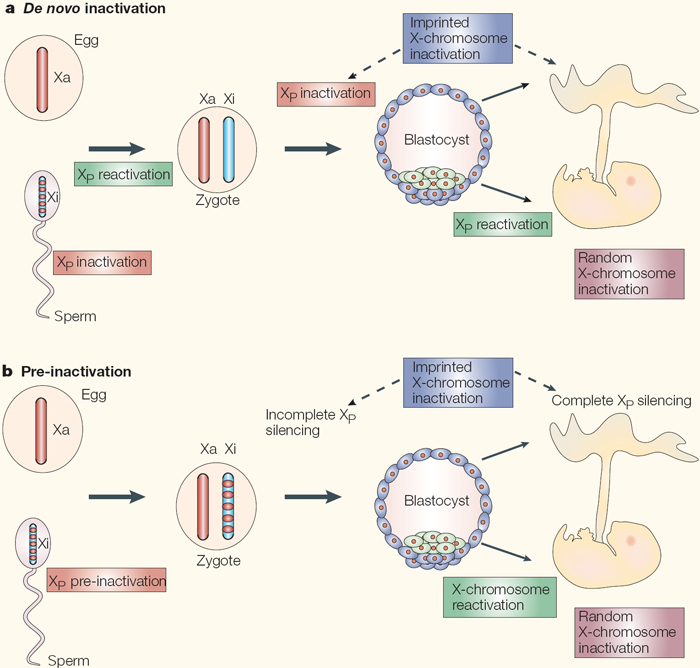
During embryonic development, one copy of a woman's X chromosome is inactivated randomly. This leaves one active X chromosome with over 1,000 genes to work its magic in development. X chromosome inactivation occurs in many female mammals, including cats. This inactivation of the other X chromosome occurs in domains, long pieces of DNA that cluster together like knots. These domains are co-regulated. Scientists have noted that it is very likely that many diseases are linked to incorrect inactivation among domains. Typically, these domains are inactivated from the center of the chromosome to the ends. Recently, Hendrik Marks expressed his hopes to uncover why one X chromosome is selected over the other for inactivation. He states that this discovery could help scientists prevent X-linked diseases, such as fragile X syndrome or Rett syndrome. Marks and other molecular biologists are working on figuring out if certain parts of the inactive X chromosome can be reactivated in order to help treat various diseases.

A two-panel diagram shows two models of X-chromosome inactivation: the de novo activation model and the pre-inactivation model. In the de novo inactivation model, the paternal X chromosome is inactivated and reactivated multiple times before fertilization and in the early stages of development until final random X-chromosome inactivation occurs in the embryo. In the pre-inactivation model, the paternal X chromosome is pre-inactivated before fertilization and undergoes complete silencing in the extraembryonic cells and random X-chromosome inactivation in the embryonic cells.
The research being done by many scientists, including Marks, can prove to be very important to the health of many women around the world. If one day scientists are able to silence specific, disease causing genes on the X chromosome, the chances of having an X-linked disease will be decreased dramatically. I believe that the research being done by Marks and his partners is a remarkable stepping stone into understanding how to prevent X-linked diseases.

To read the original article, click here.
A similar article that better explains the process by which the X chromosome is inactivated can be found here.

Friday, April 18, 2014

The Genetics of Fragile X Syndrome

This article discusses one of the most common forms of inherited mental disabilities in humans, Fragile X Syndrome. This syndrome is an X-linked trait, so generally males and females who inherit two genes for this trait are affected more than female carriers are. The severity of symptoms can vary in anyone who has this abnormality. The severity is dependent on how many codon repeats are found on the FMR1 gene on the X chromosome.
Fragile X Syndrome causes affected individuals to not make enough of a protein called fragile x mental retardation protein. This protein attaches to ribosomes between the 30s and 50s subunits to regulate protein synthesis. Before this research, done at UC San Diego, scientists only knew that a deficiency of this protein resulted in proteins that regulate brain functions being synthesized incorrectly. The fact the the protein binds between the 30s and 50s subunits of the ribosome is important, as new proteins are synthesized by passing mRNA through the two subunits. These proteins are imperative to normal cognitive function in humans-and fruit flies. Researchers used fruit flies in the laboratory to map where the protein binds to the ribosomes. This information will hopefully provide the tools necessary in the future to create new treatments for this affliction and help restore at least some cognitive function in those who have lost it.

Secondary article