Showing posts with label fragile X syndrome. Show all posts

Thursday, March 7, 2024

Fragile X Syndrome, What's New?

Recently as of January 18th, researchers have expanded their knowledge of the genetic mechanisms that underly Fragile X Syndrome. We know that Fragile X Syndrome (FXS) is "a genetic disorder caused by the gene FMR1". This genetic disorder is the most common form of an inherited intellectual disability and quite often goes hand in hand with some other conditions like autism and even epilepsy. Symptoms of FXS include developmental delays, behavior problems, social problems, as well as learning disabilities. 

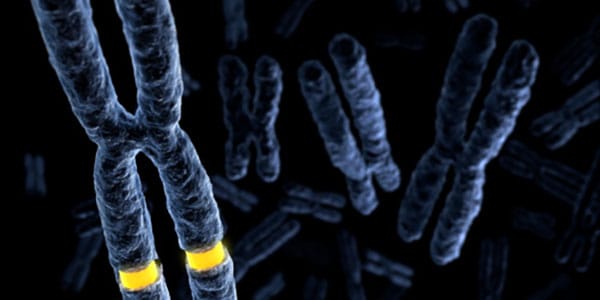
The gene FMR1 is located on the X chromosome and the first part of this gene is made of a specific sequence. When the repeats of this sequence start to expand uncontrollably, this is what causes Fragile X Syndrome. The typical sequence should have less than 40 repeats while the mutation can have over 200 repeats.

Researchers have unveiled major insights about the genetic mechanisms causing the FMR1 mutation. They found that along with the uncontrolled repeating of the special FMR1 sequence, many other genes have been silenced. These genes that have been silenced have massive roles in making sure the brain works properly and also in building tissues.

This is a massive discovery for this particular disorder as it was previously not known why there was uncontrolled replication of the FMR1 sequence. The discovery of this cause of FXS has increased the understanding that people have of this disorder and is a large step to possibly finding a way to prevent this issue from happening with children in the future.


Sources:

(News article) https://www.nimh.nih.gov/news/science-news/2024/researchers-expand-understanding-of-genetic-mechanisms-underlying-fragile-x-syndrome

(Scientific article) https://doi.org/10.1016/j.cell.2023.11.019

(Image) https://www.cdc.gov/ncbddd/fxs/sm/sm-fragile-x-gene-600x300.jpg?_=56819

(Additional source) https://www.cdc.gov/ncbddd/fxs/facts.html

Monday, November 25, 2019

New treatment trials for FXS

Fragile X Syndrome (FXS) is one of the leading causes of mental retardation and developmental disabilities and it tends to have a variable range of expression. This range is due to variations in the mutation of the FMR1 gene. The mutation that is responsible for this disorder is the number of CGC trinucleotide repeats in the 5' untranslated region of the FMR1 gene, and the number of these mutations is what can be used to determine whether an individual has a premutation or full mutation. Typically in normal unaffected individuals, the repeats could number anywhere from 5 to 50, in unaffected male carriers the repeats usually number from 50 to 200, and affected individuals (male and female) will have much longer stretches of these repeats. 

When it comes to risk, increased penetrance is seen when there are affected individuals in each successive generation of a family, a phenomenon that is commonly known as genetic anticipation. Another interesting thing about this disorder is that males tend to be more often and more severely affected than females because females will have two X chromosomes (one that is usually normal and one that is mutated) and X chromosome inactivation is often seen in females. If the mutated X chromosome tends to be turned off more than the normal, unaffected X chromosome, the female would not show any signs of the disease but she would be a carrier for it and could pass it to her children. Mosaicism is also seen from cell to cell in the body, which will often result in a mix of premutation and full mutations being expressed, and depending on the ratio, the disorder could end up being more severe. There are a lot of different factors that play in the severity of the disorder and not all of the factors are known in full, so currently it isn't possible to say with certainty how the disorder will manifest based on genetics alone. 

One of the most recent trials for treatment of this disorder is being run by Zynerba, a Pennsylvania based pharma company, and it uses a transdermal ointment of CBD. In the study all of the patients receive the treatment, there is no placebo. Over a 12-week period, the CBD ointment was applied on the shoulder of FXS patients and then the patients were asked to complete a questionnaire. Eye tracking and biomarkers were also analyzed to help determine the patients' anxiety levels and whether or not their symptoms improved following treatment. There are no conclusive results for the study as of yet because the trials are still ongoing, but all of the studies are focusing on young individuals whose brains have not fully developed yet. 

I think looking into CBD ointments is an interesting approach to treatment, but most patients don't only have anxiety. Although CBD may help with anxiety and other mild symptoms, I doubt that the CBD would work as a blanket treatment. In my option, there needs to be more studies across multiple different age ranges for the CBD ointment. CRISPR-Cas9 may also be something that could be used in studies to see if the mutated X chromosome could be altered in some way. This would be very difficult though because there would need to be a model organism besides humans that could express FXS in the same manner. Regardless, multiple treatments should undergo more trials to hopefully help people with severe FXS symptoms lead a normal life. 

Links: 

The Nature and Consequences of Fragile X Syndrome: 

Recent Trials for Fragile X Syndrome Offer Hope: 

Wednesday, April 20, 2016

Gene Editing Tool CRISPR-Cas9


Research has come along far in finding a cure for some diseases. According to Rachel Dicker writes in her article in US News that researchers have been isolating messenger RNA to edit the cell’s nucleus to make new proteins by using gene editing tool ‘clustered regularly interspaced short palindromic repeats’ also known as CRISPR-Cas9. In a study, this tool was used to remove HIV from immune cells and stop the replication of HIV permanently. This gene editing tool can be used to correct defective RNA which means many diseases such as certain cancer, fragile X syndrome and autism. CRISPR-Cas9 can also be used to edit genes that can change physical features and even personality.

I like the idea of gene editing that can permanently stop a disease or the replication cycle of deadly cells, but the question would be where does gene editing lead us? Gene editing is great in the dangerous situation such as curing a disease but physical features would be taking it too far. I would also agree in certain cases, gene editing for personality might be necessary. Some disorders are personality related and if that hinders one’s life then it can be helped. Also, the ultimate question is where do we draw the line in who gets to use this technology. Gene editing can cause some serious harm if it was to be utilized by the wrong people. We must be careful of what we create because even though we create something with good intentions, a situation can turn negative in seconds. 

Wednesday, September 16, 2015

X Chromosome Inactivation

During embryonic development, one copy of a woman's X chromosome is inactivated randomly. This leaves one active X chromosome with over 1,000 genes to work its magic in development. X chromosome inactivation occurs in many female mammals, including cats. This inactivation of the other X chromosome occurs in domains, long pieces of DNA that cluster together like knots. These domains are co-regulated. Scientists have noted that it is very likely that many diseases are linked to incorrect inactivation among domains. Typically, these domains are inactivated from the center of the chromosome to the ends. Recently, Hendrik Marks expressed his hopes to uncover why one X chromosome is selected over the other for inactivation. He states that this discovery could help scientists prevent X-linked diseases, such as fragile X syndrome or Rett syndrome. Marks and other molecular biologists are working on figuring out if certain parts of the inactive X chromosome can be reactivated in order to help treat various diseases.

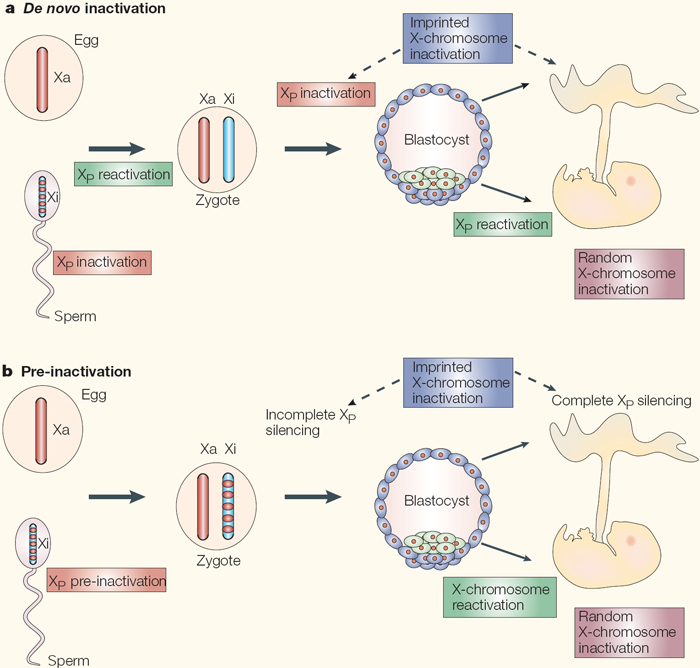
A two-panel diagram shows two models of X-chromosome inactivation: the de novo activation model and the pre-inactivation model. In the de novo inactivation model, the paternal X chromosome is inactivated and reactivated multiple times before fertilization and in the early stages of development until final random X-chromosome inactivation occurs in the embryo. In the pre-inactivation model, the paternal X chromosome is pre-inactivated before fertilization and undergoes complete silencing in the extraembryonic cells and random X-chromosome inactivation in the embryonic cells.
The research being done by many scientists, including Marks, can prove to be very important to the health of many women around the world. If one day scientists are able to silence specific, disease causing genes on the X chromosome, the chances of having an X-linked disease will be decreased dramatically. I believe that the research being done by Marks and his partners is a remarkable stepping stone into understanding how to prevent X-linked diseases.

To read the original article, click here.
A similar article that better explains the process by which the X chromosome is inactivated can be found here.

Friday, May 1, 2015

Hope for Fragile X Carriers

In this study, scientists delve head first into finding out more about the often crippling disorder, Fragile X Syndrome. This sickness is a proven cause of autism, and intellectual challenges. There are many different intensities to the genetically inherited disease, and even those individuals who are merely carriers suffer various challenges such as social difficulties, anxiety, and depression disorders.  In people will the maximum expression of the disease, the brain is blocked from manufactuing a key protein, while in those with differnet levels produce significently less of this protein. After studying a large population of both men and women, researchers have found a way to increase the protein production. Knowing little about Fragile X Syndrome, any new information is critical.
Considering the severity of what comes with this disorder, I found this article informative and interesting. It seems that if there is a way to up the lacking protein production, this sickness could one day be eliminated all together. If Autism, being the serious and crippling disease it is, were cured or at least minimized or controlled, this would be a huge breakthrough for sufferers, family, friends, and the world at large.

Monday, December 1, 2014

Different Kinds of Autism

Evan Eichler, a genome professor from the University of Washington does a study and predicts there a several kinds of autism. Eichler does a test between two boys Geoffrey Ondrich and Waylon Cude that are the same age and both have autism. Both boys are attached to their computer and that is the only thing that is similar between the two. Waylon likes to play video games and is more serious than Geoffrey. Geoffrey on the other hand like to go on the computer and listen to music or watches shows or movies. When Waylon is being tested, he is asked to do a serious of motor tests. When he gets something wrong Waylon automatically gets angry at himself and makes a pouting face. When asked questions, Waylon is polite but is only engaged in the conversations that are factual, anything else he says quiet. Geoffrey on the other hand before testing was able to use his iPad and found his favorite song and he starts bopping and dancing in his chair and when the music is off he sits in his chair rocking back and forth and slapping his right hand on his left wrist. With these results, researchers say autism is a heterogenous disorder. They looked at disorders that are similar to autism which is Rett syndrome and Fragile X syndrome.

"Beginning in the mid-2000s, microarray technology revealed that people with autism tend to carry many copy number variations, deletions or duplications of large stretches of DNA that encompass multiple genes. Researchers soon saw that people who harbor the same copy number variants often share other characteristics and symptoms as well"(Eichler). As a results, it is proven that no autism patient is the same, and all have their unique characteristics.


I think it is good that as a society we are growing to treat people with disorders and individuals and appreciate their uniqueness. Im sure that back in the day anyone with a disorder was treated and looked at the same. Their treatments were probably not as effective as they are now since everyone was treated the same and not to each individual needs.

Link:http://www.wired.com/2014/11/autism-genetics/

Friday, November 21, 2014

The Missing Link Between Fragile X Syndrome and Autism Spectrum Disorders

For a while, scientists have known that humans born with Fragile X Syndrome (FXS) have a high chance of being placed on the autism spectrum, but it was not known why this occurred. We knew that fragile X syndrome is characterized by an error in the production of the FMRP protein. We also knew that autism spectrum disorder (ASD) involves changes in normal brain development to effect social skills, empathy, learning ability, and speech. Therefore it was long theorized that the FRMP protein could be a factor in neurodevelopmental disorders, such as ASD.


Scientists have now obtained study results to support the idea that the FMRP protein does have an effect on embryonic development in the cortex of the brain. More specifically, FMRP is responsible for creating N-Cadherin. N-Cadherin helps neurons to reach their final positions in the cortex, and allow for the brain to be properly connected. Since this brain connectivity is lacking in someone with ASD, this may be a link to show the reasons why Fragile X Syndrome is highly associated with Autism Spectrum Disorder.


This study did not just give the reasoning for the link between FXS and ASD. The study also involved introducing the proper FMRP protein in mice embryos before birth to find out if it was possible to change the brain's wiring properly to potentially reduce or stop ASD from developing. It was shown that introducing the proper protein did have positive effects on the proper wiring of the cortex.

Those diagnosed with Fragile X Syndrome are highly affected by their disorder. With this, about 1/3 of those affected are also diagnosed with ASD. 15% are also affected by severe epilepsy. All three of these disorders are due to errors in development of the cortex. With this research, it could help treat or prevent Fragile X disorder in those with a genetic pre-disposition for it. Being able to help treat a disease with genetic factors is an important thing. It will allow for genetic reproduction without worry as to whether or not the offspring will inherit it.

Article: http://www.medicalnewstoday.com/releases/285578.php

Friday, April 18, 2014

The Genetics of Fragile X Syndrome

This article discusses one of the most common forms of inherited mental disabilities in humans, Fragile X Syndrome. This syndrome is an X-linked trait, so generally males and females who inherit two genes for this trait are affected more than female carriers are. The severity of symptoms can vary in anyone who has this abnormality. The severity is dependent on how many codon repeats are found on the FMR1 gene on the X chromosome.
Fragile X Syndrome causes affected individuals to not make enough of a protein called fragile x mental retardation protein. This protein attaches to ribosomes between the 30s and 50s subunits to regulate protein synthesis. Before this research, done at UC San Diego, scientists only knew that a deficiency of this protein resulted in proteins that regulate brain functions being synthesized incorrectly. The fact the the protein binds between the 30s and 50s subunits of the ribosome is important, as new proteins are synthesized by passing mRNA through the two subunits. These proteins are imperative to normal cognitive function in humans-and fruit flies. Researchers used fruit flies in the laboratory to map where the protein binds to the ribosomes. This information will hopefully provide the tools necessary in the future to create new treatments for this affliction and help restore at least some cognitive function in those who have lost it.

Secondary article