Showing posts with label CCR5. Show all posts

Tuesday, July 23, 2019

Third CRISPR-Cas9 Gene Edited Baby to be Born in China This Year

CRISPR-Cas9 is powerful gene editing tool that geneticist and medical researchers can use to edit portions of DNA in an organisms genome by adding, removing, or altering it. In the face of such a powerful discovery, the Second International Summit on Human Gene Editing was held in Hong Kong last November to discuss the pros and cons of technology like CRISPR-Cas9. While going over the clinical implications, ethics, and legal considerations of possibly creating genetically engineered humans, the entire summit was turned on its head when He Jiankui, a Chinese biophysicist, confessed that he had already done it.

He Jiankui the year prior had edited the genome of twin girls, who have already been born. To further the shock, at the time of his announcement a second Chinese woman was pregnant with another CRISPR baby. This fact was proven by an early pregnancy test, which brings the world total to three genetically modified humans that are known of. The child has already been born but the date will not be released due to risk of exposing the identity of the parents and child.

He Jiankui and his team used CRISPR to alter a gene called CCR5 in an attempt to make the girls immune to ever getting HIV. The scientific community was widely split upon finding out this discovery. Some condemned him for doing such a pointless procedure with such high risk, but others don't know what to feel. For better or worse, in science there is a notion of "all that ends well is well" and as of now He Jiankui claims that is experiment led to "two beautiful Chinese girls."

This immense overstep in the scientific community forces us as a human population to come to terms with the fact that for the first time in out existence, we can shape our evolution. We have the ability to cure diseases like sickle cell and HIV, but where does the line stop? CRISPR-Cas9 technology is relatively easy to use so what is stopping scientists from starting to modify hair color? eye color? Will we allow Designer Babies? Is it even ethically responsible to allow parents to make these life altering decisions on a human that isn't themselves? This is only scratching the surface of the many questions we have left to answer.
Image result for brave new world


I think that Aldous Huxley warned us best when he wrote in his novel Brave New World:
"All right then," said the savage defiantly, "I'm claiming the right to be unhappy."
"Not to mention the right to grow old and ugly and impotent; the right to have syphilis and cancer; the right to have too little to eat, the right to be lousy; the right to live in constant apprehension of what may happen tomorrow; the right to catch typhoid; the right to be tortured by unspeakable pains of every kind."
There was a long silence.
"I claim them all," said the Savage at last.


Monday, December 3, 2018

Implications of Jiankui's Genetically Modified Babies


The latest news in genetics comes out of Shenzhen, China where an associate professor of bioengineering at the Southern University of Science and Technology, He Jiankui, claims that two little girls are the world’s first genetically edited newborn babies. Using CRISPR, Jiankui has modified the babies’ genes to make them resistant to infection from HIV. The father of the babies is said to be positive for HIV. As of November 27th (the date of the article), there was no data to demonstrate how this experiment took place but is said to speak on more on the topic. The University has condemned the topic and even issued a statement saying that they had no idea that the project was going on.


How HIV infects cells via CCR5


In a Youtube video, Jiankui claimed that he used CRISPR to disable CCR5, a protein receptor that allows HIV to infect blood cells. On specific mutation, Delta32, disables HIV from locking onto the cell. In theory, if all individuals carried this mutant allele, then nobody would be able to get AIDs from HIV. CRISPR has been used in the laboratory for many situations, like eliminating diseases and improving the health of different crops. This technique, though, has never been used on human embryos, and therefore the results are unknown. One major problem is that CRISPR can cause off-target mutations to genes away from the target genes, and therefore can have many other implications.

Many companies are already looking to gene therapies in adults to edit the CCR5 cells in adults. In theory, scientists would remove blood from HIV positive patients, delete the CCR5 protein and return the cell back to the patient. It seems like every action has a reaction, and in this sense, getting rid of the CCR5 protein would increase susceptibility to West Nile virus, which is already seen in the real world when individuals are born without the CCR5 protein. Overall, Jiankui wrote a piece that discussed the core principles in the genetic editing of human embryos.

I am very interested in ethics in relation to science, and especially in relation to genetic editing. I believe that it should be interesting to see the effects of this experiment over time. I do not feel strongly for or against human genome editing or the idea of “designer babies”. If this experiment works and is able to basically eliminate HIV and AIDs ability to infect humans, think of what other uses human genome editing could have. Genetic cancers could be cured, and other genetic diseases could be edited. I think the use of genome editing for superficial purposes is unethical at this point in time. I think that the world has a ways to go in terms of being able to accept genetic editing and there will always be disagreement for it. Overall, the effects of this experiment will be interesting to see how it changes genetics forever, and it is so cool to see this monumental moment in scientific history.

Thursday, April 14, 2016

A Potential Cure for HIV: Gene Editing


Recently, researchers in China have been trying to create a molecular defense against HIV. This involves placing a gene, called CCR5 that prevents HIV from entering cells. Currently, scientists are trying to place CCR5 into human embryos using a technique called molecular scissors. This technique allows scientists to place three copies of the CCR5 on each chromosome. The goal of the research is to have cells resistant to HIV from birth.

However, the embryos implanted into a uterus do not develop into baby. Researchers believe the CCR5 is also causing a mutation on the chromosomes that contain its copy. In addition, in the rare case the embryo survives, the DNA is been changed, but not resistance to HIV. Scientists are continuing research and also developing a better technique to introduce CCR5 into the chromosome.

Genetic modification is a controversial topic. Furthermore, many people are against when humans try to act as God. However, this research topic may be a cure for HIV. The research needs to continue, as it will bear many fruitful results. Curing HIV may be one, but even they can’t find a cure. The understanding of human embryology will increase. In addition, developing better molecular biology techniques could lead groundbreaking discoveries in the future. In the end, scientists need to continue their research of curing HIV through gene modification (using embryos).

Original Source: https://www.sciencenews.org/blog/science-ticker/researchers-edit-genes-human-embryos-second-time?tgt=nr

Additional Reading: http://www.nature.com/news/second-chinese-team-reports-gene-editing-in-human-embryos-1.19718

Saturday, November 29, 2014

Is There a Potential Cure for HIV?

It all started with the “Berlin Patient” in 2007. Timothy Brown was cured of HIV when given the stem cells of another patient who was naturally immune to the disease. When this happened two companies, Sangoma and Calimmune, took the opportunity to attempt to recreate the natural immunity to HIV in a lab. This natural immunity occurs because of a gene mutation on the CCR5 gene which is located on CD4 T-cells. When this gene is disable HIV cannot attack the T-cells.


Sangamo was the first to attempt the recreation in 2009. Lead by Carl June from the University of Pennsylvania, a team of researchers and doctors removed CD4 T-cells from patients with HIV. The study then focused on disabling the CCR5 gene alleles and then returning the modified cells to the patient. It was stated that this did no harm to the patients and the altered genes had a half-life of 48 day, which is expected because “…T-cells are not permanent residents of the body”. In fact, several of the patients in this study even exhibited a decline in their HIV levels.

The next company to attempt to recreate the natural immunity to HIV is Calimmune. In 2013 a team led by David Baltimore and Irvin Chen decided to take a different approach to solve the task at hand. Instead of focusing their work on T-cells, they decided to take advantage of blood stem cells. This approach is different because blood stem cells, unlike T-cells, are permanent residents in the body. During this study patients were “given back both their own T cells, and longer-lived HSCs [blood stem cells], both with the CCR5 gene disabled using hairpin RNAs delivered by a lentivirus.” By doing this they hope that these blood stem cells can continue to produce T-cells with disabled CCR5 gene alleles throughout a patient’s lifetime.

Despite the fact that neither of these studies have conclusive clinical trials yet, Harvard University has decided to be next in the search for a cure for HIV. Their approach will include new CRISPR/Cas technology which has already proven effective in mice. It was stated that Harvard may even apply for clinical trial approval in five years.


Friday, March 14, 2014

Gene Editing Repels HIV

Denise Grady published an article in The New York Times on March 6, 2014 about a study involving the altering of genes as a way to repel HIV. In a recent study, scientists removed a protein in the patient's immune cells by a process known as gene editing. This protein is needed for the HIV virus to invade the cells. The cells were removed, treated, and then injected back into the patient's blood. The study found that immune cells could be altered with no harm to the patient. Gene editing also hinted as a possible way to fight infection. The idea is if enough cells can be altered to repel HIV then antiviral drugs would not be needed. Scientists hope this could be a cure to HIV in the future. An article about the study was published in The New England Journal of Medicine. A small percent of people cannot get HIV because their immune cells lack the protein CCR5. Scientists would like to look more into this protein as a way to prevent HIV. Zinc-finger nucleases are enzymes that cut DNA. This would allow specific genes to be disabled so that people could resist HIV. A study was done in 2009 that concluded with promising results. HIV patients were injected with their own CD4T cells that had been edited to disable the CCR5 gene. Scientists are now working on a way to increase the levels of edited cells and keep them at high levels once in the patient's body in order to keep HIV levels from increasing.
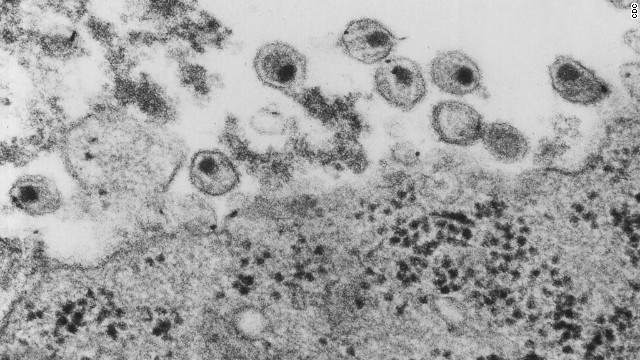
HIV seen using a microscope. 
Although the studies are preliminary it is exciting to see any advancement towards the cure of HIV. It is a horrible disease that affects the lives of so many people.  My friend was adopted from an orphanage in Romania by an amazing couple and given a chance at life. There are many articles about her amazing new family and their fight for HIV awareness.  It would be a blessing if she were able to someday say she is HIV-negative. Hopefully there will be a breakthrough in research during our lifetime.