Showing posts with label insects. Show all posts

Friday, February 9, 2024

Convergent Evolution of Viviparity in Insects & Beyond

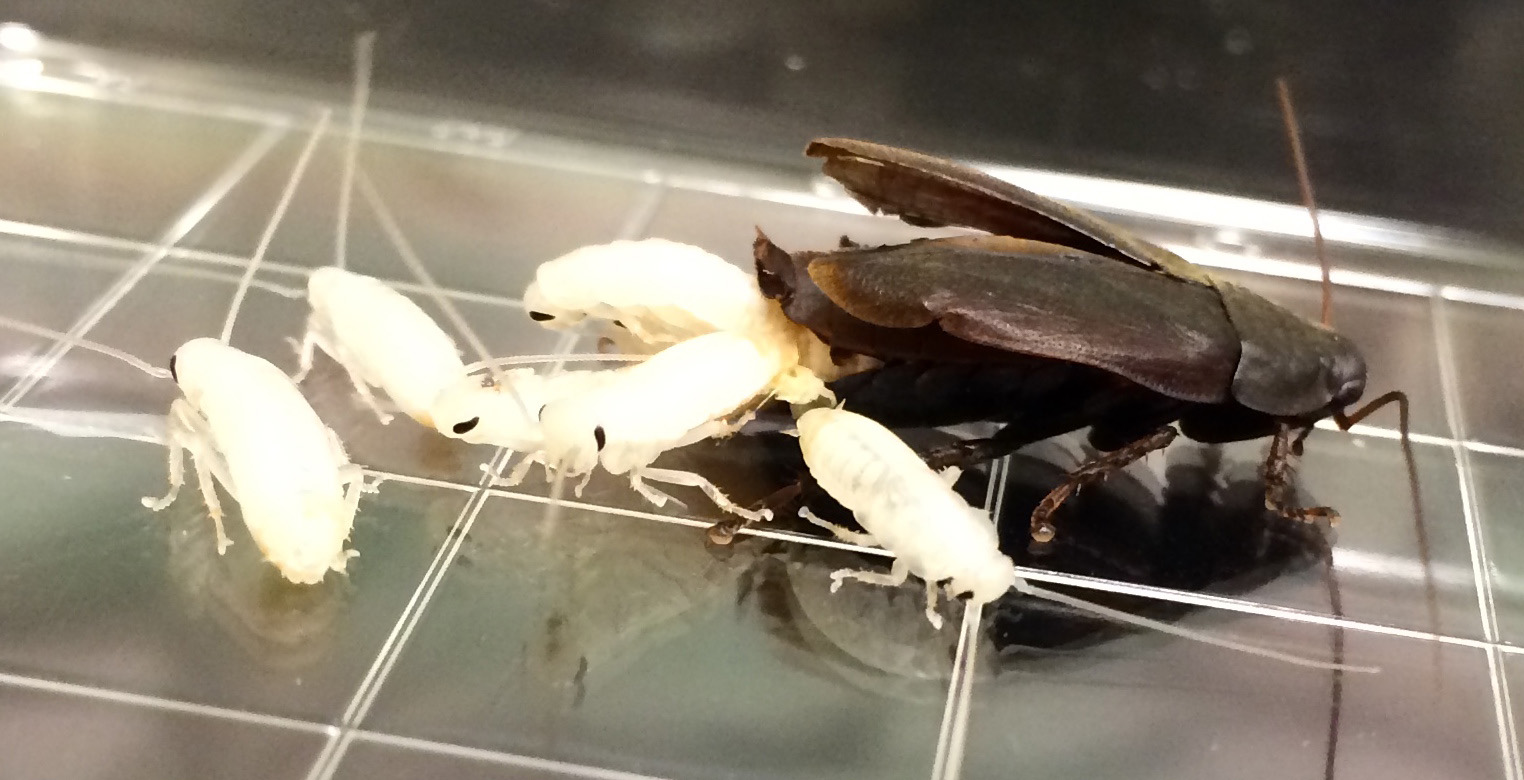
    This ScienceDirect article discusses the genome sequencing of D. Punctata, also known as the Pacific Beetle Cockroach. The study which the article discusses focused on several different orders of insects- including Blattodea (Cockroaches), Diptera (Flies), and Hemiptera (True Bugs), and how viviparity evolved independently in each of these orders. In each instance of viviparity, insects have their own specially evolved structures to support this function- such as placenta-like structures, brood sacks which act akin to a uterus... And even the ability to generate something like "milk", in  the instance of the Pacific Beetle Cockroach. These special adaptations to the urogenital system of insects are incredibly important, as otherwise the brood would not be able to receive proper care nor nutrients while within the mother. The development of these special structures rely heavily upon the rate of chitin metabolism- which is a polysaccharide insect exoskeletons are primarily made up of. The article also discusses how the bodies of viviparious insects have certain aspects of their immune system suppressed, so as to decrease the chances of their fetus being rejected. The results of their study suggest that developmental processes strengthen genes when under increasing selection pressure and positive selection.  Their study shows that in general, despite evolving independently several times, the genomic and transcriptional alterations are similar across all instances, be it within mammals, insects, or otherwise. 

    Personally, I find this topic incredibly fascinating. Usually people think of mammals when on the topic of live births, but the fact of the matter is that many other different creatures have the ability to do so. I think that it is interesting that small arthropods such as insects have evolved to be able to give live births, and even further, the adaptations that their bodies have, ie brood sacks and milk production, are even more incredible. Additionally, I find it almost endearing that creatures which may be seen as gross, such as cockroaches, can actually be considered good parents in the animal kingdom. 


Saturday, October 21, 2023

Horizontal Gene Transfer: How parasites control insect host behavior

Published recently in the journal Current Biology, research from a study conducted by the RIKEN Center for Biosystems Dynamic Research has revealed that parasites likely manipulate the behavior of their host organisms using horizontal gene transfer. 


In general, many parasites control their hosts to ensure the survival and reproduction of their species. One example of such a parasitic species is the horsehair worm, born in water but migrating to dry land using aquatic insects. After being eaten by a mantis (terrestrial insect), the worm grows within the host, beginning to manipulate its behavior. Once fully matured, the horsehair worm prompts the insect host to jump into the water and drown to its death, allowing the parasite to complete its life cycle and reproduce. 


Interestingly, previous studies have indicated that the horsehair worm likely manipulates the host’s biological pathways to increase movement towards the light (and approach water) by mimicking molecules found in the hosts’ central nervous system. To better understand how they developed such a mimicry mechanism, researchers analyzed the whole-body gene expression in a Chordodes horsehair worm before, during, and after host manipulation. From this study, researchers found over 3,000 genes that were expressed more during manipulation and 1,500 that were expressed less. In contrast, gene expression in the mantis brain did not change whatsoever, indicating that the parasites were producing proteins that would manipulate the host nervous system. After further analysis, interestingly, it was found that over 1,400 hairworm genes that matched those found in their mantis hosts were absent in species with different hosts. From these findings, researchers concluded that the identified mimicry genes (linked with neuromodulation, light attraction, and circadian rhythms) were likely the results of multiple horizontal gene-transfer events from various mantis species during the evolution of horsehair worm species.


Considering that horizontal gene transfer is far more common in prokaryotes, it was rather interesting to see an application of this phenomenon in eukaryotic species. This was especially the case since it is a primary way through which bacteria evolve antibiotic resistance. In that sense, horsehair worms would likely make ideal model organisms to study the mechanism by which horizontal gene transfer occurs and allows molecular mimicry, advancing current scientific understanding of evolutionary adaptation.


Click here to view the ScienceDaily article release

Click here for more information regarding this research study

Monday, March 1, 2021

Wild Cotton and their interaction with Ants

In the article from Science News, it was found in a study that acquired herbicide resistance and insecticide genes are able to disrupt cotton's ecosystem. These wild cotton have made it possible in the way that they are able to change their genetic modification to release excess nectar, therefore allowing more ants to keep insects and pollinators away from them. These genes are known as escape genes, it is when their genes are genetically modified to the extent that the cotton crops have produced very different native plants and changing their biology and how it interacts with the insects. 


Wild cotton is a species that can be found in Mexico as it is one of its centers of origin. In a recent study, it was shown that the transgenic offspring that were tested produced insecticides (Bt toxins) and those resistant to glyphosate. Since the study was conducted, the number of wild cotton varied greatly in the amount of nectar that it was producing and the ants that were feeding off of the plant.

As the environment is changing, plants also sometimes start modifying their genes to try and adjust to them which sometimes leads to them producing and attracting different kinds of pollinators as previously stated. When this change occurs it also affects the ants because they normally are the ones who defend the plants against pest insects. 

Sunday, March 22, 2015

Planthoppers Can Change Wings From Short to Long

The brown planthopper is a tiny insect, about the size of a sesame seed that threatens the rice crops of Asia each year. These insects hang onto the stalks of the rice plants and siphon the sap from them with their sucking mouthparts. This causes the plants to turn yellow and to dry up, known as hopper burn. Large numbers of the brown planthopper can lead to the destruction of thousands of acres of rice, which is the primary source of food for approximately half of the world’s population. In order to do this these insects have a developed a strategy, which involves the wing length of the brown planthopper.


When the conditions in a rice field are stable the juvenile planthoppers develop wings that are short. Short winged planthoppers cannot fly, but produce offspring fairly quickly. A short winged female can lay more than 700 eggs in her lifetime. However, as the fall approaches and the days shorten and temperatures drop these insects start to develop longer wings. This allows them to fly into new rice fields in search of food. Previously scientists did not understand how the cooler temperatures and the shorter days caused the insects to shift from short winged to long winged or which hormones were involved, but a new study by Duke University reveals new information on the topic.

The study involved using a technique called RNA interference or RNAi. As a result of this technique genes for two different insulin receptors were able to be silenced. The effects that doing this had on the animals’ wings were then measured. In the past scientists had believed that all insects have only one insulin receptor, but it was discovered that the brown planthopper has two.

The researchers silenced the first insulin receptor and the planthopper nymphs developed into adults with short wings. Silencing the second insulin receptor caused the nymphs to develop into long winged adults. The scientists pushed their research even farther and were able to determine that the long winged form of the planthopper is the default form. However, the secretion of a certain type of insulin due to changes in temperature and day length causes the second insulin receptor to inactivate the first insulin receptor and short winged planthoppers develop. Essentially, the second insulin receptor interferes with the first and shuts down the signal.

The implications of the study could be numerous, but as of yet it is too early to tell if these findings could lead to techniques for controlling these insects. Scientists have discovered this mechanism in other planthopper species and hope to determine if insulin plays a similar part in other insects with flying and flightless forms.

To me this is astounding that these insects have evolved in such a way. It is really interesting to think that these insects have evolved such mechanisms to survive. It seems so complex and rather ingenious of these organisms, but I also think it is excellent that scientists have discovered how they are able to change from form to form. Hopefully, in the future researchers will be able to find a way to stop these insects from invading the rice fields and destroying the crops. It is exciting to think how far science has come and what can happen with the new information these studies are providing. 

Tuesday, March 10, 2015

Crop Pests Stopped by Plants That Cripple Attackers' RNA


Invasive species are known to be the cause of many devastating agricultural failures throughout history. One insect in particular, dubbed the "international super pest", is the Colorado potato beetle (pictured above). This beetle eats different crops all across the world, and costs the agricultural industry billions of dollars per year. The worst thing about this beetle is that it is resistant to practically every insecticide and has very few predators. The good news is scientists have finally come up with a way to protect crops from this pest.

A team of researches in Germany are using RNAi (RNA interference) to kill-off this beetle. First, the scientists found a gene that is essential to the insect; this gene codes for a "cytoskeleton protein vital to maintaining a cell's shape." Then, plants were engineered to produce a special type of RNA. When the beetle eats this plant, the plant's RNA interferes with the beetles'. In turn, the insects ribosomes are unable to read the mRNA (or messenger RNA), and code for the essential protein previously mentioned. Without that, the insect dies. 

The idea to use RNAi has been around for about a decade, however, it was unsuccessful in killing all the pests when tested years ago. This time, scientists modified the technique by inserting the plant's "instructions" for the unique RNA into their chloroplasts instead of the nucleus, which proved to work much more efficiently. This new mechanism can possibly help put a stop to crop devastation by pests in the future. The question still remaining is will the pests develop resistance to the RNAi like they have insecticides? 

I liked this article because it has brought a possible scientific solution to insects destroying crops around the world. Farmers try everything to protect their crops from being attacked by pests, but many times it makes the problem worse. For example, when an invasive insect is introduced to a crop, one possible solution is to bring a predator of that insect to the crop, too. This strategy can go very bad, very fast. If this new technique works, it could be revolutionary for farmers and consumers everywhere. 


Friday, November 14, 2014

Patent Awarded for Genetics-Based Nanotechnology Against Mosquitoes

            The Mosquito (Culiseta longiareolata) is arguably the most annoying insect humans interact with on a regular basis. During the mild weather of spring and the sweltering heat of summer, mosquitos swarm their victims in droves, surreptitiously sucking blood from a choice of several animal species. In addition to this grievance, mosquitos are primary carriers of HIV, Malaria and West Nile virus in the Eastern hemisphere. However, these petty creatures may no longer pose such a significant threat to overall health and quality of life in the near future.
            Researchers at Kansas State University have developed a method of keeping mosquitos and even other annoying insects at bay from their victims. It is United States patent number 8,841,272, formally called "Double-stranded RNA Based Nanoparticles for Insect Gene Silencing." This technique uses genetics-based technology to kill these insects with minimal repercussions, especially upon juxtaposing alternative methods such as using pesticides that have detrimental effects on the environment. Kun Yan Zhu, professor of entomology and Xin Zhang, a research associate in the Division of Biology, developed the technology. They said it utilizes nanoparticles comprised of a non-toxic, biodegradable polymer matrix and insect derived double-stranded ribonucleic acid, or dsRNA. The purpose of this process would be to interfere with RNA interference, or RNAi, to destroy the genetic code of an insect in a specific DNA sequence.


            This technology could be the near perfect solution for the inundation of these types of insects, particularly in Africa. Once ingested the nanoparticles act as a "Trojan horse," releasing loosely bound dsRNA into the insect gut. This subsequently triggers a genetic chain reaction, thus destroying messenger RNA and killing the insect. If these studies ultimately come to fruition, this method of killing insects could save hundreds of thousands of lives per year. 


Saturday, September 27, 2014

Indispensible Nature of Cell Division Protein Questioned

There exist various genetic factors and biological processes that are conserved throughout time due to their essential nature to the biological world. One of those most key is the process of cell division, by which genetic information is transferred from one generation of cells to the next. All organisms rely heavily on the continued functionality of the process of cell division, making it unlikely for change in the procedure for this phenomenon to take place as time progresses. Centromeres prove to play a crucial role in the process of cell division, providing attachment sites for duplicate chromosomes to separate to opposite poles within the cell. Microscopic analysis has continued to show researchers that while always present, centromeres are quite variable in the sequence of their coding DNA across the cells of different species. Regardless of this variability CenH3, a DNA packaging protein, has continued to remain a common factor for all cases of cell division to biologist knowledge until now.


Investigation by researchers at Malik and Henikoff labs has shown that there exist insect species whose cells lack this supposedly essential CenH3 protein. Their course of research into this topic began with the observance that certain species of insect, specifically butterflies and moths, had an abnormal centromere structure. Analysis of insect chromosome structure and centromere organization has allowed for researchers to divide various insects into two groups; these are monocentric and holocentric insects. The monocentric insects have traditional X-shaped chromosomes with singular centromere attachment while the holocentric insects have chromosomes that appear like railroad tracks as the centromeres run along the full span of the chromosomes with multiple attachments. Some insects identified as monocentric are bees, flies, and beetles; some identified as holocentric are moths and butterflies. Through genome sequencing analysis, researchers were able to come to the conclusion that monocentric insects had all conserved the CenH3 protein while holocentric insects had lost coding for this protein at some point in evolution due to its lack of necessity in the cell division process.


This proved an intriguing finding due to the disappearance of a protein thought to be essential to such a necessary process in the biological world as cell division. This discovery raises many questions as to the possibility for other changes in conserved genetic factors and biological processes among various species. This also brings about thoughts regarding implications to the development of defects in cell division.


I found this article to be quite interesting in the questioning of such a fundamental concept in biological studies. With a process like cell division, one would assume all characteristics and factors involved to remain consistent even as various species evolve due to the essential nature of this process. I find it fascinating that the CenH3 protein has been lost in the genetic code for some insects while not for others, and that this has not negatively impacted these species. Findings such as this that challenge prior belief really add excitement to the study of genetics. Maybe other similar discoveries will come about in the near future.


Friday, April 18, 2014

In sex-reversed cave insects, females have the penises

In this article , on April 17, Brazilian insects which represent four distinct but related species in the genus Neotrolga, are the first example of an animal with sex reversed genitalia. There have been many sex role reversal in different animals, but Neotrolgla is the only example in which the intromittment organ is also reversed says Kazunori from University of Japan. During sexual intercourse which lasts 40-70 hours, female insects insert an elaborate, penis like organ into males much reduced vagina like opening. This makes in advantages for females to mate more because of their higher nutrient count as well as sperm count. 
It will be important why only the Neotrolgla is the only to be a sex reversal role which elaborates a female penis. 

http://www.wired.com/2014/04/scientists-discover-bugs-with-sex-reversed-genitalia-doing-it-for-70-hours/http://www.wired.com/2014/04/scientists-discover-bugs-with-sex-reversed-genitalia-doing-it-for-70-hours/

Sunday, November 3, 2013

Altering Mosquito's Sense of Smell

On a hot summer day, hiking through a wet area, you find yourself being a plate of food for mosquitoes. By the end of the trip, you are covered in bug bites and the all you can think about it is cursing those damn mosquitoes. In a ScienceDaily article, it was reported that researchers have developed a way to alter an insect's sense of smell. Ocro was identified to be a gene that contributed to odor sensing in mosquitoes. When this gene was silenced, mosquitoes had difficulty sensing odors. Furthermore, the study showed that mosquitoes did not hold a preference toward a certain species (including humans). However, mosquitoes were shown to land on DEET (main component in bug repellent) covered subjects, but quickly fly away. Therefore, this indicates that there are multiple mechanism involved with sensing odors. All in all, orco was shown to interfere with an insect's receptors on sensing smells. As a result, future studies will dive deeper into understanding the other mechanisms involved with certain repellents and why mosquitoes prefer humans.
The Genetically Engineered Mosquito

The sense of smell is such an important way to retrieve information from our surroundings. It only took one gene to confuse a mosquito from its normal behavior. I believe that even though there is a genetically modified version of the mosquitoes that has no preference to humans, it would not survive in the wild due to the fact that humans are the most accessible type of nutrient for mosquitoes. Mosquitoes continue to favor Human for a reason. That is why the genes for this specific affinity were passed down. It was favorable to them, and those that could better sense Human odor better, survived more easily. 

Thursday, April 18, 2013

Controlling Mosquitos Without Pesticides

Gentics posted an article of study on controlling mosquito carried diseases.  According to the article there are two ways to control mosquito carried diseases. These two ways are to reduce mosquito populations or replacing populations with disease refractory varieties.  The study suggests, Semele.  Semele consists of  a toxin expressed in transgenic males that either kills or makes wild type female mates infertile and transgenic females have an antidote that protects them from the effects of the toxin.  If all males are released it would result in population suppression because wild type females that mate with transgenic males cannot produce offspring.  A release that includes transgenic females results in gene drive since females carrying the allele are favored at high population frequencies.  Semele is a favorable because if transgenic insects are released accidentally they are unlikely to affect anything because high transgenic populations are needed to affect the wild population, but  intentional release of transgenic mosquitos can be confined to certain areas and then through sustained release of wild type mosquitos transgenic mosquitos can be removed from populations.  This sounds like a great way to reduce insect populations without the use of pesticides.  It also doesn't seem like it would have any harmful results as long as the mosquito numbers are kept at sustainable levels. This discovery will be very useful to humans and the environment because it reduces the need to use harmful chemicals to control the mosquitos and hopefully this discovery can be used to learn about better ways to control of insects through genetics rather then pesticides.

The Article- http://www.genetics.org/content/187/2/535.abstract

Another Article- http://www.eurekalert.org/pub_releases/2011-02/gsoa-nmr021011.php

[caption id="attachment_7981" align="alignnone" width="480" caption="Mosquito"][/caption]