Showing posts with label nanoparticles. Show all posts

Thursday, October 22, 2020

Nanoparticles Can Turn Off Genes In Bone Marrow Cells


MIT engineers discovered a way to turn off genes in bone marrow cells. This new discovery can help treat heart disease, which is a huge killer in America, as well as produce more stem cells in patients. Researchers did a study with mice in which they turned off these genes and inhibited the blood cells in bone marrow that produce inflammation as well as aid heart disease. The results showed that the mice were able to recovery easier from a heart attack given this technique. If this can work for tiny mice, imagine the effect it would have on humans especially in America where many people die every day from heart disease. Scientists begin a technique called RNA Interference in which they bring short strands of RNA to block the genes from being turned on that would promote the inflammation. These nanoparticles are able to target the diseased cells and the scientists are able to apply gene therapy. SDF1 is a gene that doesn't allow the blood cells to leave the bone marrow, and MCP1 is a gene that is released from bone marrow after a heart attack. By knocking down SDF1 with the use of nanoparticles, we are able to produce more stem cells which would help so many people. MCP1 delivers immune cells to the heart and aid with the progression of heart disease, by turning off this gene, we are able to improve heart disease. Another study with mice tested and the results came back to same. Overall, this is a great discovery that can help millions and I am so excited for what new discoveries on this topic come in the future.

https://news.mit.edu/2020/nanoparticles-bone-marrow-rnai-1005

https://www.ncbi.nlm.nih.gov/pmc/articles/PMC3423651/

Tuesday, November 22, 2016

PNA Enables Gene Editing without Exogenous Enzymes Added

Scientists at Carnegie Mellon University and Yale University have developed a new gene editing system, consisting of synthetic, biocompatible nucleotide technology, that has cured a genetic blood disorder in living mice. The new technology, pioneered at Carnegie Mellon's Center for Nucleic Acids Science and Technology (CNAST), relies on peptide nucleic acid (PNA) molecules. Unlike the CRISPR/Cas9 gene-editing technique, this new synthetic nucleotide technology can be administered to living animals and it also significantly decreases unwanted, off-target, gene mutations. The PNA’s are fitted inside an FDA-approved nanoparticle delivery system for transportation. According to the researchers, the chemistry behind the design of the PNA molecule is innovative because it makes the PNA water-soluble and biocompatible, which means that it doesn't bind to proteins and other biomolecules in a non-specific manner, and the distinct stereochemistry of the synthetic molecule also makes it bind to DNA more easily.

The findings of this study, published in Nature Communications, are said to offer a new approach to treat genetic diseases targeting genes in hematopoietic stem cells. In their study, the researchers targeted the gene for beta-thalassemia, a blood disorder that reduces the production of hemoglobin. Beta-thalassemia is a common target for gene editing because the disease results from defective blood cells. It seems that the PNA system “tricks” the cell's normal repair machinery into chemically altering the bad gene. This is different from other gene editing strategies, (CRISPR), which involve adding an active enzyme into the cell from the outside.
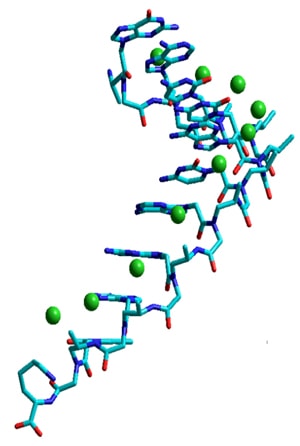
"We have developed a system that uses FDA-approved nanoparticles to deliver our PNA molecule along with a donor DNA to repair a malfunctioning gene in living mice. This has not been achieved with CRISPR," said Danith Ly, professor of chemistry in Carnegie Mellon's Mellon College of Science and an expert in PNA chemistry.
CRISPR/Cas9-mediated genome editing relies on enzymes to cleave open the DNA at a target site, and it uses the cell's normal repair machinery to repair the gene. Using CRISPR, it is difficult to administer large enzymes directly to living animals, and once the enzyme is inside a cell, the enzyme may indiscriminately cut DNA at nontarget sites. As I understand it, the reliance on the enzyme and native repair systems is what leads to different efficiencies of CRISPR/Cas9 in different cell types and organisms.

The newly designed PNA molecule is designed to cleave the double-stranded DNA molecule and bind near the target site in a highly specific manner without cutting anything. PNA, "peptide nucleic acid", is a molecule with the same bases as DNA and RNA, but instead of the sugar-phosphate backbone of natural nucleic acids, the molecule has a peptide backbone, similar to proteins. This means the molecule can base-pair with standard nucleic acids, but has other properties that allow it to carry out different functions. Most notably, PNA can form triple-helix interactions with DNA, which seems to be linked to its role in gene-editing.

The lack of provided enzyme to carry out the biochemistry of this innovative gene editing technique is the really remarkable thing about this study. Gene editing as a whole has been attached to the name "CRISPR", which is only one method for gene editing, although by far the most successful.  There has been so much CRISPR-related research recently, that the fact that this gene editing technique isn’t CRISPR is noteworthy.  More proof of concept will be important before taking the new synthetic gene editing technology to patients, and if proven effective, the earliest human application of this type of technology would definitely be about a decade or more away. I think it’s awesome though, that “nanoparticle delivery”-systems are currently being developed, and it’ll be interesting to see how synthetic biocompatible techniques will shape our current understanding of the genome.

Thursday, March 19, 2015

DNA Nanobots that Kill Cancer Cells Scheduled for Human Trials.

Researchers at Bar-llan University in Israel developed tiny nano-robots made entirely of molecular DNA that search for and destroy cancer cells, while leaving healthy cells unharmed. This process has also been called "DNA origami" instead of "DNA nanobots."  While the research has, so far, only been performed on cell cultures and live animals (cockroaches, to name one), their hopes now turn to perform the research on a living person. Head researcher, Dr. Ido Bachelet, described the design of the nanobots back in 2012. At that time, the nanobots recognized at least 12 different types of cancer and had the ability to detect when a diabetic needed insulin. About one year ago, the nanobots were revamped and injected into live cockroaches with promising results. The first human test will be performed on a terminally ill leukemia patient with only a few months left to live. The research team is hopeful the cancer will be irradicated within one month.

The design of the nanobots is such that it won't incite an immune response. They were modeled after the body's natural immune system. The nanobots patrol the blood stream, much like white blood cells, and immediately report to any signs of distress. Since DNA is biodegradeable and biocompatible, it will eventually break down and avoid a foreign body immune response. The older version, from the 2012 Science magazine description, is shaped like a hexagonal tube with a latched hinge. When a targeted cell is recognized, the latch swings open (like Pac-Man) and deliver deadly drugs or nanoparticles to the targeted cell. The nanoparticles (mostly) cause the cancer cells to self-destruct. The newly revamped version, published in Nature magazine and practiced on cockroaches, resemble boxes with lids. These "boxes" were created using DNA strands, and inside the "box" were molecules that contained hemolymphs.

A photo of the first version of the nanobots from 2012.


Dr. Bachelet has huge visions and hopes for his nanobots. In the future, he wishes to treat just about any disease process, as well as perform cellular level surgeries, such as repairing spinal injuries via nerve cells.

The revamped version of the nanorobots injected into cockroaches.

This is revolutionary in the nanotechnology world. While nanotechnology has existed since the 1980's, there has yet to be such a medical wonder. However, there are some risks associated with this process in human beings. Some cancers actually invade an entire organ, rather than just floating around in the bloodstream or existing on the epithelial tissue. If these nanobots are programmed to take out the cancer cells, they could (theoretically) destroy an entire organ in the process. If the nanobots are so rapid at destroying a slowly developing cancer, they could wipe out a substantial amount of an organ before it has time to repair itself. If the nanobots are to be successful, their destruction rate of cancer tissue should be equal with the regeneration rate of healthy tissue.

Another concern I have is that this technology can be used, if in the wrong hands, to destroy healthy cells. There are plenty of terrorist organizations in this world that are leaning more and more towards bio-terrorism. Rather than a widespread poison, like anthrax or cyanide, these little nanobots could easily make their way into human bodies and destroy an entire country, if not more. Perhaps not by means of injection, but ingestion or inhalation. It's worrisome and scary, but it is always a possibility that things created for the good of humanity can be altered for the evil.


Original Article: Can DNA Nanobots Successfully Treat Cancer Patients? First Human Trial Soon

Sunday, November 16, 2014

Using Genetics-based Gene Slicing Nanotechnology to Fight Mosquitoes and other Pests.

          Kansas State University researchers have developed a patent to kill mosquitoes and other pests without using pesticides. The technology is being developed by Kun Yan Zhu professor of entomology and Jianzhen Zhang a visiting scientist from Shanxi University in China. The technology is "comprised of a nontoxic, biodegradable polymer matrix and insect-derived double stranded ribonucleic acid (dsRNA), which is a synthesized molecule that can trigger a biological process known as RNA interference, to destroy the genetic code of an insect in a specific DNA sequence."
         The technology itself was developed when the researchers were trying to disable the genes in mosquito larvae development. After failed genetic techniques they switched their focus to nanoparticles. The researchers designed the DsRNA to target the mRNA enzyme that coded the mosquitoes chitin exoskeleton. "Once RNAi is triggered, it destroys the messenger RNA, or mRNA, of a particular gene. This prevents the translation of the gene into its product, silencing it." It was found that these mosquitoes were producing less chitin making them more exposed to insecticides and eventually killed them. The researchers hypothesized that if they could get the chitin down to an even smaller level the mosquitoes can be killed without the use of any insecticides. There have been other studies showing nanotechnology being used as an alternative to pesticides. 


Retrieved from 
http://www.k-state.edu/media/images/nov14/dsrna.jpg
         This technology could be a much safer alternative to pesticides. Using a pesticide to kill a pest has a lot of by products. The pesticide could be affective at killing the pest but it could also kill anything else that ingests the pesticide. This nanoparticle would only attack the specific RNA that it was coded for. Making it completely safe to anyone or everything that is not a mosquito. This technology could be developed to attack other pests that are detrimental to the farming industry. The technology can be used to fight mosquitoes in a dense malaria area, stopping the spread of malaria and other dangerous diseases. 
         
Original Article
Related Article 

Friday, November 14, 2014

Patent Awarded for Genetics-Based Nanotechnology Against Mosquitoes

            The Mosquito (Culiseta longiareolata) is arguably the most annoying insect humans interact with on a regular basis. During the mild weather of spring and the sweltering heat of summer, mosquitos swarm their victims in droves, surreptitiously sucking blood from a choice of several animal species. In addition to this grievance, mosquitos are primary carriers of HIV, Malaria and West Nile virus in the Eastern hemisphere. However, these petty creatures may no longer pose such a significant threat to overall health and quality of life in the near future.
            Researchers at Kansas State University have developed a method of keeping mosquitos and even other annoying insects at bay from their victims. It is United States patent number 8,841,272, formally called "Double-stranded RNA Based Nanoparticles for Insect Gene Silencing." This technique uses genetics-based technology to kill these insects with minimal repercussions, especially upon juxtaposing alternative methods such as using pesticides that have detrimental effects on the environment. Kun Yan Zhu, professor of entomology and Xin Zhang, a research associate in the Division of Biology, developed the technology. They said it utilizes nanoparticles comprised of a non-toxic, biodegradable polymer matrix and insect derived double-stranded ribonucleic acid, or dsRNA. The purpose of this process would be to interfere with RNA interference, or RNAi, to destroy the genetic code of an insect in a specific DNA sequence.


            This technology could be the near perfect solution for the inundation of these types of insects, particularly in Africa. Once ingested the nanoparticles act as a "Trojan horse," releasing loosely bound dsRNA into the insect gut. This subsequently triggers a genetic chain reaction, thus destroying messenger RNA and killing the insect. If these studies ultimately come to fruition, this method of killing insects could save hundreds of thousands of lives per year. 


Tuesday, November 20, 2012

Nanoparticles Stop Multiple Sclerosis In Mice

According to Medical News Today there has been a breakthrough of a new experimental treatment that uses nanoparticles covered with proteins to trick the immune system. These nanoparticles managed to stop disease in mice with relapsing remitting Multiple Sclerosis and by administering these particles the disease stopped abruptly. Not only did the disease stop, the nanoparticles prevented future relapses for up to 100 days in the mice which correlates to several years in humans. This approach is very similar as to using a patients white blood cells and researchers think it would be cheaper and easier.

Multiple Sclerosis is an auto-immune disease when the immune system attacks the bodies healthy tissues by mistake and releases harmful pathogens that can give rise to different diseases. Myelin, which is the protein that forms a protective shield around the nerve endings of the brain, gets attacked and destroyed and this prevents electrical signals from traveling resulting in mild numbness up to paralysis. Around 80% of people with Multiple Sclerosis have the relapsing remitting type of the disease leading them to experience the symptoms on and off. By coating nanoparticles with myelin proteins it tricks the immune system into thinking myelin is friendly so it doesn't get destroyed. These nanoparticles are 200 times thinner than human hair and are the same material as dissolvable stitches. Once the particles were injected into the mice they travel to the spleen where they were engulfed by macrophages. This in turn made the immune system think that the nanoparticles were regular blood cells and not something that should be attacked.


This therapy has multiple benefits because it does not compromise the immune system like other current therapies do. By suppressing the immune system the Multiple Sclerosis patients would be more vulnerable to infections and diseases such as cancer. The big excitement of this discovery is that it may have the ability to be used in many immune-related diseases by simply changing the antigen that is delivered to the body. Currently the researchers are testing nanoparticles in hope to treat type 1 diabetes and asthma. Not only can these particles make a significant difference in medicine but they are easily produced and easily accessible. It is exciting to read articles like this and know that we are so close to curing such common diseases that people suffer with on a daily basis.