
Showing posts with label Cell division. Show all posts
Showing posts with label Cell division. Show all posts
Wednesday, April 19, 2017
Elemental Bacteria Size Discovered

Tuesday, November 22, 2016
Obesity Linked to the Biological Age of Newborns
A recent study shows that a mothers' obesity may affect the biological age of her newborn child. This study, conducted at Hasselt University in Belgium, associates a shorter telomere length (located in the cells of the newborn) with the obesity of their mother. Researchers that conducted this study used a sample of 743 mothers, ranging from the age of 17 to 44, The researchers were able to use samples of umbilical cord blood obtained from each newborn, directly after their delivery.
Biological age is essentially the number of times a cell will be able to divide in its lifetime, which is typically determined by the length of the telomeres in the cells of our bodies. Telomeres are vital to have in a person's genome, given that they protect chromosomes from degrading; they are the structures at the ends of chromosomes. Given this benefit, cells then have a more likely chance of dividing throughout their lifetime depending on the length of the telomere that ends the chromosome in which it is attempting to divide.
After observing all of the data gathered throughout this study, it remained prevalent that newborns whose mothers were not considered obese had longer telomeres versus newborns who had mothers that were indeed considered obese. In fact, only a single point increase in a mother's body mass index, or ones' weight-to-height ratio, was linked with newborns whose telomeres were shortened by about fifty base pairs considered to the average newborn's telomere length. Although it is normal for telomeres to shorten as people age, the rate at which telomeres shorten does not remain consistent between individuals. The fifty base pair shortage in these newborns is actually equal to the amount of base pairs an adult would lose on average in only a bit over a year.

According to previously done studies, the length of telomeres in adults may be associated with some age-related diseases such as cardiovascular disease, type 2 diabetes and increased mortality; however, studies on the impacts of telomere length in newborns and children still remains limited. This study also does not take into account the body mass index, or the obesity of the paternal figure, which also may play a part in the length of the telomeres. Several factors have been ruled out to lead to the length of the telomeres; however, this is being further looked into.
I am very curious to see how this study will continue, and what further findings these researchers may have. I think it would be extremely important to learn about the influence of telomere length in newborns and children, given the associated health risks in adults. I also am very curious to see what role the paternal BMI, or possible other factors, will play in the deciding of the length of the newborn's telomeres.
Deficiency of the QKI Gene and Cancer
The University of Texas MD Cancer Center has concluded that the
survival of cancer cells is possibly linked to the deficiency of a tumor suppressor gene called quaking. Quaking is also known as the QKI gene. The QKI
gene is a huge contributor to the regulation of cancer stem cells in
glioblastoma. Glioblastoma are the deadliest kind of brain tumor that one can
have. The cells that make up these tumors, called glioma stem cells, are able
to self-renew inexhaustibly until tumors are produced in the brain. The glioma
cells self-renew by creating identical daughter cells when dividing. To
maintain the process of cell division the glioma cells have to be in
environments providing the proper cellular signals.
When glioma cells are in
optimal conditions, they are said to be in niches and can continue to divide. This
increases the amount of cancer stem cells. Previous studies conducted proved
that the QKI gene is a tumor suppressor that regulates cancer stem cells. In addition,
QKI affects cellular activity by regulating endocytosis. This process is
responsible for the degradation of receptors on the cell that allow the
continuation of stem cell self-renewal. The increase in cell receptors due to
deficiency of the QKI gene causes the cancer stem cells to divide in areas
outside of the niches. A defective QKI
gene will result in an increase of the cell receptors on cancer stem cells. Therefore,
the amount of glioma, cancer cells, can divide very rapidly even if they are
located in areas outside of the niches.
According to Dr. Jian Hu, assistant
professor of the Department of Cancer Biology, the discovery of the deficient
QKI gene may lead to alternative methods for therapeutic treatments of cancer.
This is a great discovery. I feel that scientists are making great progress and
learning so much about the destructive disease that we call cancer. Cancer has
taken, and is still taking, the lives of so many people. Cancer does not
discriminate by age or the current great health one may have. Scientists can
work on gene therapy techniques with the QKI in the future to learn more about
cancer. Consequently, I hope to see the development of a technique to isolate a
working QKI gene to administer to individuals with a deficient QKI gene as a
cancer treatment. It is great that scientists have discovered so much about the
worst kind of tumor that one can have.

Thursday, May 5, 2016
Cells Check DNA Segregation.

During their research they have also discovered that there are some chromatin bridges that give no signals. They believe that by understanding why some chromatin bridges halt cell division could lead to a prevention of cancer cells causing permanent damage.
Sunday, April 26, 2015
Using Genetics to Make Trees Grow Larger and Quicker
A small group of scientists found that the over expression of two specific genes causes trees to grow more quickly and larger than normal. Tree growth is determined by cell division. The two genes, PXY and CLE, are over expressed and thus override regular growth patterns. This enhanced cell division is takes over and cell division is conducted in the tree's stem.
This newly discovered process is as advantageous to humans as it is to the trees. With this faster growth rate, more trees could be at disposal for supplies. Furthermore, CO2 deposits would become reduced, while renewable bio-fuels among other bio-supplies would be heightened. Across the field, everyday needs and long term goals could be more easily met.
 I found this article very interesting because it really puts in perspective how important genetics are and how wide open this field is. There are so many possibilities to explore. Specifically though, this breakthrough is so important and I think could really downplay and help to remedy the world's pollution and waste issues.
This newly discovered process is as advantageous to humans as it is to the trees. With this faster growth rate, more trees could be at disposal for supplies. Furthermore, CO2 deposits would become reduced, while renewable bio-fuels among other bio-supplies would be heightened. Across the field, everyday needs and long term goals could be more easily met.
Sunday, November 23, 2014
New Mechanism for Cell Division Found
A protein known as PKM2 has been proven to control cell division and could possibly lead to the findings of the molecular basis for tumor diagnosis. Zhimin Lu who is a professor of neuro-oncology at the University of Texas conducted a study that showed PKM2 can control gene expression.

Dr.Lu found that during tumor progression PKM2 is released at high levels but it is also important for cell growth. Dr.Lu and his team observed how the PKM2 operates in the tumor development in mice. From this experiment they found that when PKM2 regulates MLC2, a protein coding gene, during cytokinesis, the phosphorylation can play a role in brain tumor development and was also found to control cell division. The research team also found that PKM2 regulates cytokinesis does occur in malignant tumors but has a bad outcome leading to many different cancers. In some tumor cells there are certain proteins that are activated which change the developing patterns and these changes can lead the tumor cells through cycle of progression of PKM2.
These findings are extremely important because it can lead to finding more treatments or even a cure for cancer. If researchers can find out how to stop PKM2 from regulated MLC2 and forming tumor cells then there is a huge possibility of cancer being cured in the future.
Article: http://www.sciencedaily.com/releases/2014/11/141121082746.htm
These findings are extremely important because it can lead to finding more treatments or even a cure for cancer. If researchers can find out how to stop PKM2 from regulated MLC2 and forming tumor cells then there is a huge possibility of cancer being cured in the future.
Article: http://www.sciencedaily.com/releases/2014/11/141121082746.htm
Saturday, November 22, 2014
Cohesin: the cherry moecule that safeguards cell division
Scientist from the research institute of Vienna have for the first time discovered a way to visualize the molecule cohesin in action. Cohesin is the molecule responsible for keeping the sister chromatid and chromosomes together. This allows the chromosomes to all align correctly during meta-phase before being further split up and assigned to different cytoplasm in the dividing cell. Without the safeguarding property of cohesin, one side of the cell may obtain more chromosomes than the other. This can in turn lead to a defective cell becoming cancerous. Cohesin was discovered in 1997 but a technique by a graduate student Pim Huis showed that cohesin acts similar to a carabiner that rock climbers use. By inserting mutant alleles from a virus into a worm Pim was able to force the cohesin to stay unlocked. Cohesin turns out to have a lock and key mechanism that prevents the segregation of chromatids. This was recently seen for the first time on screen.

This finding can be very important simply because cohesin is an important molecule when it comes to cell division. This is also an important step towards cell division. As previously stated cohesin helps prevent cancerous cells and knowledge of cohesin can help reduce cancer in society.
Main article: http://www.sciencedaily.com/releases/2014/11/141121085944.htm
Related article: http://dx.doi.org/10.1126/science.1256904
Scientist from the research institute of Vienna have for the first time discovered a way to visualize the molecule cohesin in action. Cohesin is the molecule responsible for keeping the sister chromatid and chromosomes together. This allows the chromosomes to all align correctly during meta-phase before being further split up and assigned to different cytoplasm in the dividing cell. Without the safeguarding property of cohesin, one side of the cell may obtain more chromosomes than the other. This can in turn lead to a defective cell becoming cancerous. Cohesin was discovered in 1997 but a technique by a graduate student Pim Huis showed that cohesin acts similar to a carabiner that rock climbers use. By inserting mutant alleles from a virus into a worm Pim was able to force the cohesin to stay unlocked. Cohesin turns out to have a lock and key mechanism that prevents the segregation of chromatids. This was recently seen for the first time on screen.
This finding can be very important simply because cohesin is an important molecule when it comes to cell division. This is also an important step towards cell division. As previously stated cohesin helps prevent cancerous cells and knowledge of cohesin can help reduce cancer in society.
Main article: http://www.sciencedaily.com/releases/2014/11/141121085944.htm
Related article: http://dx.doi.org/10.1126/science.1256904
Sunday, November 2, 2014
Cell Division Without Cells
Cell division is the essential process of life. The final step in cell division, when the two daughter cells split from each other by a process known as cytokinesis, has fascinated scientists for a long time, mainly because of how difficult it is to find cells undergoing this process. To this day, it is still a mystery as to how a cell can signal where the furrow should be. This is such a problem because of how difficult it is to see and test such a process in living cells.
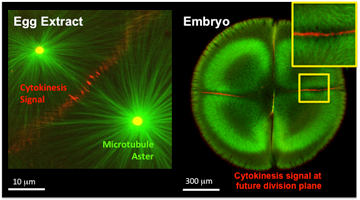
Harvard Medical School systems biologists report that they have "reconstituted" cytokinesis "complete with signals that direct molecular traffic" without the cell. The scientists combined frog-egg extracts with lipid membranes that have the ability to mimic the membrane of the cell. They essentially built a "cell-free" system that summarizes how a cleavage furrow is made. This system has two huge advantages: it makes the furrow-building events easier to see by expanding the scale, and it also gives the researchers an easier way to manipulate the proteins involved in the process. They can now more easily remove and return proteins to see how they affect the process of cytokinesis.
The main problem with this is that cytokinesis is completely dependent on having a membrane to furrow. By having a "cell-free" system, the membrane must be removed. This experiment is only possible by having a controlled, flat membrane. This membrane is made by having two layers of artificial lipid supported by glass.

The process begins by crushing unfertilized egg cells from the Xenopus frog and isolating their internal contents. The scientists built artificial centrosomes and fluorescent microtubules and then mimicked fertilization. They then used labeled proteins to "visualize the self-organization of structures required for the cell division process." This process uses fluorescence microscopy in ways that are not possible with living cells in tissue cultures. The final part of the process was the model of the cell membrane.
"To really prove that we reconstituted the cytokinesis signal, we needed to add the bilayer membrane and then see if it could recruit the proteins that would be on the cortex of the cell.... That's the signal to the membrane we were looking for," said Christine Field, HMS instructor in systems biology. Field had used actin in their system which was used to organize the long filaments and meshwork and allowed the components to move and change shape, including the membranes and other cellular components. Only when the actin is around can the microtubules signal to the plasma membrane and also to the actin cortex that forms on top of the plasma membrane. It was found that multiple types of signaling complexes are at work in the cleavage furrow. They "talk" from the microtubules to the actin cortex and then to the cell membrane.

"The beauty of this system is that we have reconstructed cytokinesis from its individual structural components: actin, microtubules and membranes," said Aaron Groen, a researcher in systems biology. "And we can now begin to spatially manipulate these components, which is not possible in live cells. I'm very excited by the possibilities."
Although their work is the most basic aspect of science, cell division is the center of embryonic development, stem cell renewal and cancer. The understanding of this process is relevant to many types of diseases.
It was exciting to see such an incredible breakthrough in science today. This can be the beginning to finding cures for countless types of diseases and I am very interested in where this research team is going next with their studies. I won't be surprised at all if this process is what helps in future medical breakthroughs.
Article: http://www.sciencedaily.com/releases/2014/10/141031133545.htm
Related Article: http://hms.harvard.edu/news/cell-division-minus-cells
Harvard Medical School systems biologists report that they have "reconstituted" cytokinesis "complete with signals that direct molecular traffic" without the cell. The scientists combined frog-egg extracts with lipid membranes that have the ability to mimic the membrane of the cell. They essentially built a "cell-free" system that summarizes how a cleavage furrow is made. This system has two huge advantages: it makes the furrow-building events easier to see by expanding the scale, and it also gives the researchers an easier way to manipulate the proteins involved in the process. They can now more easily remove and return proteins to see how they affect the process of cytokinesis.
The main problem with this is that cytokinesis is completely dependent on having a membrane to furrow. By having a "cell-free" system, the membrane must be removed. This experiment is only possible by having a controlled, flat membrane. This membrane is made by having two layers of artificial lipid supported by glass.

The process begins by crushing unfertilized egg cells from the Xenopus frog and isolating their internal contents. The scientists built artificial centrosomes and fluorescent microtubules and then mimicked fertilization. They then used labeled proteins to "visualize the self-organization of structures required for the cell division process." This process uses fluorescence microscopy in ways that are not possible with living cells in tissue cultures. The final part of the process was the model of the cell membrane.
"To really prove that we reconstituted the cytokinesis signal, we needed to add the bilayer membrane and then see if it could recruit the proteins that would be on the cortex of the cell.... That's the signal to the membrane we were looking for," said Christine Field, HMS instructor in systems biology. Field had used actin in their system which was used to organize the long filaments and meshwork and allowed the components to move and change shape, including the membranes and other cellular components. Only when the actin is around can the microtubules signal to the plasma membrane and also to the actin cortex that forms on top of the plasma membrane. It was found that multiple types of signaling complexes are at work in the cleavage furrow. They "talk" from the microtubules to the actin cortex and then to the cell membrane.
"The beauty of this system is that we have reconstructed cytokinesis from its individual structural components: actin, microtubules and membranes," said Aaron Groen, a researcher in systems biology. "And we can now begin to spatially manipulate these components, which is not possible in live cells. I'm very excited by the possibilities."
Although their work is the most basic aspect of science, cell division is the center of embryonic development, stem cell renewal and cancer. The understanding of this process is relevant to many types of diseases.
It was exciting to see such an incredible breakthrough in science today. This can be the beginning to finding cures for countless types of diseases and I am very interested in where this research team is going next with their studies. I won't be surprised at all if this process is what helps in future medical breakthroughs.
Article: http://www.sciencedaily.com/releases/2014/10/141031133545.htm
Related Article: http://hms.harvard.edu/news/cell-division-minus-cells
Saturday, September 27, 2014
Indispensible Nature of Cell Division Protein Questioned
There exist
various genetic factors and biological processes that are conserved throughout
time due to their essential nature to the biological world. One of those most
key is the process of cell division, by which genetic information is
transferred from one generation of cells to the next. All organisms rely
heavily on the continued functionality of the process of cell division, making
it unlikely for change in the procedure for this phenomenon to take place as
time progresses. Centromeres prove to play a crucial role in the process of
cell division, providing attachment sites for duplicate chromosomes to separate
to opposite poles within the cell. Microscopic analysis has continued to show
researchers that while always present, centromeres are quite variable in the
sequence of their coding DNA across the cells of different species. Regardless
of this variability CenH3, a DNA packaging protein, has continued to remain a
common factor for all cases of cell division to biologist knowledge until now.

Investigation by
researchers at Malik and Henikoff labs has shown that there exist insect
species whose cells lack this supposedly essential CenH3 protein. Their course
of research into this topic began with the observance that certain species of
insect, specifically butterflies and moths, had an abnormal centromere
structure. Analysis of insect chromosome structure and centromere organization
has allowed for researchers to divide various insects into two groups; these
are monocentric and holocentric insects. The monocentric insects have traditional
X-shaped chromosomes with singular centromere attachment while the holocentric
insects have chromosomes that appear like railroad tracks as the centromeres
run along the full span of the chromosomes with multiple attachments. Some
insects identified as monocentric are bees, flies, and beetles; some identified
as holocentric are moths and butterflies. Through genome sequencing analysis,
researchers were able to come to the conclusion that monocentric insects had
all conserved the CenH3 protein while holocentric insects had lost coding for
this protein at some point in evolution due to its lack of necessity in the
cell division process.

This proved an
intriguing finding due to the disappearance of a protein thought to be
essential to such a necessary process in the biological world as cell division.
This discovery raises many questions as to the possibility for other changes in
conserved genetic factors and biological processes among various species. This
also brings about thoughts regarding implications to the development of defects
in cell division.
I found this
article to be quite interesting in the questioning of such a fundamental
concept in biological studies. With a process like cell division, one would
assume all characteristics and factors involved to remain consistent even as
various species evolve due to the essential nature of this process. I find it
fascinating that the CenH3 protein has been lost in the genetic code for some
insects while not for others, and that this has not negatively impacted these
species. Findings such as this that challenge prior belief really add
excitement to the study of genetics. Maybe other similar discoveries will come
about in the near future.
Original
Article: http://www.sciencedaily.com/releases/2014/09/140924113748.htm
Related Page: http://www.plantcell.org/content/14/11/2825.full
Monday, September 22, 2014
Mitotic Cell Division Made More Clear
At any given moment thousands of cells are dividing by Mitosis in our bodies. During Mitosis the cell duplicates its genetic material and divides itself into two identical halves. If this process does not work efficiently it can lead to mutations which can cause diseases like cancer. A research on this complex mechanism was carried out by Manuel Mendoza and his team from Centre for Genomic Regulation (CRG) using yeast.
When a cell prepares to divide, it duplicates its DNA into pairs of identical chromosomes. This chromosomes are tangled and twisted amongst themselves. For a cell division to occur, this twisted chromosomes have to be untangled, and that is where the enzyme Topoisomerase 2 (Topo 2) comes into play. Topo 2 cuts the DNA knots, untangles the knots between replicated chromosomes, and then ties back the ends afterwards so each pair of chromosome can migrate to the opposite ends of the cell.
It was thought that Topo 2 acted quickly and equally on all the chromosomes. But it was found that longer chromosomes need extra help to undo the knots. This extra help to Topo 2 is given by microtubules. Microtubules anchor to the chromosomes at a precise point and pull them apart towards opposite ends, so each cell gets its individual copy.
Mendoza and his research team noticed the speed at which the microtubules pull the chromosome apart was constant. But, when a shorter chromosomes was under tension it would be untangled rapidly, on the other hand a longer chromosome took more time to come under tension (due to its long length), and therefore Topo 2 would finish untangling them for a longer time. The untangling only occurs when the microtubules begin to stretch the chromosomes (anaphase). Right up to that moment Topo 2 keeps doing its job.
It is surprising to know that not everything yet has been known about the Mitotic cell division as it is a repetitive mechanism that has been occurring in our bodies from the beginning of time. I think it is essential that everything about it should be known, and this discovery about the role of Topoisomerase 2 is step towards knowing the proper functioning of cell division and hence higher survival of all the cells, and living beings.
Article: http://www.sciencedaily.com/releases/2014/09/140916101958.htm
Related Article: Mitosis - http://www.nature.com/scitable/topicpage/mitosis-14046258
 | ||
| Mitotic Division in Cells |
It was thought that Topo 2 acted quickly and equally on all the chromosomes. But it was found that longer chromosomes need extra help to undo the knots. This extra help to Topo 2 is given by microtubules. Microtubules anchor to the chromosomes at a precise point and pull them apart towards opposite ends, so each cell gets its individual copy.
Mendoza and his research team noticed the speed at which the microtubules pull the chromosome apart was constant. But, when a shorter chromosomes was under tension it would be untangled rapidly, on the other hand a longer chromosome took more time to come under tension (due to its long length), and therefore Topo 2 would finish untangling them for a longer time. The untangling only occurs when the microtubules begin to stretch the chromosomes (anaphase). Right up to that moment Topo 2 keeps doing its job.
It is surprising to know that not everything yet has been known about the Mitotic cell division as it is a repetitive mechanism that has been occurring in our bodies from the beginning of time. I think it is essential that everything about it should be known, and this discovery about the role of Topoisomerase 2 is step towards knowing the proper functioning of cell division and hence higher survival of all the cells, and living beings.
Article: http://www.sciencedaily.com/releases/2014/09/140916101958.htm
Related Article: Mitosis - http://www.nature.com/scitable/topicpage/mitosis-14046258
Subscribe to:
Posts (Atom)