Showing posts with label convergent evolution. Show all posts

Tuesday, April 16, 2024

CYC2 Expression and flower symmetry understood through convergent evolution

 Scientists set out to capture a detailed family tree of the sunflower family, a family with over 28,000 species, based on DNA sequences. The sunflower head, which is radially symmetric (can be divided into equal halves in any direction), is made of multiple smaller flowers, which are bilaterally symmetric (has one line that divides the flower into equal halves). Hong Ma, the lead, and his team used low-coverage genome sequences through genome skimming to "increase the number of species available for comparison" (Science Daily). Along with the samples the team provided, they also used publicly available and newly generated data to collect a total of 706 different species which form 16 subfamilies, 41 tribes, and 144 subtribe level groups for the sunflower family. The study found that bilateral symmetry has independently evolved and been lost multiple times, which means the sunflower family shows signs of convergent evolution. They also found a gene, CYC2, that was activated in species which bilaterally symmetric flowers, which also added substance to the convergent theory hypothesis. Ultimately, the scientists found that the convergent evolution is likely due to changes throughout time in expression patterns of the CYC2 gene. 

The sunflower family is one of the two largest plant families with various agricultural and horticultural value. The family holds over 28,000 species and has evolved over thousands of years. Due to their huge role in both the agricultural and horticultural worlds, I feel that their detailed family tree was very interesting to see but also to understand trends seen in the tree, like the CYC2 expression patterns. It's interesting to see how much biodiversity there is within one species or family, and how it evolves and repeats over time. Gaining a more detailed family tree of such a dominant plant family could answer many questions about plant and genetic evolution, as well as questions about other plants with similar traits.  


https://www.sciencedaily.com/releases/2024/04/240403171035.htm#:~:text=A%20new%20sunflower%20family%20tree,of%20this%20large%20plant%20family.
https://www.earth.com/news/sunflower-family-tree-explains-evolution-of-flower-symmetry/ 


Monday, April 15, 2024

Convergent Evolution of Silks in Arthropods

This article details a study regarding the convergent evolution of silk production in a few different arthropods. In particular, the study selected a type of butterfly, three types of caddisfly, and a type of spider. They each had different uses for their types of silk. They found that the variation in silk gene alleles are relatively consistent when compared between organisms which have long since been independently evolving. They suggested that this means there are common mechanisms for the formation of those genes within organisms. The researchers stress that they would like to repeat this study with other organisms which share similar traits but evolved independently. 

    The topic of convergent evolution is one that has always intrigued me. I am particularly interested in the pathways that evolution takes to develop similar traits despite independent evolution of organisms… As well as the fact that the above study could be replicated and utilized to study other traits relative to convergent evolution. Not only am I interested in the replication of this study, but the evolution of silk producing glands and maintenance of them in arthropods is such a cool concept. Overall, I look forward to seeing what other types of evolutionary genetic comparisons these researchers go on to make.


Friday, February 9, 2024

Convergent Evolution of Viviparity in Insects & Beyond

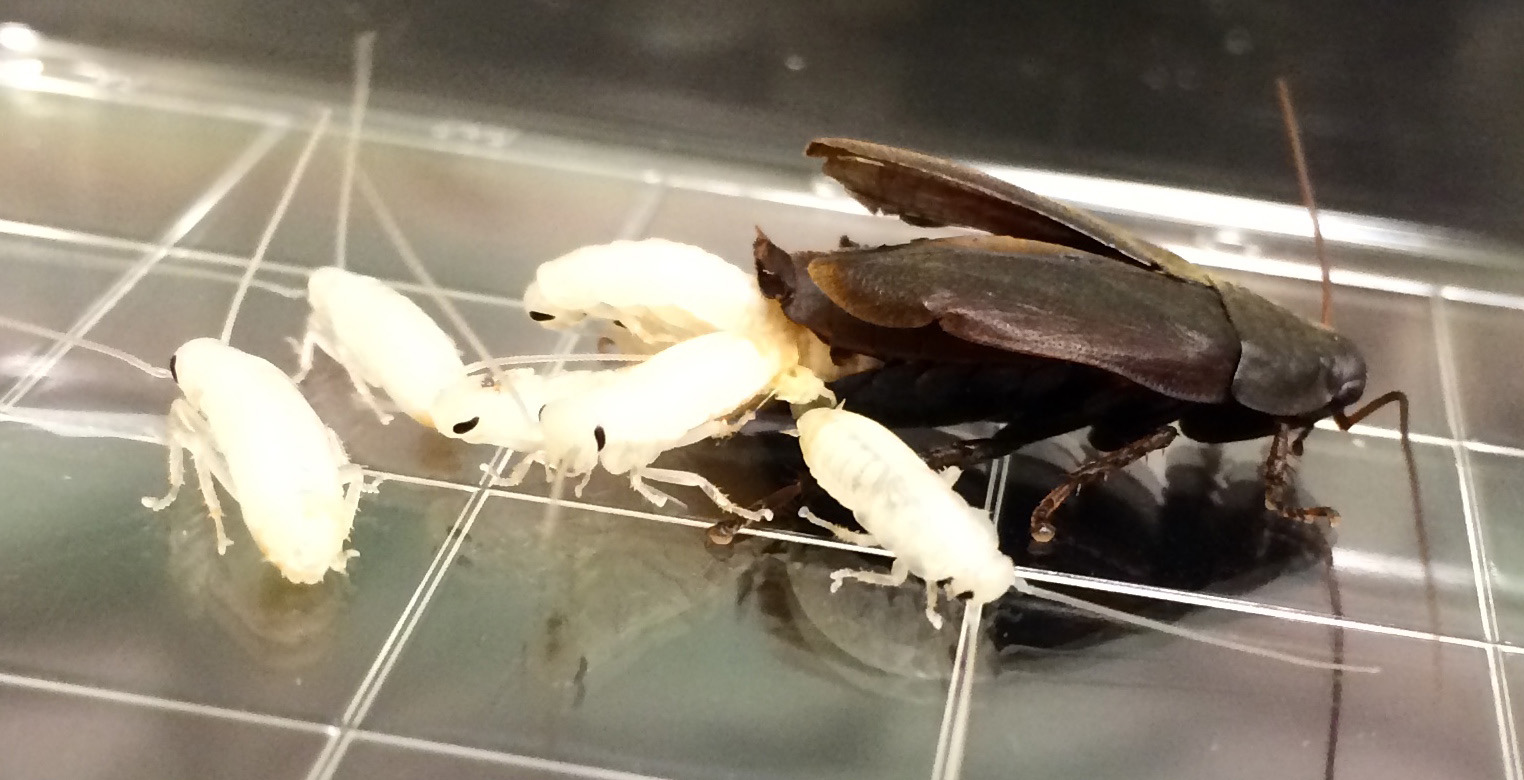
    This ScienceDirect article discusses the genome sequencing of D. Punctata, also known as the Pacific Beetle Cockroach. The study which the article discusses focused on several different orders of insects- including Blattodea (Cockroaches), Diptera (Flies), and Hemiptera (True Bugs), and how viviparity evolved independently in each of these orders. In each instance of viviparity, insects have their own specially evolved structures to support this function- such as placenta-like structures, brood sacks which act akin to a uterus... And even the ability to generate something like "milk", in  the instance of the Pacific Beetle Cockroach. These special adaptations to the urogenital system of insects are incredibly important, as otherwise the brood would not be able to receive proper care nor nutrients while within the mother. The development of these special structures rely heavily upon the rate of chitin metabolism- which is a polysaccharide insect exoskeletons are primarily made up of. The article also discusses how the bodies of viviparious insects have certain aspects of their immune system suppressed, so as to decrease the chances of their fetus being rejected. The results of their study suggest that developmental processes strengthen genes when under increasing selection pressure and positive selection.  Their study shows that in general, despite evolving independently several times, the genomic and transcriptional alterations are similar across all instances, be it within mammals, insects, or otherwise. 

    Personally, I find this topic incredibly fascinating. Usually people think of mammals when on the topic of live births, but the fact of the matter is that many other different creatures have the ability to do so. I think that it is interesting that small arthropods such as insects have evolved to be able to give live births, and even further, the adaptations that their bodies have, ie brood sacks and milk production, are even more incredible. Additionally, I find it almost endearing that creatures which may be seen as gross, such as cockroaches, can actually be considered good parents in the animal kingdom. 


Saturday, November 18, 2023

Microchromosome fusions underpin convergent evolution of chameleon karyotypes


Link to Article

Karyotyping

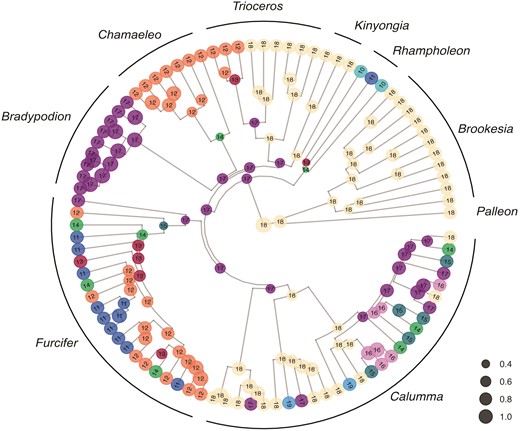
Convergent evolution is defined as the independent development of specific similar traits and structures, among species. Typically, a characteristic is considered to be convergent if the previous ancestor in the lineage did not possess the same traits. In this study, the hypothesis explores the wide variety of karyotypes in chameleons. Species in the Chamaeleonidae family can have anywhere  between 20 and 62 chromosomes, which, given their similar phenotype, prompted researchers to investigate what was driving the convergent evolution. The study explored microchromosome fusions, and found this to be the predominant cause for reduced evolutionary change.

Research was gathered from 57 species of chameleons, and PCR was utilized to amplify markers in the specimens. Chromosome samples were analyzed and separated into separate categories: haploid, diploid, arm number, macrochromosome, microchromosome and position of NOR loci. Sex chromosomes were not researched, due to their independence from autosomal chromosomes and different arrangements in various species.  Loss and gain of chromosomes was tracked on ChromEvol system. Estimates of chromosome numbers were generated for the chameleon genuses, as shown below, with the color and number indicating the number of chromosome pairs (haploid value). It is extremely interesting to see the convergence of traits, given the diversity of the Chamaeleonidae family.  Many of these species have had little to none research, so there is a significant amount of information we have yet to learn from these beautiful creatures.


Thursday, September 29, 2016

Great White Sharks and Tuna Share Common Genes That Allow Them To Be Top Predators

Great White Sharks and Tuna have evolved independently from one another for 400 million years. Despite this, scientists from the Imperial College London looking at these two species have found evidence that suggests that these two fish have similarities in many of their genes that allow them to be dominant predators. Genes linked to traits such as quick swimming behavior, metabolism and the animals ability to produce energy were passed down in both groups and expressed in both. These common genes amongst species that evolved independently of each other could help researchers determine the relationship between genetics and physical traits.


Physical traits are difficult to link directly to specific genes as gene expression can be different in every individual. Tuna and Great White Sharks live completely separate lives but both are top predators with similarly expressed genes. Examining two different species with comparable gene expression is extremely valuable for scientists to find the link between the genes a physical traits on display. In order to do this, the team members on this project collected muscle tissue from sharks as well as tuna to see all the genes that were expressed. In doing this, it was able to be determined that genes could be seen in both species that were associated with different functions such as a higher metabolism being selected for in these sharks. This could spark more questions to be asked on genetic expression and its link to physical traits.


Monday, February 8, 2016

Not Good Company in Bed


              Having to work with an exterminator may not be most people’s dreams, but most people aren’t biological geneticists. When Warren Booth, from the University of Tulsa thinks of New York City, he’s not singing the Frank Sinatra song; he’s thinking of bed bugs. Bed Bugs are perhaps the city’s bestmodel of evolutionary genetics. This is due to the species close extinction in the 1940’s as pesticides first emerged, yet an eventual flourish with new generations becoming resistant. In an article also posted by the New York Times earlier this week on these bugs, when Scientists mapped the genome of the bugs, they found co-relational variation of subspecies in relation to the subway lines. High transit is acting as a catalyst for these creatures to find ways to new niches, in which generations of bedbugs fill. Each neighborhood varies and subsequently the bedbugs niche it fulfills differs, amounting to a higher challenge to exterminate with so many environmental adaptions. So not only do New Yorkers have to pay the rising subway fare, the price essentially includes the diversification of bed bugs that travel with them.


          Dr. Booth teamed up with Dr. Ondrej Balvin, researcher from Charles University in Prague to assimilate a comprehensive data set of Bedbugs. The leading discovery was that, “The common bedbug, Cimex lectularius, feeds not only on humans but on other animals, especially bats. So as well as collecting human-feeders, the researchers gathered bedbugs from bat roosts in houses, churches and castles (Booth, 2016).” With this information, Dr. Booth was able to map out the DNA of 214 bed bugs. Although currently a part of the same species, he found extreme differences genetically in the bed bugs found in caves, and those collected by exterminators from apartments.


         This solidifies a prior hypothesis of convergent evolution; that bedbugs predominantly lived in caves, and when humans began to reside in caves, then bed bugs assimilated to their new host. One example of assimilation is the change in sleep cycle. As Bats are nocturnal bed bugs has to adapt to humans sleep cycle in order to receive sustenance. Bed bugs that still feed on bats follow their hosts sleep cycle. Also, these adapted bedbugs live longer with nutrients in human blood as opposed to those feeding on bat’s blood. This conclusion of almost near diversion within the same species is extremely exciting for Dr. Booth and others. They view these pests as a future new branch on the evolutionary tree, grafted on by humanity. However poetic of a light Dr. Booth may see the Cimex lectularius in, The Plaza Hotel still is unlikely to hold a convention presenting his results.