Showing posts with label PCR. Show all posts

Saturday, November 18, 2023

Microchromosome fusions underpin convergent evolution of chameleon karyotypes


Link to Article

Karyotyping

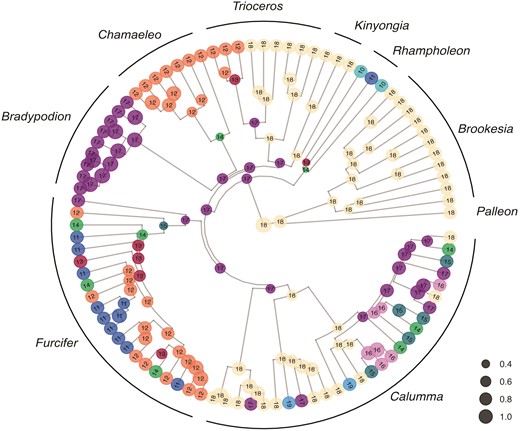
Convergent evolution is defined as the independent development of specific similar traits and structures, among species. Typically, a characteristic is considered to be convergent if the previous ancestor in the lineage did not possess the same traits. In this study, the hypothesis explores the wide variety of karyotypes in chameleons. Species in the Chamaeleonidae family can have anywhere  between 20 and 62 chromosomes, which, given their similar phenotype, prompted researchers to investigate what was driving the convergent evolution. The study explored microchromosome fusions, and found this to be the predominant cause for reduced evolutionary change.

Research was gathered from 57 species of chameleons, and PCR was utilized to amplify markers in the specimens. Chromosome samples were analyzed and separated into separate categories: haploid, diploid, arm number, macrochromosome, microchromosome and position of NOR loci. Sex chromosomes were not researched, due to their independence from autosomal chromosomes and different arrangements in various species.  Loss and gain of chromosomes was tracked on ChromEvol system. Estimates of chromosome numbers were generated for the chameleon genuses, as shown below, with the color and number indicating the number of chromosome pairs (haploid value). It is extremely interesting to see the convergence of traits, given the diversity of the Chamaeleonidae family.  Many of these species have had little to none research, so there is a significant amount of information we have yet to learn from these beautiful creatures.


Monday, October 25, 2021

European Goose Disease: European Variants of Parvovirus Detected Through PCR


    A study led by scientists at Sivas Cumhuriyet University in Turkey have found that new variations of Derzsy's disease, a parvovirus that affects many vertebrate species, have appeared in Europe. Using tissue samples from deceased eggs and infants of geese, the scientists were able to isolate the DNA of the virus from within the cells. Standard PCR was applied to create samples of DNA from the isolated virus that expressed the identity of the virus type. As a result, the nucleotide sequences had been compared to previously known variations and unique amino acids were identified. This study may assist in understanding what level of contagiousness and fatality may result from the spread of these variations.

Hopefully the study of these parvoviruses shows that the current vaccine is effective in treating/preventing more loss of livestock and reduced transmissibility between the animals and humans. I would be very upset to learn of more diseases affecting and hurting farmed organisms. I hope for efficacy for the sake of farmer's livelihood, goose health, and other organism's health in the face of a novel parvovirus variation.

Friday, August 6, 2021

The Testing of Covid-19

 THE TESTING OF COVID-19

    During this pandemic the Covid-19 virus has killed so many people and caused chaos around the whole world. In the beginning of the pandemic, there was no testing for it, after there are two main testing known as PCR and rapid. The most accurate testing would be the PCR which most of them get send to the lab. Most of the rapid testing are done in office, and most of them are antigen tests. 
    These test are performed by a nasal swab, which is the most effective way. It can also be done by saliva, it is less accurate than the nasal, but it is another option. The testing feels as if you had water up your nose. Unfortunately, this test must be perform in order to detect for the virus. As an MA (medical assistant) who performs testing and has been tested many times, the best test to choose is the PCR, most places that require a test ask for a PCR test. Rapid antigen test can come back as a false negative. It depends on the patient, and it is important to talk to your healthcare provider. 


2. https://health.ucdavis.edu/health-news/newsroom/different-types-of-covid-19-tests-explained/2020/11 

Tuesday, April 9, 2019

Disinfect water its important but is it enough?

Millions of Americans get sick and antibiotics are not a solution for the infections and many of these individuals die. The disinfectants used to kill bacteria or at least to prevent it from growing does not remove the genes that encode for the specific traits that make the bacteria resistant to antibiotics. Even though it is not proven that this is occurring at the moment, researchers want to be aware. A group of people from the University of Washington realized an experiment involving current water and waste water. It consisted in figuring out whether disinfecting water have an effect in antibiotic resistance genes in bacterial DNA. The results showed that qPCR analyses substituents for ARG deactivation. This result could be a rough prediction of actual deactivation levels. In order to provide more information about how this applies to ARGs and other bacterial species, additional work needs to be done. DNA itself is not harmful but it needs to be taken into consideration the effects it could have once it spreads in the environment such as having unwanted traits.


Bacteria are getting hard to kill with antibiotics

Many of us believe that when are buying a water bottle from the store, we are consuming clean water. This is definitely not true in all the cases, as mentioned above different disinfectants can be used to kill bacteria. This does not mean that this water is free from genes that protect bacteria from antibiotics.


Friday, November 16, 2018

Mosquitoes In Forensic Science


Forensics is still a new science that combines science and criminal justice and can provide evidence in a crime scene to either convict criminals or prove their innocence. There has been an emergence of new techniques in how exactly we extract DNA. Forensic scientists often extract DNA from physical objects within the crime scene. Other methods include locating DNA samples on domestic animals such as dogs and cats.

This article focuses on forensic entomology. A team of forensic scientists are discovering the possibilities of using DNA of human blood taken from the stomach of mosquitoes to solve criminal cases. Mosquitoes have been used to confirm the presence of a person in the crime scene although its reliability has been questioned. The article I read focused on one question: how long would the DNA remain viable as it becomes digested in the mosquito’s stomach? Volunteers of this study were asked to let mosquitoes bite them. After allowing a certain time for digestion, the DNA was extracted and amplified using polymerase chain reaction, or PCR techniques. This was used to determine the quantity of DNA left right after the mosquito’s blood feeding and who exactly the DNA came from. After two days of using PCR, the DNA was still identifiable but after the third day, the DNA was completely digested and therefore unrecognizable.

I think this form of DNA extraction is disregarded by some forensic scientists especially given that it is not the most reliable source. The fact that mosquitoes are only prevalent during the summer season and the chances of the criminal getting bit show that there are slim chances that the mosquito’s stomach contains the correct matching DNA or even any DNA. Also in the case where there are many mosquitoes at the crime scene, the work to amplify all the DNA from the mosquitoes can become burdensome and may result in zero evidence. But in the case where there is no evidence to begin with, then I think it’s a feasible beginning.

Links:
https://www.sciencedaily.com/releases/2017/07/170710092141.htm
https://journals.plos.org/plosone/article?id=10.1371/journal.pone.0179319
https://www.aetv.com/real-crime/animal-dna-crimes-csi-forensics-murder-kidnapping

Tuesday, September 11, 2018

PCR for Peanut Chloroplast DNA


This article from Science Daily summarizes a recently published article in the Journal of Agricultural and Food Chemistry about a new method involving DNA to detect trace amounts of peanuts in baked goods, chocolate and tomato sauce. This is extremely practical in the sense that peanut allergies are one of the most common allergies, and there are at least 3 million people in the US alone that suffer from this type of food allergy (1). A lot of people with this type of allergy can suffer from anaphylaxis when the allergy is triggered, even from only trace amounts of peanut. Anaphylaxis can be life-threatening and usually involves breathing difficulty, rashes, and nausea;  if not treated with the Epipen, it can lead to unconsciousness or death in extreme cases.

The team chose to study the chloroplast DNA of the peanut for several reasons. First, there had been previous research involving testing for the proteins in the peanut. This research is effective, but many of the proteins in peanuts can be destroyed during food processing. The nuclear DNA in the peanut can also be tested for with PCR, or polymerase chain reaction. However, it may prove challenging to find nuclear DNA sequences unique to only the peanut. The team wanted to try a new approach with chloroplast DNA in peanuts because chloroplasts are more abundant in the peanut compared with having only one nucleus per cell. The peanut chloroplast DNA is unique to the peanut only, so the team did not have to worry about overlapping sequences with other foods.

The team was able to successfully use PCR to test for three sequences in the peanut chloroplast DNA. Having three regions to test made their results even more convincing that the DNA is from peanuts, and not any other plant. The PCR successfully detected trace amounts of peanut in all of the food they tested, and were able to test for the peanut traces as low as 1 PPM. This is an improvement upon the 10-50PPM limit in PCR that tests for peanut nuclear DNA.

The reason I chose this article and enjoyed it was because of my personal connection. I have a severe egg allergy, and it too can be set off by trace amounts of egg, and it can even be triggered by breathing in the air containing eggs. I understand how serious these allergies can be because there can be cross-contamination with pots and pans and that is enough to trigger an allergic reaction. I am very happy to know that PCR can now detect trace amounts of peanut chloroplast DNA, but eggs do not have chloroplast. Maybe another team can develop a PCR method that detects mitochondrial DNA unique to eggs. It makes me very happy to know that there is research out there that is helping food allergy suffers make their lives a little easier. Maybe one day they will invent some kind of food scanner that can tell an allergy sufferer if the food contains the allergen. We're not there yet, but maybe one day.


Related article:

Scientists Have Identified A Key Gene Linked To Peanut Allergies

Wednesday, September 13, 2017

I Got Points Off Once For Having A large Percent Error, What Does NY Get?

As a normal person, I am one to think of ways to get out of legal conflict (aka I done goofed and got myself behind bars).  But today I am here to say, "Katie, look no further." Yes, ladies and gents, I am here to inform you that the people in charge of putting the convicts behind bars have come in clutch. According to a piece by Lauren Kirchner for they New York Times, New York City's FBI labs have been using faulty technology to do the impossible: identify suspects based on only a few picograms of DNA. And no, picograms is not a gram of the spicy and colorful salsa of the Spanish culture, pico de gallo.  Picograms is a really really really small sample of DNA (I'm talking 10E-12) that the public and some uninformed law enforcement believe a scientist can pinpoint to a certain person's DNA sequence. This feat of course came with consequences, such as sending innocent people to jail or not sending anyone to jail at all (including the suspects that were guilty!)  It seems that in a heavily concentrated bureaucratic system, the people ordering the sample to be analyzed did not realize that they were asking for something that is beyond the technology that is currently available.  But like any scientist that wants to please the people in charge of them, Dr. Theresa A. Caragine created new DNA analysis tests that is able to analyze smaller amounts of DNA than the technology that were being used currently (Kirchner, New York Times).  One technique that Dr. Caragine developed was the high sensitivity test.  This test pushed the usual technique of amplification through polymerase chain reaction a few cycles more to amplify the small amount of DNA a total of 31 times (compared to 28).  This allowed a larger sample to be analyzed, however like all good things, there is always a "but."  With larger amplification of the DNA sequence came larger amplification of imperfections from missing or contaminated DNA sequences.  Accounting for this, Dr. Caragine had to agree to only use samples that were 20 picograms or more before the use of her technique was approved by her directors.  This policy was not carried out correctly and samples as low as 14 picograms have been used as evidence to convict the accused, creating a larger margin of error.  This would be fine except in some cases, people who have had no other evidence against them have been sent to jail because of this technique.  This meant people who were going to be found innocent saw a different fate because of a technique that has an average error of about 20%.  After five years of continuous use, the techniques that Dr. Caragine had developed are finally going to be suspended until the percentage of error is at the more accepted value of less than 5% (Kirchner, Propublica).  Unfortunately, if I wanted to rob a bank in the city of New York and leave no trace except for a few skin cells, I'm going to have to pull a 30 second montage and get it done quickly.

Monday, March 28, 2016


When you buy whole fish at a fish market, it's possible to visually identify what fish your buying. When a fish is heavily processes, such as a frozen fish stick, it is near impossible to visually identify was species of fish is in it. In processed foods is where most mislabeling and misrepresentation of fish products occurs, mainly because its easier to get away with. Producers typically will substitute, mislabel, or misrepresent a fish product in order to make a greater profit, or utilize a species of fish that would otherwise not be legal to catch/sell. If your selling a fish stick and advertise it as containing cod, but secretly make it with a cheaper cod like substitute, they are less expensive to make and you can sell it at cod value. Other primary sources of mislabeling are between fishermen and buyers if the fishermen call a fish by a common name multiple species share.

This article, published in "Fisheries", delves into the global causes and effects of fish product misrepresentation and the genetic tools they used to gather data from whole and proceed fish to find the statistical rate or mislabeling. They collected 245 fish sample from a variety of markets in Spain, such as grocery stores, fish markets, restaurants, and wholesales food venues, and found that 7% of all fish sold were not what they were advertised as. 

They authenticated all fish collected using mitochondrial genes, which were extracted from even the most processed of fish products by means of polymerase chain reaction (PCR) amplification. An alternative method of identifying fish is bar coding mitochondrial cytochrome oxidase sub unit I (COI). The article itself when into excruciating detail as to the experimental process, far beyond the scope of this blog post. Interestingly, they found the greatest amount of fish fraud occurring in Wholesale stores, followed by restaurants and hypermarkets, with the most reliable fish products being sold at fish markets and grocery stores. 

The value of these methods of genetically authenticating fish products is protecting consumers from paying top dollar for bottom of the barrel fish products, enforcing fishing regulations by penalizing those passing of the fraudulent fish, and protecting endangered fish stocks from being illegally harvested and sold by names of fish that are legal to sell. Having a label of fish products that genetically authenticates that your tuna is tuna ensures there are no name changing shenanigans between the fishermen catching the fish, and the store/restaurant/etc that supplies the fish to your dinner plate.


Muñoz-Colmenero M, Blanco O., Arias V., Martinez J., Garcia-Vazquez E.(2016). DNA
Authentication of Fish Products Reveals Mislabeling Associated with Seafood Processing. Fisheries,  41, 128-137.

Tuesday, March 11, 2014

Individualized treatment plans for metastatic cancer patients prolong survival rate

Specialists at the National Cancer Institute have discovered a way to prolong the life of lung cancer patients whose cancer has spread to other parts of the body. Metastatic cancer is the term used for cancer that has spread from a place where it first started and contains the same types of cells as the original tumor. Scientists extract DNA from the tumor and then analyze the mutations by using a special test called a PCR. A PCR or polymerase chain reaction is a biochemical technology used to amplify a single or a few copies of a piece of DNA, generating thousands to millions of copies of a particular DNA sequence. Based on the information gained from the test, specialists can develop personalized treatment plans including oral drugs and biomarkers that can sometimes be more beneficial than traditional chemotherapy or radiation techniques. Arrieta Rodriquez is the head of the Laboratory of Experimental Oncology and Translational Medicine Studies at the National Cancer Institute and reveals some amazing statistics. "We have achieved an improvement of 80 percent in the metastatic stage and three times the survival. i.e., 30 months with good quality of life, while chemotherapy the response is just 30 percent in some cases".  If you have had cancer or are currently undergoing cancer treatment and would like to help this research group on their current project, a public questionnaire is available that asks questions regarding your quality of life. (The page is in Spanish, but browsers such as Google Chrome allow it to be translated to English.)


Picture A shows primary lung tumor (arrow) with mediastinal nodal metastasis (bold arrow). Picture B is after three cycles of chemotherapy, which shows a large reduction (almost completely gone) in the primary tumor (arrow) but and increase in size and uptake of mediastinal nodes (bold arrow). Also, Picture B shows the appearance of new metastasis (arrowhead) in the lymph node of the armpit. 

Picture from: http://journal.sajc.org/article.asp?issn=2278-330X;year=2013;volume=2;issue=3;spage=171;epage=178;aulast=Sharma

Thursday, April 18, 2013

What's Really in Our Food?

An article in the ScienceDaily suggests any plant or animals used in the preparation of food almost always leave behind their residual DNA. Scientists at the Institute of Molecular Genetics have came up with a technique that allows food to be screened for for the animal, plants, and microbial substances found in the food. They use techniques that allow for DNA sequencing. It allows for the identification of species we would not really suspect at a much higher accuracy than a PCR (polymerase chain reaction). This technique was developed by Dr. Thomas Hankeln and Professor Bertil Schmidt. In some trails they have done, they actually reported finding 1% horse meat in products such as mustard, lupin, and soy. Many food inspectors have shown in interest in their findings.

DNA on plate of food, What are you really eating?

I think that this is a great creation. I think it would really help out with issues with food allergies. One would be able to know exactly what is in the food and because of it’s accuracy the producers cannot bluff about it and get away with it. Also, with food inspections it would certainly be a great success. Food inspectors can’t always know what is in the food, but now it’s possible. This is an amazing development, and should definitely be introduced to the public soon.


Monday, December 5, 2011

Biohackers Bring Genetic Lab Home

Biohackers are attempting to bring the study of genetics and other sciences to the people by making inexpensive biotechnology. These innovations are sold for fractions of the cost of professional equipment and are simple enough to use at home. One of these devices is a homemade apparatus for performing PCR called OpenPCR. The professional machine costs a minimum of $6,000 whereas OpenPCR only costs $599, a tenth of the price.  Biohackers are excited for the possible educational opportunities the simplified technology will provide people who do not have access to a bio lab. People who could not have exposure to biotechnology whether from restrictive costs or simply because they are not studying in a college or university science lab can now learn how genetics is studied and manipulated in a lab.

Some of the technologies created by hackers are being utilized by professionals. The SpikerBox is an example of one such technology. The SpikerBox recognizes, copies and makes audible the sound of neurons firing. The genius of the technology lies in its low cost, only $90. The professional equivalent, the Preamplifier, costs $2,400. W. David Stahlman, a professor of psychology at UCLA, used the SpikerBox in his research.  His project was about hermit crab behavior and he used the SpikerBox to observe how behaviors are exhibited within the brain of the hermit crab. He said that the advantages to using this technology were the low cost as well as its ability to upload to an iPhone or an iPad.

Biohackers should be applauded for trying to innovate ways to perform lab techniques in less expensive ways. As scientific research costs decrease, funding can be used to do further research than is currently possible. Also, it allows for the general public to gain exposure to biotechnology which could increase overall awareness of how scientific discoveries are made. In terms of genetics, biotechnology would allow aspiring geneticists to perform independent experiments without prohibitive costs.

This is a summary of an article from Wired Magazine titled, "Genome at Home: Biohackers Build Their Own Labs."