Showing posts with label "Genomes" "RNA". Show all posts

Wednesday, November 26, 2025

The Genetic Alphabet Has Been Expanded and Welcomes New Proteins

     Researchers at Scripps Research have created a new paradigm that expands the genetic alphabet as we know it by engineering biologic molecules. As a typical protein is built from 20 amino acids encoded in mRNA by triplet codons, the new method done at Scripps use four RNA nucleotides instead of three. This new technique will allow for easy addition of non-canonical amino acids to proteins. 
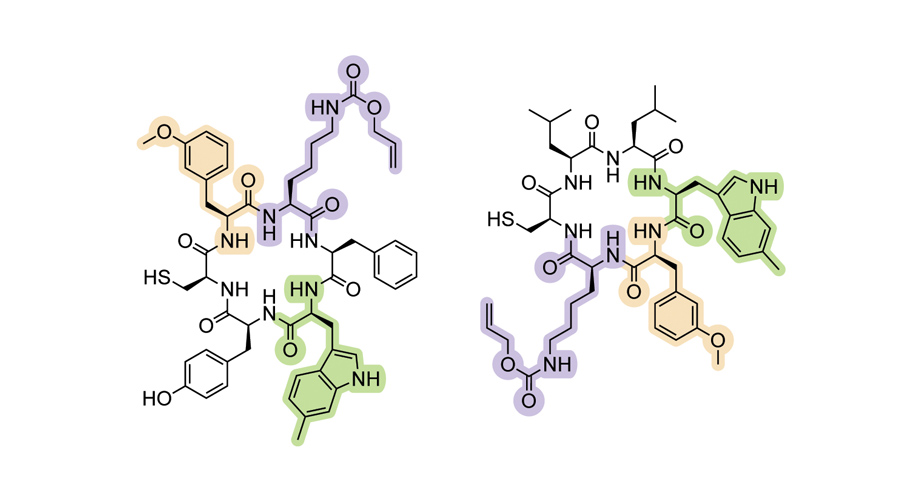
    

Figure I:  "Examples of the >100 macrocycles generated in this study. Colored components represent new-to-nature amino acids that were incorporated into either peptide" (Scripps Research)

    The engineering of unique transfer RNAs (tRNAs) correspond with the four-letter codons shows that editing one gene will incorporate the synthetic amino acids by using the cell's ability to synthesize proteins.Using this successful technique allowed scientists to generate over 100 new cyclic peptides (aka macrocycles), where all contain no more than three non-canonical amino acids. This result bypasses the need to rewrite the organism's entire genome, allowing for a flexible, efficient application to tailoring proteins. 

    Using this successful technique allowed scientists to generate over 100 new cyclic peptides (aka macrocycles), where all contain no more than three non-canonical amino acids. Lead researcher Dr. Ahmed Badran exclaims "our results suggest that one can now easily and effectively incorporate non-canonical amino acids at diverse sites in a wide array of proteins." 

    This newfound ability, when perfected, will broaden the horizons for future biological endeavors and presently, more research will only benefit the scientific community as a whole. 


Sources: 

https://www.scripps.edu/news-and-events/press-room/2024/2024911-badran-rna-nucleotides.html 

https://pubs.acs.org/doi/10.1021/acs.chemrev.5c00065


* sorry for black/ white highlighting, formatting was affected when taking quotes from study

Wednesday, December 11, 2024

Modern Drug helps Improve and Restore Neuron Function for Those Affected by Timothy Syndrome

A developing drug has shown promising improvements with restoring effective function to neurons affected/impaired by Timothy Syndrome, also known as Long QT syndrome Type 8. This syndrome caused by a single gene mutation is responsible for impairment across multiple body functions, notably that of the heart and brain. Neurons impaired by the disorder were restored by the introduction of this new drug class, being a Antisense Oligonucleotides, These medications specifically target the expression of certain genetic disorders by modifying RNA transcripts, and effective restoration of neuron function is just one of many potential uses this drug could employ. 


This drug class is incredibly promising as we scientifically discover more and more about the genetic expression and major roles regarding RNA. By studying many single-gene mutation caused disorders, modifying these drugs to specifically adapt and counteract the RNA related expression of these ailments becomes a real possibility and something to learn an incredible

amount from. 


Links:

Wednesday, November 13, 2024

tRNA as a function of energy production


A mitochondrial study unveiled new insights in how our cells use tRNA for the process of energy production. Researchers from the Karolinska Institutet, with the help of cryo-electron microscopy, have been able to identify the mechanism of mitochondrial tRNA 3’ processing by the enzyme RNase Z. The exact process of tRNA in mitochondria was not fully well understood, but with this study how the RNase Z complex recognizes and process tRNA molecules. It was discovered that there is a 5’ to 3’ processing order of the tRNAs, which makes sure that they are correctly prepared for protein synthesis. The researchers declared the directionality of tRNA as a crucial part of the process.

When thinking of tRNA, whether in mitochondrial processes or not, we understand its importance in the function of cells and organisms. Problems in the processing of these transport sequences can lead to serious mitochondrial diseases. Another study done by researchers from Kumamoto University revealed the critical role that tRNA has in modifying enzymes in the brain. By creating the absence of the TRMT10A gene in different mice subjects, the researchers encountered a decreased level of measured tRNA levels in the brain. Most specifically, in the initiator methionine tRNA, and glutamine. This process diminished protein synthesis and compromised the structural integrity of the synapses, leading to impaired cognitive abilities.

In my opinion, both studies show the importance of tRNA as part of the cellular process and its importance in the structural integrity of our making as organisms that can think and express ourselves. Furthering our understanding of the mechanisms behind tRNA in mitochondrial processes and energy production can lead us into having solutions for different genetical processes. We understand that failures in the tRNA messaging can lead to disease and cognitive disorders, and we also recognize now that without specific genes and enzymes that support our brain function, our tRNA can be compromised and so can our health. Understanding the mechanisms and consequences of tRNA and its implications in the human body is of crucial importance to me and it should be to everyone.


Sources:

https://medicalxpress.com/news/2024-09-reveals-critical-role-trna-enzyme.html

https://phys.org/news/2024-11-mitochondrial-insights-cells-rna-energy.html#google_vignette


Saturday, December 2, 2023

Researchers Uncover a New CRISPR-like System in Animals That Can Edit The Human Genome

 The First RNA-guided DNA-cutting enzyme found in Eukaryotes, named Fanzor, could one day be harnessed to edit DNA more precisely than CRISPR/Cas Systems

    The first programmable RNA-guided system in eukaryotes has been discovered by a team led by Feng Zhang at MIT's McGovern Institute for Brain Research. They published a study introducing Fanzor, a protein that utilizes RNA guidance to precisely target and edit DNA. Unlike CRISPR/Cas systems, Fanzor is more easily delivered. The team isolated Fanzor proteins from various species and demonstrated their ability to cut DNA using non-coding RNAs. Fanzors show promise for genome editing because they are efficient and can cut DNA very precisely without collateral damage. This marks a significant discovery in eukaryotic organisms. 
    This was honestly very surprising to me even though I don't know much about gene editing and why this is such a big discovery for eukaryotes. It was surprising to hear that something that comes from animals can be more precise at cutting DNA than CRISPR, as well as more easily deliverable. It is just crazy to me that new things are discovered all the time that just make other discoveries seem so complicated and out of date. It's very interesting to think how this is such a big discovery at this time but years later we'll hear about new technology that's even better than this. 

LINKS:


Wednesday, November 15, 2023

How Octopi Can Edit Their Own RNA to Rapidly Respond to Environmental Changes

How octopi can edit their own RNA to rapidly respond to environmental changes

 Organisms have multiple ways that they change their gene expression in response to stimuli. For example, an octopus thats suddenly put into frigid water can slow their enzyme activity. Some organisms can control their genetic responses to stimuli in another way, RNA editing. RNA editing involves the insertion and deletion of nucleotides in the RNA and has been visualized in mRNAs, tRNAs, rRNAs. It has not been yet visualized in prokaryotes. RNA editing is divided into two categories. One categories being insertion and deletion of nucleotides that changes the length of the target DNA. The second category is editing by base modification that changes a nucleotide into a different nucleotide, without changing the length of the RNA. The article describes how cephalapods, octopi, squid, and cuttlefish can change their mRNA in ways that can alter enzymes. Since the edits are in RNA and not DNA, they can go away quickly. The nucleotide adenine in the mRNA is replaced with inosine, a nucleoside that acts similar to guanine. This RNA edit can be known as "A-to-I RNA editing" and if it occurs in a protein, it alters its function. Finding out what the cephalopods use this RNA editing for was the big question. Researchers tested this by using the California two-spot octopus, which cannot generate its own body temperature, and placed both captive and wild octopi in tanks of 13 degress celcius. In these tanks, the researchers observed an increase in 13,285 mRNAs where the edited genes altered the proteins functions. When placing the animals back into warmer water of 22 degrees celcius, the amount of mRNAs decreased to 550. These RNA edits affected their nervous system and the scientists could hypothesize that the octopi were using these gene edits to cope with the change in temperature. 

Monday, December 4, 2017

Bees prefer certain color pigmentation caused by certain genes in Snapdragons


According to an article written by The New York Times, snapdragons lure in bees with the color of their petals. Apparently, the colors of the petals are a big contributor to whether or not bees will come to them to collect their nectar. According to the article, there are two colors of petals that were studied, the magenta and the yellow. In one species of snapdragon, the petals would be magenta with an accent of yellow on them, and the other would be the opposite with yellow petals with an accent of magenta. It turns out that both of these species shared 30,000 of the same genes, but they still had different colors for their petals. This change in color was represented by the change in sequence of small RNAs, which are made up of approximately 50-250 nucleotides, and are responsible for how certain genes express themselves. It turns out that if the small RNAs make the genes express magenta petals with yellow accents, then bees are more likely to come to them and the same goes for the yellow with the magenta accent. If there was not an accent on the petals for either color, then the bees would not be as interested in going to those snapdragons. This helps us better understand that natural selection still plays a major role on the ecosystem, since changes on the genetic level can lead to certain organisms to thrive, and others to not.
Natural selection has always been a very interesting subject to me. I think that it is very compelling that nature has ways of "selecting" for certain genes and alleles that allow for certain organisms to thrive and others to not. The idea that slight changes in DNA and RNA can lead to either extreme or very slight changes in behavior is so interesting because it shows us that multiple "solutions" in natural selection can benefit the same species in multiple ways as demonstrated by this experiment.