Showing posts with label "codons". Show all posts

Wednesday, November 26, 2025

The Genetic Alphabet Has Been Expanded and Welcomes New Proteins

     Researchers at Scripps Research have created a new paradigm that expands the genetic alphabet as we know it by engineering biologic molecules. As a typical protein is built from 20 amino acids encoded in mRNA by triplet codons, the new method done at Scripps use four RNA nucleotides instead of three. This new technique will allow for easy addition of non-canonical amino acids to proteins. 
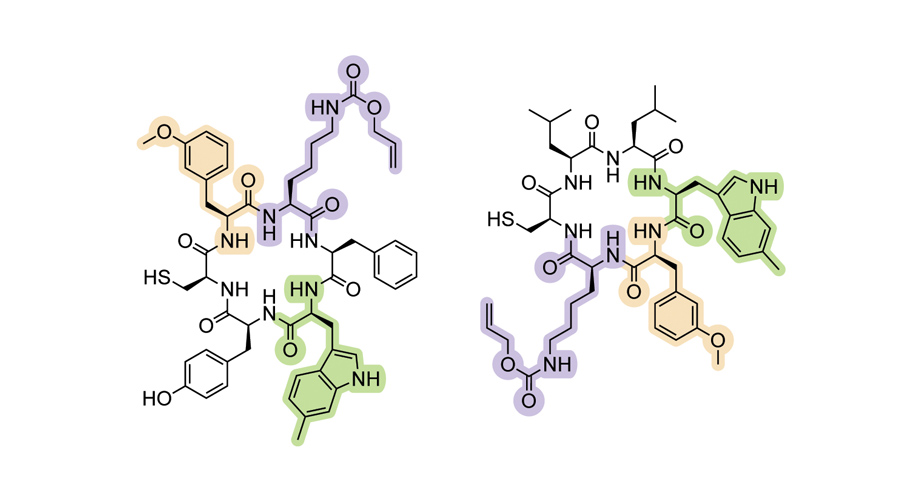
    

Figure I:  "Examples of the >100 macrocycles generated in this study. Colored components represent new-to-nature amino acids that were incorporated into either peptide" (Scripps Research)

    The engineering of unique transfer RNAs (tRNAs) correspond with the four-letter codons shows that editing one gene will incorporate the synthetic amino acids by using the cell's ability to synthesize proteins.Using this successful technique allowed scientists to generate over 100 new cyclic peptides (aka macrocycles), where all contain no more than three non-canonical amino acids. This result bypasses the need to rewrite the organism's entire genome, allowing for a flexible, efficient application to tailoring proteins. 

    Using this successful technique allowed scientists to generate over 100 new cyclic peptides (aka macrocycles), where all contain no more than three non-canonical amino acids. Lead researcher Dr. Ahmed Badran exclaims "our results suggest that one can now easily and effectively incorporate non-canonical amino acids at diverse sites in a wide array of proteins." 

    This newfound ability, when perfected, will broaden the horizons for future biological endeavors and presently, more research will only benefit the scientific community as a whole. 


Sources: 

https://www.scripps.edu/news-and-events/press-room/2024/2024911-badran-rna-nucleotides.html 

https://pubs.acs.org/doi/10.1021/acs.chemrev.5c00065


* sorry for black/ white highlighting, formatting was affected when taking quotes from study

Thursday, May 1, 2025

How Horses Hacked Their Genes to Become Super Athletes

New research from Johns Hopkins University reveals that horses owe their incredible athleticism to a rare genetic mutation and a clever evolutionary workaround. Scientists discovered that horses, donkeys, and zebras have a premature stop codon in the KEAP1 gene, which usually halts protein production and can cause disease. But in a viral-like twist, horses evolved a way to override this stop signal, enabling them to produce a full, functional KEAP1 protein.


This tweak supercharges the NRF2/KEAP1 pathway, which is vital for energy production and protecting cells from oxidative stress during intense exercise. The result? Horses generate more cellular energy and are better equipped to handle the physiological demands of speed and stamina. Beyond explaining horsepower, this discovery could open new doors for treating inherited and age-related diseases in humans, especially those caused by similar premature stop codons. As researcher Elia Duh puts it, this breakthrough highlights not only a key piece of horse evolution but also a promising avenue for medical innovation.

sources:

https://hub.jhu.edu/2025/05/01/genetic-mutations-and-evolutionary-trick-makes-horses-athletic/

https://www.science.org/doi/10.1126/science.adr8589

Tuesday, April 12, 2022

Life With Longer Genetic Codes Seems Possible, But Less Likely


A recent study talked about on Quantamagazine showed that life with the triplet codon design that we know makes up all of life on Earth is not the only possible way for life's genetic codes. The study showed that it is possible to successfully change an organism's genetic code from being a 3-letter triplet code to a 4-letter quadruplet code. This allows for 4 times the possible codon combinations. However, it was found that this resulted in the E. coli experimented on to produce only 9 of the 20 essential amino acids. It was also found that the quadruplet code translations were inefficient; sometimes to the point that it hindered cell growth. This experiment helped to shed light in a couple ways. One way being that it is possible for life to exist with a different coding mechanism than our triplet codes. Another way being that it shows why evolution has selected a triplet code over a more complex quadruplet code. Life as we know it works much better with triplet codes, but it is possible that there is life somewhere else in the universe that lives in a complex enough environment that a quadruplet code is better.

Wednesday, December 13, 2017

These Bacteria Use New DNA Bases to Make a Protein Not Found in Nature

Image result for bacteria

Researchers at Scripp's Research Institute have used semi-synthetic bacteria to incorporate unnatural bases in their genetic code, allowing them to make amino acids that code for proteins that do not exist in nature. These two new bases were made using chemicals called dNaM and dTPT3 and were named X and Y. E.coli was first used to copy the unnatural bases and only recently were they able to be stored and passed on to daughter cells. The interesting thing about these new bases is that the RNA was able to transcribe them and incorporate unnatural amino acids that would code for a protein. This ability was used to create an alternative green fluorescent protein. This constructed protein was not functionally different from the original, however the new base pairs contributed to every stage of recovering information from the genetic code and using it to build proteins. Researchers hope to use this new technology in medicine to rework a molecule.

https://singularityhub.com/2017/12/07/these-bacteria-use-new-dna-bases-to-make-a-protein-not-found-in-nature/
http://www.iflscience.com/plants-and-animals/scientists-describe-potential-new-addition-dna-code/