Showing posts with label eukaryotes. Show all posts

Saturday, December 2, 2023

Researchers Uncover a New CRISPR-like System in Animals That Can Edit The Human Genome

 The First RNA-guided DNA-cutting enzyme found in Eukaryotes, named Fanzor, could one day be harnessed to edit DNA more precisely than CRISPR/Cas Systems

    The first programmable RNA-guided system in eukaryotes has been discovered by a team led by Feng Zhang at MIT's McGovern Institute for Brain Research. They published a study introducing Fanzor, a protein that utilizes RNA guidance to precisely target and edit DNA. Unlike CRISPR/Cas systems, Fanzor is more easily delivered. The team isolated Fanzor proteins from various species and demonstrated their ability to cut DNA using non-coding RNAs. Fanzors show promise for genome editing because they are efficient and can cut DNA very precisely without collateral damage. This marks a significant discovery in eukaryotic organisms. 
    This was honestly very surprising to me even though I don't know much about gene editing and why this is such a big discovery for eukaryotes. It was surprising to hear that something that comes from animals can be more precise at cutting DNA than CRISPR, as well as more easily deliverable. It is just crazy to me that new things are discovered all the time that just make other discoveries seem so complicated and out of date. It's very interesting to think how this is such a big discovery at this time but years later we'll hear about new technology that's even better than this. 

LINKS:


Wednesday, November 8, 2023

Thousands of DNA- Cutting Enzymes Found in Eukaryotes


Many eukaryotic organisms contain DNA cutting enzymes called Fanzors and scientists at MIT’s McGovern Institute for Brain Research have identified that there are thousands of them.  Fanzors are RNA- guided enzymes that can be programmed to cut DNA at specific sites and its diversity gives scientists a large set of programmable enzymes that could be adapted into new tools for research or medicine. These enzymes are much like bacterial enzymes known as CRISPR, bacterial enzymes that power the widely used gene editing system. CRISPRS have made clear how useful RNA guided enzymes can be when used in the lab. The CRISPR-based genome editing tools were developed by MIT professors and McGovern investigators. These editing tools have changed the way scientists modify DNA, accelerating research and enabling the development of a lot of different types of gene therapies. Fanzor enzymes can be programmed to cut specific DNA sequences and it has been discovered that Fanzors can target DNA sequences in humans without optimization. Fanzors likely evolved from the RNA-guided DNA-cutting bacterial enzymes called TnpBs. The traced evolutionary connections suggest that the TnpBs probably entered the eukaryotic cells, some had likely been transmitted by viruses and some were likely introduced by symbiotic bacteria. A feature that they had developed through evolution was having a signal that allows them to enter a nucleus of a cell, where they would have access to DNA. The research team determined that Fanzors evolved a DNA-cutting active site that is distinct from their predecessors. The active site seems to allow the enzyme to cut its target sequence more precisely than the ancestors of TnpB. When the other enzymes are targeted to a DNA sequence in a test tube, they become activated and cut other sequences in the tube, which is something that the Fanzors do not do. When the researchers used an RNA guide to direct the enzymes to cut specific sites in the DNA of human cells, it was found that certain Fanzors were able to cut the target sequences with about 10% to 20% efficiency. 

These new findings are very important as they could help with discovering different, sophisticated genome editing techniques. Hopefully, with the discovery of the diversity of Fanzors, enzymes naturally evolved in eukaryotes could be better suited to function safely and efficiently in other eukaryotes, including humans. This article was exciting to read because it indicates the promises of further discoveries of different editing techniques for DNA.


Sources:

https://news.mit.edu/2023/thousands-programmable-dna-cutters-found-algae-snails-other-organisms-1013 

https://news.mit.edu/2023/fanzor-system-in-animals-can-edit-human-genome-0628 

Thursday, May 2, 2019

The Medusavirus


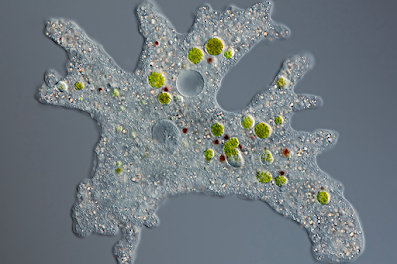
Virologists have recently discovered a giant virus, much like the mythical monster- Medusa, that can turn amoebas into "stone". The discovery of the Medusavirus holds clues to more complex life. This virus infects a species of amoeba known as Acanthamoeba Castellanii, and causes it to develop a hard stony shell. Researchers have discovered that DNA replication occurred in the nucleus of the host amoeba and evidence of exchange of genetic information between both the host and virus was observed. It was also discovered that the Medusavirus contains some of the complex protein building blocks of eukaryotes. Scientists have even stated that, "genomics research of the giant virus indicates that there is likely a relationship between the Medusavirus and the origin of eukaryotic life." Viruses are classified based on how they generate mRNA to produce proteins and genetic material. The Medusavirus is a nucleocytoplasmic large DNA virus. Unlike most viruses, it contains genes that encode for proteins that involve DNA packaging. This virus has a full set of histones, which are proteins that help keep the DNA folded within the nucleus. This was very strange to scientists considering viruses do not contain a nucleus. This could mean the virus acquired the histones during coevolution. This could mean that the Medusa virus is a family all on its own. Overall, I think this is a beneficial discovery that can help better understand the virus genome and better equip ourselves with possible vaccines. 
A new giant virus may help scientists better understand the emergence of complex life.

Friday, March 8, 2019

Stolen Genes


An article from Science Magazine is posing the question if eukaryotes have had an evolutionary "helping hand" because of their cell nucleus when it comes to genes that are transferred from bacteria. When scientists analyzed the genomes of some red algae, which are single-celled eukaryotes, they found that 1% of the genes came from foreign origins. It is suggested that these genes that were acquired helped them adapt to their environments. Prokaryotes regularly and heavily swap genes within a species and it is suggested that this ability is beneficial to evolution.

I wasn't aware that prokaryotes were capable of swapping genes and would really like to know more about how that works. This article from NCBI talks a little bit about genetic switches. The article stated that the sequencing of the human genome has also suggested that at some point humans may have picked up microbial genes, which I also find very interesting.

Thursday, January 24, 2019

Little Known about Fungi Defense


A New York Times article discussed about how little is known concerning fungi's defense system. Humans are capable of sending and receiving nerve impulses and plants have the vascular system; fungi lack these processes. In a recent study, scientists gave mushrooms to nematodes who digest fungi. Unknowingly, the mushroom sensed the presence of invaders and sent signals throughout the body. Under a microscope, researchers added a dye, which exhibited genes that turned on as the signal traveled through the mushroom. Gene activation enabled the mushrooms to produce poison for the foreigner. There is sparse insight about fungi defense mechanism and some scientists predict there may be some chemical signaling distinct from animals or plants.


It is truly baffling that in this day and age with technology booming at a fast pace, there is still so many unanswered questions. Fungi are quite distinct eukaryotic cells that share a closer relation to animals than plants. Their primary role is to decompose and recycle material in the environment. I agree that further scientific investigations should continue in order to properly acknowledge how the defense system of fungi work. It is quite exciting when new information is uncovered and shows how biology evolves.    

Monday, April 11, 2016

New 'Tree of Life' Diagram

A team of scientists have recently recreated the "Tree of Life" diagram. They extended the amount of organisms primarily under the bacteria branch because they have found such a vast amount in mud of meadow-lands. They pulled pieces of their DNA to be analyzed through a separated that separated each entry to create the new diagram. The new tree has a thinner branch for eukaryotes with archaeabacteria being shown as having a closer relationship between the two. They have selected 3,000 species to be on this new tree with over 1,000 being newly discovered species. However there is speculation that some of these species could be chimera which would have a mixture of DNA from more than one organism. There is also the debate of whether the bacteria branch has begun to plateau or if there is an astoundingly larger amount out to still be discovered.

Aesthetically, the tree looks a lot more interesting than what Darwin's original "Tree of Life" from his 1859 book "On the Origin of Species". There is so much more to the new diagram, and it gives a better idea of how vast the amount of bacteria there are especially in comparison to eukaryotes such as mammals. I believe that there are more bacteria to be discovered that will only belittle the amount currently depicted. With the advancement of technology discovering new species should be simple. I do find it peculiar how archaeabacteria is actually more closely related to eukaryotes as opposed to bacteria. Archaeabacteria seem like very simple organisms that do not have the same complexity of eukaryotes.
Figure 1. New "Tree of Life" Diagram.

Figure 2. Darwin's Original "Tree of Life" Diagram