Showing posts with label trees. Show all posts

Tuesday, November 14, 2023

The Return of American Chestnuts, A Triumph of GMOs

 The American Chestnut Castanea dentata used to be a critical component of the North American Eastern Forests for centuries, what happened to them? At the turn of the 20th Century, a fatal fungal blight was introduced from Asian Chestnut Trees. By the 1950s, around four billion American Chestnut trees were dead, with only100 individuals persisting in isolated geographic areas.

Historic Range of the American Chestnut

With such few individuals and no viable means to reliably pollinate them to produce new offspring across such broad geographic areas, the American Chestnut seemed destined to extinction. This imminent extinction prompted a concerted effort by botanists, foresters, and geneticists to save the species. Through a combination of identifying American Chestnuts that survived the blight naturally and genetic modification blight resistant cultivars were developed and planted. One such blight resistant cultivar was developed at Salt Air Farm in Long Island NY. In 1998 a single resistant individual was planted on the property, with six more planted since then. The largest individual of the Long Island population has produced nuts as well highlighting the success of these conservation projects.
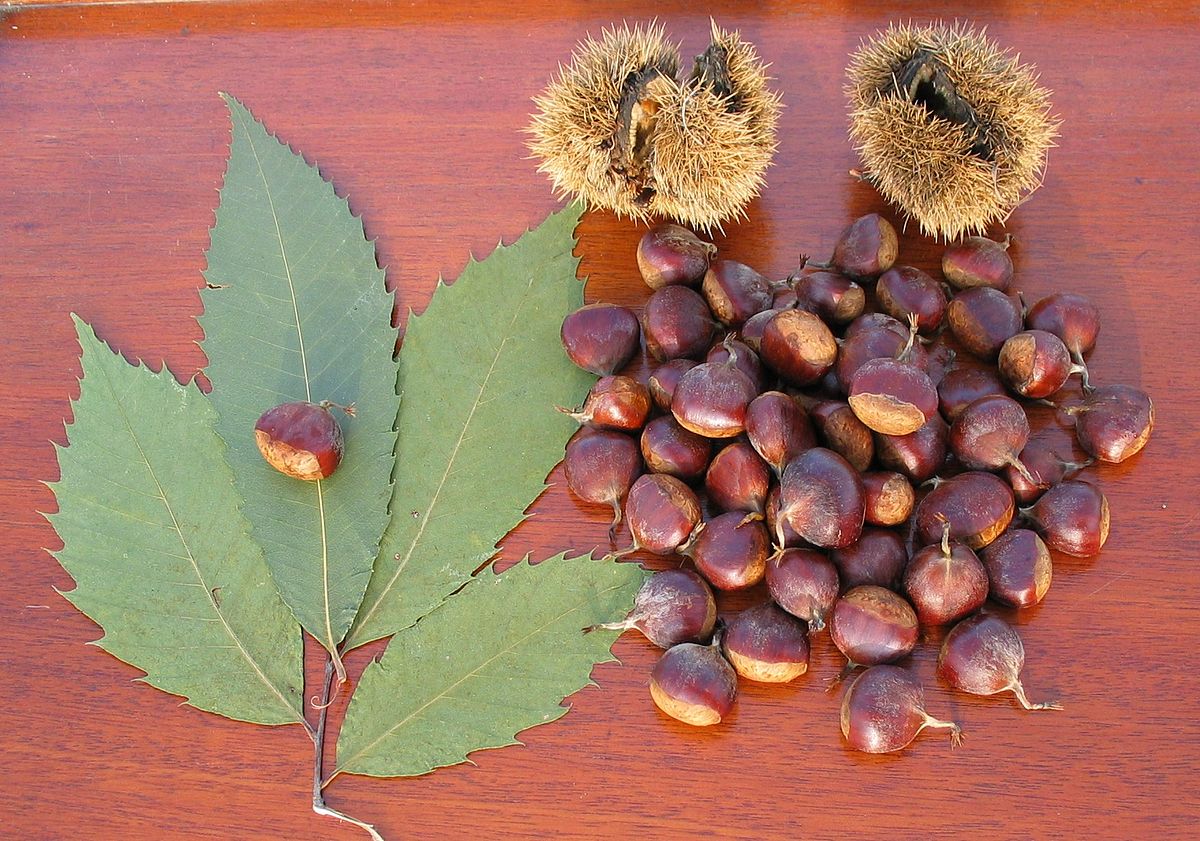
The leaves and nuts of the American Chestnut 

Another blight resistant cultivar, Darling 58, was developed at SUNY ESF by inserting a gene named Oxalate Oxidase (OxO). OxO is found naturally in wheat and helps to break down the acidic byproducts of the blight fungus' lifecycle. This allows Darling 58 Chestnuts to be infected by the blight fungus without suffering the ill effects, a sort of win-win scenario for both the American Chestnut and the fungal blight. Darling 58 is unlikely to hit the public market until after 2025 but the hope this additional cultivar brings to conservationists cannot be understated. 

A historic photo of a massive old growth American Chestnut


It cannot be understated how wonderful this effort is as it could very well bring back a species from the brink in a thunderous fashion. It is far from perfect though as with such few individuals to pull from, the genetic composition of future American Chestnuts will likely be bottlenecked, making them potentially more susceptible/sensitive to novel diseases or climate changes. This worry at this stage is only hypothetical however, and this news should be celebrated at this point with a grain of salt. 


Thursday, November 26, 2020

Can Trees Get Cancer?


In an article published by PBS, a fascinating aspect of the Chernobyl catastrophe was brought to light, which was the effect that the radiation had on trees in the area. And, as it turns out, trees can get cancer, especially the trees in Chernobyl because of the amount of radiation they are exposed to. Radiation is not the only way in which trees and other plants can get cancer, they can also get cancer via mutations in their DNA, just like in humans and other animals. What I find particularly interesting is that cancer is not as lethal in trees as it is in humans and other animals. This is due to two main reasons. The first reason is that trees do not have a true circulatory system like humans have. Human circulatory systems contain cells with specialized functions, but trees’ “circulatory systems” do not transport cells, they transport nutrients, like in the form of sap. This means that it is very difficult for the cancer cells to metastasize, meaning that the cancer cannot spread to different regions of the tree nearly as easily as they can in humans. The second factor also limits the cancer’s ability to metastasize, and that is the plant cell well. Even in there was a true circulatory system in plants, the cancer cells would not be able to just break off and spread to different parts of the tree. The cancer cells are rather confined in that one location due to the structure of the cell. Since the tree cancers have difficulty spreading throughout the entirety of the tree, the cancer cells cannot cause nearly as much damage as they can in humans.


Friday, April 26, 2019

The Genetics of California's Oldest Trees

An article in the San Francisco Chronicle discusses the large multi year project that was conducted to sequence the genomes of the coast redwood and giant sequoia trees, which are some of California's oldest living trees. They are doing this to see which trees are better suited to adapt to a newer, warmer climate, and to see how the trees have adapted over the past years. While sequencing they found that the Coast Redwood is the second largest genome ever sequenced, with about 27 billion base pairs with 9 times the size of the human genome. Now that they have sequenced the genome they plan to observe which genetic traits perform better than others so that they can compile a sort of map for the future conservation of the different species in those areas. Researchers also find this work to be important as about 95% of California's old growth has been wiped out, so there is not much that genetically remains of the different types of species in these areas.   


I think that this article is rather interesting because trees are some of the oldest living organisms on the planet so I think it would be very beneficial to learn all that we can from their genetics while we still can. I also think it was fascinating to learn that almost 95% of the California’s old plant life is nearly gone, which sort of makes it even more imperative that we start to make more progress towards learning about, and conserving them to the best of our current abilities.  

Monday, April 17, 2017

Dental plaque leads to news about Neanderthal diet


Research done by  Laura Weyrich, a microbiologist at the University of Adelaide in Australia, has shown that plaque found in fossilized teeth proves that Neanderthal diets were a wide range of things. DNA was recovered from calcified plaque on teeth from four Neanderthal individuals. Two groups were found, one from the grasslands and one in the forests. The DNA from the individuals around the grasslands proved to eat woolly rhinoceros and wild sheep and the DNA from forests showed to eat moss, mushrooms and pine nuts. This shows that Neanderthals were neither vegetarian or herbivores. Also found in the DNA were materials from trees that act as aspirin. Any information found in fossils is truly amazing. To further our knowledge on the cavemen, helps us understand evolution and how we are today. This article shows that the Neanderthals were very smart, and knew about medicine way before we thought they did. This is a major break through for us. 


Article: https://www.sciencenews.org/blog/science-ticker/ancient-dental-plaque-tells-tales-neandertal-diet-and-disease
Related article: http://www.pnas.org/content/108/2/486.full.pdf

Saturday, April 18, 2015

Making Trees grow Bigger and Faster

Section of a genetically modified Poplar tree

Researchers at the University of Manchester have successfully isolated two genes in poplar trees responsible for the rate of their growth. The genes, PXY and CLE, dictate the rate of cell division in the plant stem. Cell division is the driving force behind growth of the organism, so by over-expressing PXY and CLE, researchers found that the trees grew at twice their normal rate, to a much larger final size and with more leaves.

The implications of this discovery are very positive and applications of it extend to many areas. For one, wood commands one of the highest demands of the biofuels. Faster growth of trees may significantly increase sustainability in the wood industry, let alone allow for the discontinuation of deforestation. The study could potentially be extended to crops as well. Their increased growth rate and size may allow them to overcome their chemical signaling that leads to a lower yield when faced with worsening environmental conditions such as global warming and pollution. I am very excited to see where this research leads, and hope that it will better our world in a major way.

Thursday, April 16, 2015

Making Trees Grow Bigger and Faster

The University of Manchester recently released the results of their study on gene manipulations in an Arabidopsis plant. Lead by Professor Simon Turner, the team successfully discovered a way to make the small flowering plant grow faster and bigger. Two genes (called PXY and CLE) which control the growth were manipulated to be over expressed which lead the plant in the study to grow twice as fast and taller. The altered organism also had more leaves which are responsible for oxygen production.

Although this has not yet been tested in nature or larger trees, it is a great discovery that can pave the path for future studies to implement this type of technique in the wild. This could lead to increase of bio fuels, renewable resources and producing more oxygen while also taking CO2 out of the atmosphere! While many people may be against genetically modified plants, I believe this would be beneficial to the planet to replenish tree populations that have been destroyed while also counteracting our carbon dioxide pollution.

Ways trees benefit the world

A New Tree


Professor Simon Turner from the Faculty of Life Sciences led the research: "The rate at which trees grow is determined by the rate of cell division in the stem. We have identified two genes that are able to drive cell division in the stem and so override the normal growth pattern." The two genes they found were PXY and CLE. They control the growth of the tree trunk, when overexpressed the trees grew faster, wider, taller and produced more leaves.
 
I think this is great research being done and can lead to a better future. It could help with global warming. It would lead to more oxygen being released into the air than CO2. Because at the rate we at we will be walking around with oxygen tanks on our backs.
 
Source:

Friday, April 10, 2015

Red Wood Cloning May Help Forest Management

Red wood trees are well known for their incredible size and impressive longevity, but very few
people realize there’s more to the great trees than their size. Red Wood trees are often examined in biology for their cloning tendencies, as they are prone to sprouting entirely new trees from roots, cut branches, and fallen stumps of grown trees. Not much research has looked at the lineages created by these cloning trees, but a recent study at UC Berkley has pioneered this kind of study. Because Red Woods are hexaploid – that’s right, not one or two but six sets of chromosomes in the genome – their lineages are difficult to trace, especially with the chance of mutation taken into account. In the UC Berkley study, DNA was extracted from 770 redwoods and 449 distinct clones were identified. Because redwoods are prized both for their natural preservation and their youthful lumber, understanding the genetics of redwoods could help create healthy forest management options for redwood lumber as well as help in the current actions beign taken to preserve currently growing redwood areas. The head researcher of this study hopes that clonal studies could expand beyond redwoods to other cloning species, as well as help scientists understand the physical structure of forests.

Monday, November 24, 2014

Genetic resistance agains budworm in spruce

A gene for the natural resistance to budworm, a common pest, has been identified in white spruce trees by scientists at Universite Laval, the University of British Columbia, and the University of Oxford.

The research consisted of the professors, students, and postdocs comparing the genomes of the resistant trees versus those of the spruces that suffered significant damage. The gene, betaglucosidase-1, was expressed up to 1,000 times more in resistant trees than in non-resistant trees. The gene produces a natural insecticide in the spruce's needles. The degree of the expression varies by the individual.

The discovery of this gene is of great significance to forestry. For example, planting saplings from particularly resistant lineages would produce a forest full of resistant spruces.

link: http://www.sciencedaily.com/releases/2014/11/141121102920.htm

Wednesday, March 26, 2014

Genome Sequence of Lobolly Pine

Scientists have just successfully mapped the genomic sequence for a very important tree to Americans - the Lobolly pine. The tree has been used for many years in the United States and in other countries for paper products and is now being looked at for using in biofuels. This mapping is a huge accomplishment because it is now the largest genome sequenced to date with over 22 million base pairs. Researchers were able to do this because of new methods that have been developed so that larger scale genomes are able to be successfully put together. The new method had to do with putting overlapping parts of the sequence in larger chunks and then throwing away the redundant information. This cut down on the time that it took to process immensely. By mapping this genome, scientists are hopeful that they will be able to pinpoint the location of genes that fight pathogens in these trees, along with other useful information relating to their genome sequence.

While typically something like this wouldn't interest me, since botany isn't my field of study, I found this article interesting. It has to do with more than just Lobolly pines because the methods that scientists used for mapping the genome of this tree can be used for mapping other genomes too. This is quite exciting that the gene mapping is progressing even as we speak. Scientists are constantly coming up with more efficient ways of sequencing genes and I am sure that it will be beneficial for everyone.