Showing posts with label gut microbiome. Show all posts

Saturday, October 28, 2023

Probiotics: Biofilm Formulation Protects The Intestines and Brain

Necrotizing enterocolitis (NEC) is a deadly, debilitating disease that affects premature babies, causing inflamed intestinal tissue and even ischemia and necrosis of related tissue in severe cases. Children who manage to live to adulthood can face several lifelong challenges, like neurodevelopmental delays and short-gut syndrome. Oftentimes, NEC treatment involves surgical removal of the dying tissue.

Working to create a novel preventative solution, principal research investigators at Nationwide Children’s Center for Microbial Pathogenesis developed a probiotic system employing the durability of biofilm to improve probiotic administration to neonate patients. Hoping to demonstrate their model’s efficacy in an animal similar to humans, a piglet model of NEC was adapted to the study, providing the same care given to premature infants in terms of the medication and fluids, nasogastric tube feedings, and monitoring done and given. Overall, the data from the piglet model supported those of the initial rodent model, and the findings demonstrated that the Lr’s (Limosilactobacillus reuteri) biofilm protected both the brain and intestines from NEC, preventing the associated morbidity and mortality. 


Considering the severity of a child’s condition after developing NEC, it was interesting to learn about how bacterial biofilms (often having a negative connotation) could be applied to life-saving treatments to protect newborns. By using this piglet model, as well, we can better understand the safety issues associated with this biofilm formulation and provide a better foundation for researching neonatal risk for certain diseases. Potentially, a clinical trial may even be possible in the foreseeable future thanks to this model.


Click here for information

Click here for the journal article for the study information

Friday, April 15, 2022

Decoding a direct dialog between the gut microbiota and the brain


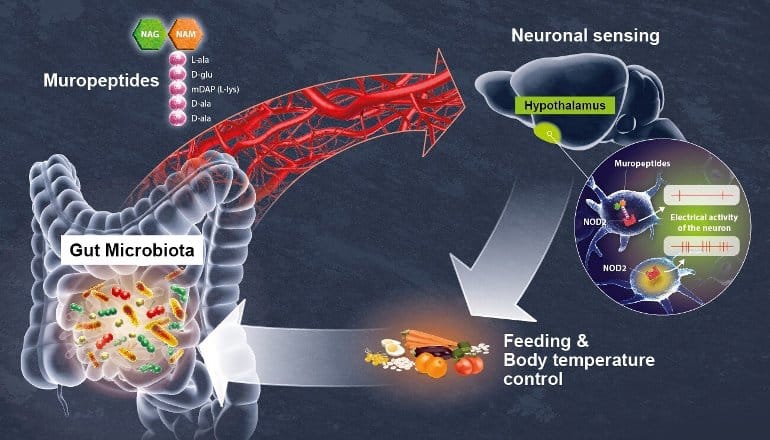
By-products of the gut microbiota circulate in the bloodstream, altering host physiological processes such as immunity, metabolism, and cognitive function. Hypothalamic neurons in an animal model directly sense differences in bacterial activity and adapt appetite and body temperature appropriately, according to researchers from the Institut Pasteur (a partner research organization of Université Paris Cité), Inserm, and the CNRS. These findings show that the gut microbiota and the brain communicate directly, a finding that could lead to new therapeutic methods for metabolic illnesses including diabetes and obesity. The gut is the body's greatest bacterial reservoir. The degree of interaction between hosts and their gut microbiota is becoming clearer, highlighting the relevance of the gut-brain axis. The researchers concentrated their efforts on the NOD2 (nucleotide oligomerization domain) receptor, which is present primarily in immune cells. Muropeptides, which are the building components of the bacterial cell wall, are detected by this receptor. Furthermore, variations of the gene coding for the NOD2 receptor have previously been linked to digestive problems, such as Crohn's disease, as well as neurological diseases and mood disorders. These findings, however, were insufficient to show a link between neuronal activity in the brain and bacterial activity in the stomach. This was uncovered in a new investigation by a group of scientists.
The scientists first discovered that the NOD2 receptor is expressed by neurons in numerous parts of the brain in mice, particularly in the hypothalamus, using brain imaging techniques. They discovered that when these neurons come into touch with bacterial muropeptides from the stomach, their electrical activity is reduced. Muropeptides, on the other hand, have no effect on these neurons if the NOD2 receptor is missing. As a result, the brain loses control over eating habits and body temperature. The mice acquire weight and become more prone to type 2 diabetes, especially in older females. Scientists discovered that neurons may directly perceive bacterial muropeptides, despite the fact that this activity was previously assumed to be exclusively performed by immune cells.
Muropeptides' impact on hypothalamic neurons and metabolism raises questions about their possible participation in other brain functions and may help us comprehend the link between certain brain illnesses and NOD2 genetic variations.

Article links:


Sunday, April 10, 2022

Progress of Analytical Tools and Techniques for Human Gut Microbiome Research

Gut reaction: How the gut microbiome may influence the severity of COVID-19

    'Progress of Analytical Tools and Techniques for Human Gut Microbiome Research' is an article published in the Journal of Microbiology in 2018. This deals with DNA sequencing among humans with their gut and cancer. In the title and abstract it has said the article will be about DNA sequencing amongst human genomes. 

      This article has stated, "The process of DNA extraction is one of the key steps in microbiome studies and thus, errors arising during DNA extraction should be kept at a minimum so that the diversity of microbial communities can be accurately estimated. Owing to the differences among the each bacterial cell, in terms of cell membranes and cell wall structures, in the diverse population of microorganisms (Bag et al., 2016), differences in the method of DNA extraction can affect the outputs from cell lysis, thus producing erroneous profiles of the microbial community (Salonen et al., 2010; Smith et al., 2011; Mau- konen et al., 2012). Recent studies have demonstrated that the use of bead beating during DNA extraction improves the extraction efficiency by effectively disruping the cell walls of Gram-positive bacteria (Yuan et al., 2012; Guo and Zhang, 2013; Bag et al., 2016; Lim et al., 2018)." Isolating DNA by itself is a vital step thus contamination must be prevented at all costs. There are techniques being used as a way to have the percent of contamination lowered(Son, Lee,Nam 2018).  

For more articles like this, please click here.

Monday, April 4, 2022

MinION Sequencing of Colorectal Cancer

 MinION sequencer in our laboratory. | Download Scientific Diagram

    As the new generation is coming, new devices are also developing. The MinION sequencer is a small device that can sequence genomes. In a recent research study this device is used to find the sequence of colorectal cancer. 

    The study was published in 2020. The study compares different methods to find the genome of colorectal cancer. The sequences compared were MinION sequencing, rRNA sequencing, and 16s RNA sequencing. All used the same amount of DNA and RNA samples of colorectal tumor. The results have showed the rRNA sequencing can analyze more colorectal samples than MinION sequencing. According to the article, the sequencer can do, "Long-read sequences generated using MinION sequencing can compensate for low numbers of reads for bacterial classification. MinION sequencing can discriminate between bacterial strains and plasmids..." (Taylor et al 2020). This shows the MinION has its pros and cons as a sequencer as do the others. 

    Another great article that should be read along with this one would be 

'Microbiome Data Distinguish Patients with Clostridium difficile Infection and Non-C. difficile-Associated Diarrhea from Healthy Controls'.  It is a great read in which gives a little bit more of insight into the gut microbiome. 

Sunday, September 22, 2019

"Exercise Changes Our Gut Microbes, But How Isn’t Yet Clear?" Ashley Yeager


Sara Campbell, an assistant professorship in exercise science, at Rutgers University wondered if exercise could influence the microbes in the gut. Everyone knows all the benefits that come along with exercising, including keeping down inflammation and the enhancement of antioxidant defenses. Campbell realized the symbiosis and mutualism that goes on between the host and the microbes, which led to the beginning of the research process. After creating a research team, Campbell designed an experiment to analyze fecal samples of male mice that were fed a normal or high-fat diet for 12 weeks, while some mice were allowed to exercise and others were not(Yeager 2019). The mice that participated in physical activity generated a "unique microbiome in the guts" and also hosted, "Faecalibacterium, Clostridium, and Allobaculum"(Yeager 2019). In contrast, the mice on the high-fat diet, without any exercise, had inflammation in the gut. Exercising does boost the levels of gut microbes, which also produces butyrate. Which means, "exercise alone, without any dietary changes, is enough to change the composition of gut bacteria"(Sandoiu 2018). Overall, exercise has a larger impact on the human body than ever expected.
Image result for exercise changes gut microbes
Moving more in depth into the research, looking at obese individuals who began to exercise had changes in their gut microbes. Although, lean individuals had different changes, "developed higher levels of Clostridiales, Lachnospira, Roseburia, and Faecalibacterium in their guts, but those microbes returned to baseline levels when the individuals stopped exercising"(Yeager 2019).the difference in changes between lean and obese individuals is still unknown, bur regardless of diet or body composition, change in the gut microbiota is still apparent. Researchers are still unsure of how exercise exactly changes the gut microbes, or if the changes are beneficial to the health, but are determined to find answers.


Wednesday, June 26, 2019

Autism and Gut Microbiome


The strongest linkage of Autism can be seen with the gut microbiome or gut bacteria. Gut microbiome affects many different body functions and the cause of many different disorders. Researchers from CalTech performed an experiment on mice built on the previous work done of microbiome differences in autistic and non-autistic people.


The researchers bred mice to lack a microbiome and transplanted bacteria from autistic patients to one group of these mice. As they observed the mice, they noted that they began to show similar signs and symptoms of autism in humans. In addition, the brains of the mice altered in gene expressions. There were two metabolites that were lower in mice with the microbiota which affect GABA receptors in the brain.


Arizona State University noted that individuals with autism often have gastrointestinal problems more frequently than those without autism. Scientists explored microbiota transfer therapy for autistic children in order to resolve their gastrointestinal problems and see if it affected other markers of autism. In their study,  58% of the children’s gastrointestinal problems improved and 48% showed improved autism symptoms.


Microbiota transfer therapy showed to be successful over a 2-year period study but is seen as unethical to whether autism has symptoms or is neurodiversity. Autism is known to negatively and s everely impact the daily life of an individual with the disorder. For scientists to transfer gut bacteria in patients with autism to improve their symptoms is an amazing discovery and treatment option. There are more beneficial outcomes to this therapy than there are disadvantageous, therefore should be available to those who could improve from it.


Monday, April 8, 2019

Antibiotics: Cause damage to bones


While diet and exercise helps regulate bone mass, antibiotics can impact the osteoimmunology and skeletal development of the body. It has been known that antibiotics disrupts the microbiota. It has been shown that it has affected the regulation of bone cells and the overall skeletal phenotype. To show how antibiotics truly affect the microbiome, Novince worked with team members at MUSC and treated mice with a cocktail of three antibiotics. The trabecular bone was affected, while the cortical bone had little impact from the antibiotic-induced changes. There was a raise in osteoclast from the result of a specific immune response to a change in the microbiota. In summary, Novince's group has shown that antibiotic disruption of the gut microbiota proceeds in the cutting out of communication between immune cells and bone cells. 

The study of antibiotics and its effect on our body continues to interest me. Since patients rely so much on antibiotics for their specific treatment, we can better understand how much our body can take for it to degrade and have negative impacts in the long run. By continuing research like these, we can find therapeutic ways in which we can prevent skeletal deterioration.