Showing posts with label birth defects. Show all posts

Sunday, November 15, 2020

Radiation and Its Affects On Wildlife


    Chernobyl was one of the largest radioactive accidents in history. In 1986 a radioactive reactor at a plant failed and exploded causing mass contamination. The town was immediately evacuated, but the animals remained. Scientists are now able to study long term effects of large amounts of radiation. The radioactive isotopes damage DNA in the animals therefore causing mutations in their offspring. Animals were being born deformed, extra appendages, and abnormal coloring and size. Although a lot of domestic animals have suffered greatly, wildlife has blossomed. There is an increase of wild horses, wolves, elk, boars, bison and many more. These animals, although highly radioactive, have adapted to live in this harsh environment. Scientists are still looking into the detrimental effects of the radiation to the wild animals. I think that studying these animals is helpful so that scientists know how radiation affects the body. This comes in handy when considering moving people back into places like Chernobyl and it can help with treatments such as chemo radiation.

https://www.thoughtco.com/chernobyl-animal-mutations-4155348

https://allthatsinteresting.com/chernobyl-animals-red-forest

Tuesday, April 10, 2018

A Tragic Tale or Ancient Alien, the Story of Ata


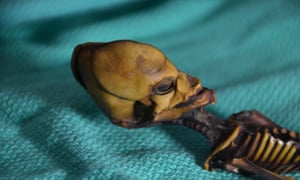
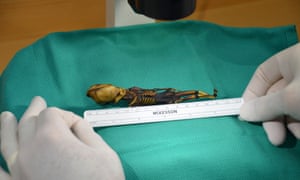
Back in 2003, In Chile’s Atacama Desert, a miniature, deformed, mummified humanoid skeleton was found wrapped in a piece of white cloth. As one can imagine this caused a plethora of perplexing questions and many equally as perplexing claims to answer them. The widest spread and outlandish of which was that this small skeleton, nick named “Ata”, was some sort of ancient alien who passed away long ago. With a back story like that, this little specimen was sold around the world between private collectors, all of whom paid a pretty penny to get their hands on it. Yet it wasn’t until 2013 that a scientist, Garry Nolan, and his team at Stanford University, decided to conduct an actual DNA analysis of Ata in the hopes of unraveling the mysteries surrounding it.

The mummified skeleton of a baby girl found in the Chilean desert in 2003.
DNA extracted from the bones shows Ata was a girl who carried mutations in at least seven genes that are known to cause major skeletal malformations.

What they found was that Ata was not an ancient alien at all, but in fact a human female who exhibited skeletal malformations, along with a condition called congenital diaphragmatic hernia, which results in an improper formation of the diaphragm. Because Ata exhibited these defects, this would mean that she would have been a still born or must have died immediately after birth, which would also explain the care displayed in her wrapping and burial. Furthermore, the analysis uncovered that Ata’s DNA closely resembled that of other Chileans, and that she most likely died approximately 40 years prior. So, although Ata may not have been an alien corps, but instead a human child with mortal birth defects, the discovery of the mutations believed to have aged her bones could potentially aid in the development of therapies and drugs that can help drive bone development in people with skeletal problems. Thus, giving a happy ending to this seemingly tragic tale.

And for Ata’s original study conducted at Stanford, use this link: http://siriusdisclosure.com/evidence/atacama-humanoid/

Monday, April 11, 2016

Mom’s Smoking Can Alter Fetus’s DNA


Despite the large amount of research and warnings, studies have shown that 12% of pregnant women in America still smoke. Studies are also showing that smoking during pregnancy can actually alter the DNA of the fetus and lead to birth defects such as low birth weight, asthma, and cleft lips/palates. In order to collect this data, researchers gave questionnaires to 7,000 mothers from around the world where they were asked how often they smoked during their pregnancy. Also, they collected a blood sample from each newborn’s umbilical cords so that they could examine their DNA. The studies showed that DNA does not change the DNA sequence in smoke-affected babies, but affected which genes were turned on or off. For example, “methylation” is when a small molecule is added onto DNA, preventing a certain section from being turned on, which can lead to birth defects. Even though the fetuses aren’t breathing in the smoke, many toxins from cigarettes will pass through the placenta and into the fetus. Researchers believe that methylation plays a large role in the effects on the DNA in the fetus.

It is alarming to me that a percentage of pregnant women in the country still smoke while pregnant. Even though 12% is not that high while looking at the big picture, in reality 1% would still be too high a number. Also, this percentage doesn’t take into account the amount of women who lied and said they did not smoke while pregnant. The effects of smoke on adults is significant and can lead to a number of health complications over time such as various types of cancers and heart disease, so I can only image how many complications these affected fetuses will have growing up. It is also often said that these fetuses are more likely to die from Sudden Infant Death Syndrome and if they do live, they have an increased chance of ADHD. Mothers are supposed to love and care for their children, and smoking while pregnant is selfish because their addiction can lead to lifelong complications or even death for their child.


Wednesday, November 25, 2015

Bioelectrical Connections Key in Understanding Development

Biologists at Tufts University have successfully induced worms to grow heads and even brains of other species of worms without changing their genome. The previous dogma surrounding development was that an individuals genomic code was the only thing responsible for large scale anatomy. Without altering the worms genome, researchers were able to stimulate anatomic changes by simply interrupting the connections of electrical synapses at gap junctions. This goes against the current understanding of the chromosomes role in development. Interestingly, the closer the two species of worms were related evolutionarily, the easier it was for the researchers to induce change to modify them to become more like one another.

This new information can be used to help doctors treat babies with birth defects as well as help fix injuries more efficiently. One day, an individual might simply be able to undergo electrical therapy to make the body experience changes to heal and fix structures that were previously damaged. This is new and exciting research that would be very beneficial to many people.
G. dorotocephala, the worm used in this study

Wednesday, March 25, 2015

Shattered Chromosomes May Be Cause of Birth Defects

A study done by the University Medical Center Utrecht in the Netherlands observed three different families whose children suffered from abnormalities due to chromothripsis or a shattered chromosome. According to the senior author of the project, Wigard Kloosterman, this does not necessarily cause lead to a disease to occur. Although the presence of a shattered chromosome impacts reproduction through difficulties such as not getting pregnant, miscarriage, or the birth of children who have multiple birth defects. The children who were studied have abnormalities that were passed down from the mother. Even though the mothers were affected, they had genomes which had more chromosome breakage than their children. Dr. Kloosterman found that only two children had inherited a small set of the damaged chromosomes from the mother. In all three of the children the differences from the mothers results in a duplication or deletion of chromosomes which lead to their birth defects.
Genetics is a very complex study that researchers are slowly beginning to understand. There is just so much that we have yet to discover about the human genome. Chromosomes are so tiny and they control so much of our DNA. I find it so interesting that these children only inherited a small fraction from their mothers and yet they were so affected by what was passed down to them. Even that the mothers genome contained more chromosome breakage than the children's and they were unaffected is so difficult to understand. As scientists progress into further research of chromothripsis, we may have more of the answers that we need to understand birth defects.

Monday, April 14, 2014

Cleft Palate and Nova Scotia Duck Tolling Retrievers


Cleft palate is one of the most common birth defects in children. In the United States, 1 out of every 1500 is affected with this disability and it occurs when the baby’s mouth does not form properly. Specifically, the roof of the child’s mouth does not join correctly and both the front and back parts of the palate are open. This opening can cause problems with speaking, chewing and possibly hearing which can also lead to social problems as the child gets older. Understanding this disability better is a way for scientists to help the prevention of this disease from affecting others. Researchers at the UC Davis School of Veterinary Medicine have discovered the genetic mutation in the dog breed, Nova Scotia Duck Tolling Retrievers , that is responsible for one kind of cleft palate. This is an interesting and breakthrough discovery because these dogs can be studied and used to better understand the causes of this disease. By studying these dogs, researchers have found a similarity that affect humans who are prone to developing cleft palate; a shortened lower jaw. This resembles people who suffer from Pierre Robin Sequence. Pierre Robin Sequence is a birth condition that involves the lower jaw being either small in size or set back from the upper jaw. This is usually accompanied by cleft palate in infants. The multiple genetic causes of this disease can be focused on in these dogs and will hopefully provide some insight to other genes that cause this defect in humans.

Nova Scotia Duck-Tolling Retriever puppy  wallpaper

Monday, November 14, 2011

Common Male birth defect; Gene discovered.

      Hypospadias is a common congenital condition affects around every one in 400 infant boys. This condition is where the urethral opening is not located at the correct position of the male reproductive organ. With immediate surgery needed to correct the condition, many males have psychological and sexual consequences later in life, due to the malformation. King’s College of London and Radboud University of The Netherlands have recently discovered a new gene associated with this condition, along with the inheritance traits. The information from their study was located in the Science Daily article, “Scientists find Gene linked to male birth defects”.
      The article stated that through a series of tests, scientists were able to uncover that the boys with modified DGKK genes have a greater chance of have the condition of hypospadias. The DGKK gene was found to be located on the X chromosome, which means that it is inherited by the mother. With this information, new prenatal studies can be done to determine whether a particular male fetus will be born with the hypospadias condition. With discoveries in this condition and many others like it, scientists are becoming one step closer into understanding the idea of genetics and the modification effects of particular genes.