Showing posts with label #resistance. Show all posts

Wednesday, December 11, 2019

Prion Disease

Prion diseases are complicated and often fatal illnesses. This specific prion disease is known as kuru, or the cannibalism disorder. Although extremely rare, it is devastating, and resistance may be attainable. People with a mutation on codon 129 of the prion protein seem to be less susceptible to prion diseases if they have one or two copies. When tested on mice, it was found that a different codon, codon 127, made mice completely resistant when it was mutated. The research shows the reason behind this is because the mutation on codon 127 prevents the prion protein from becoming misshapen, which is what causes the disease.
Researchers are currently working on determining the structure of the mutated protein, and trying to use it as a defence in other diseases. I hope it is successful.


original link: https://www.nature.com/news/genetic-mutation-blocks-prion-disease-1.17725
related link: https://www.nature.com/articles/gim201032


Sunday, November 24, 2019

Toxic Toads Pose Threat to Madagascar's Predators

A photo of an Asian common toad


The common Asian toad has skin that is poisonous to nearly all predators in Madagascar. The toad arrived in Madagascar about 10 years ago, and scientists have always suspected it was toxic to many species, but it was not until recently that scientists found that there is genetic evidence that can confirm that this toad can kill nearly any predator on the island. The poison that is being secreted from these toads can cause a disruption of the sodium potassium flow which is critical to muscles and the heart and how they function if a predator were to consume it. However, certain predators can be immune to this toxin. A scientist Wolfgang Wuster led a research team that then discovered that any predator that presents resistance to the toxin means that they also possess a mutation in a gene for their sodium-potassium pump. However, when hey studied 77 various species that possessed resistance, only 1 was actually immune to the toad's poison. This species was the white-tailed antsangy. This means that the 76 other species would die if they consumed the toad despite having the gene mutation. I find this to be interesting because even though a species has a gene mutation that would insinuate that they would be immune to something, they actually do not in fact possess resistance. This shows that genes and mutations are a lot more complex than just having a mutation and not having a mutation.

Original Article: https://www.sciencenewsforstudents.org/article/toxic-toads-pose-threat-madagascars-predators
Supporting Article: https://www.livescience.com/62752-madagascar-toxic-toad.html

Monday, November 11, 2019

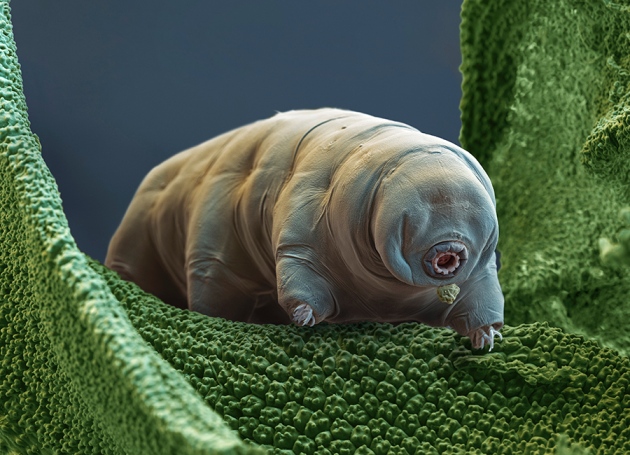
Tardigrades Protecting their DNA

It is well known how tardigrades are invincible, adorable creatures that can live anywhere in the world. When I first heard of them I was baffled. I had no idea that anything like this existed, and an entire class of organisms whom are resistant to extreme environments exists, which is even more amazing. How they are capable of this, was always an unanswered question, and learning one little aspect of tardigrades protecting their DNA from radiation is revolutionary. The research shows a protein named Dsup is responsible for encapsulating the DNA when the tardigrade is vulnerable. Further research involved incorporating the protein to human cells, and astoundingly it also protected the human cells from radiation after being exposed. With more experiments and research, we could find a way to truly protect humans from radiation, which would aid in medical research for obtaining a safer cure for cancer if we still use radiation by then.

Image result for tardigrade protecting dna

original link: https://www.sciencenews.org/article/tardigrades-dna-damage-radiation-death
related link: https://www.scientificamerican.com/podcast/episode/tardigrade-protein-protects-dna-from-chemical-attack/

Tuesday, November 6, 2018

Gene Drives to Eradicate Diseases

   Scientists are currently in the works of developing a gene drive to ultimately force a population into extinction, being known as a crash drive.  The technique of gene drives occur when specific genes, such as fertility genes, are made to be resistant to certain diseases, pesticides, or even reproduction itself.  With each gene only having a 50% chance of inheriting a specific trait, from either its father or mother, gene drives increase this percentage drastically but also have the ability to reduce reproductive rates.  Basically, through many populations within one type of organism, traits could be altered and could reflect beneficial results into the ecosystem.
    Pest populations such as insects and rodents can also be hypothetically decreased if the gene that is being altered results in lower fertility rates or higher death rates. The population currently being experimented on is mosquitoes in hopes of the rate of contracting malaria to decline.  In order to do this, scientists construct a Y chromosome which drives the X chromosome to disintegrate during the mosquitoes’ embryonic stages, resulting in only male offspring.  Or, since there are three sites at which could affect the fertility of female mosquitoes, two of the three could be impacted to result in less and less mosquito offspring being born.  An additional experiment could be to make malaria-resistant genes within the mosquitos themselves, which would be passed down from one generation to the next.
    What is hopefully expected is the amount of females in the population diminishing rapidly until the entire population eventually dies off.  This is because there is no possible  way for the males to reproduce sexually if there are no females.  Since the only mosquitoes that pierce skin to suck blood are female, the spread of malaria is hoped to also decrease since there are less of that gender. 
    While the amount of wild mosquitos in the population will be almost completely eradicated, this does not mean that the species will be lost from the world forever. Scientists would develop a way which mosquitos could be introduced into the world without being able to contract the disease which is being tested for, in this case it is malaria. 
    This will be the first gene drive which is to be released into nature, however, it is unknown what exactly the results of this experiment will conclude.  Gene drives also will only work on sexually reproducing organisms which produce at a fast rate, because if generation rates are extremely slow, the experiment will render to be useless.  With this new technique, common diseases such as malaria, lyme, yellow fever, and others could be almost completely eliminated if this experiment works correctly.  If done on plants to be made resistant to pesticides, this plays into the crops being genetically modified which is continually argued about in today’s world.  While it will be beneficial to reduce the amount of pesticides being released into the natural ecosystems and poisoning the soil and waterways, the concept of eating crops with these resistant traits is believed by some to cause similar characteristics in the person eating them.  However, when mixed with the spread of diseases through insects and rodents, I believe that it will be very helpful as our medical and technological advancements continue to improve.

Monday, April 9, 2018

Overcoming Livestock Disease Through Gene Editing


The livestock industry may be on the brink of an effective tool to fight against disease thanks to geneticists at the Roslin Institute in Edinburgh. Professor Eleanor Riley and her team have recently identified the gene in pigs that allows viruses to enter the cell. By removing this gene from a pig's DNA resulted in these animals to become resistant to common diseases like Porcine Reproductive and Respiratory Syndrome Virus (PRRSV) which affects the livestock industry roughly $170 million every year. This same approach has also been used at the Roslin Institute to identify the gene that provides resistance against avian flu in chickens. With the final trail yet to be published, the livestock industry is anxious to see the results. According to Eleanor Riley, it would only take three to five years to produce these disease resistant animals into the livestock community. This could potential save farmers millions in biosecurity, animal deaths and possibly increase the food production in the world. With the population of humans already over 7.0 billion there are more mouths to feed than ever before. By increasing livestock resistance to fatal diseases, this could potentially be a significant result for much more than just the farming community.

Article: https://www.theguardian.com/science/2018/mar/17/scientists-on-brink-of-overcoming-livestock-diseases-through-gene-editing
Additional Information: https://www.theguardian.com/environment/2018/jan/15/british-supermarket-chickens-show-record-levels-of-antibiotic-resistant-superbugs

Sunday, November 6, 2016

Multi Drug-Resistant Pathogens

Animals are often given antibiotics in their food or sprayed on them so they ingest it when they clean themselves. The use of antibiotics in animals was thought to prevent disease and therefore produce more healthy livestock. However, pathogens are now becoming resistant to more and more antibiotics. Since the antibiotics are only killing off the pathogens that are not resistant to bacteria,the antibiotic resistant pathogens are thriving and are flourishing. 
A study was performed to find out how resistant they are becoming. Investigators sequenced 11 pathogen's genomes from chickens and the broilers of India. Each pathogen was resistant to at least five antibiotics in the fluoroquinolone, cephalosporin, sulfonamides, and macrolide families.  H. pollorum can be harmful to humans and livestock since it carries a toxin that interferes with the cell cycle. Interference with the cell cycle ultimately leads to cancer. The pathogen is a health concern due to the antibiotic resistance created by the abuse of antibiotics. The consumption of chicken in India and all over the world is becoming more and more prevalent which could lead to more antibiotic resistant bacteria. In the United States, 80% of antibiotics sold are given to livestock. In 2013 alone, 53% of sampled chicken was E. Coli resistant.
Back when it was decided to use antibiotics in livestock it made sense to the farmer/big business because their livestock could possibly live longer. If the pathogens were not making their livestock sick because the chickens and cows and whatever else are pre-treated with antibiotics, the business is making money. The introduction of antibiotics was rather selfish and could lead to more bad than it did good. Initially, it was a good idea but it should have been researched more. Antibiotics is over used in so many cases, even humans. Many people will insist on the prescription of an antibiotic to get better when it is not necessary. The use of antibiotics should be more strict and more limited. All we can do now is stop over-using antibiotics so more pathogens are not antibiotic resistant. 


https://www.sciencedaily.com/releases/2016/11/161104191327.htm
http://news.nationalgeographic.com/2015/02/150213-antibiotic-resistance-animals-ngfood/