Showing posts with label heart cells. Show all posts

Monday, May 6, 2019

Suffering from a broken heart? This new discovery could help.

In a very recent article written by Ana Sandoiu and published by Medical News Today, new research on regenerating heart tissue is discussed. This research was originally published in the journal Nature Communications. The study was conducted by Da-Zhi Wang from Boston M.A. and his colleagues. Continuing on from previous research conducted by Prof. Wang, the research team further expanded on the function of microRNAs in the generation of cardiomyocytes. The team identified two specific microRNA molecules which influenced the inflammatory response and cell death which follows a heart attack. These microRNA molecules are known as miR-19a and miR-19b. Experiments were conducted on mice who displayed promising results. The team intends to test the microRNAs on larger mammals and hopefully proceed to human studies. They hope this could be a revolutionary treatment and prevention of heart disease.

In America, heart disease is the leading cause of death. Heart disease can be caused by a variety of factors. A major element which causes this steep number of fatalities, is due to the hearts lack of ability to continue to proliferate new cardiomyocytes. This means that once the hearts cells are damaged they can not regenerate thus putting individuals at risk for heart failure. Our heart is the crucial for life and it deserves to be carefully cared for. However some events are out of our control. Discoveries such as these have the potential to save many people equip the heart to replace deceased cells.  

Monday, March 27, 2017

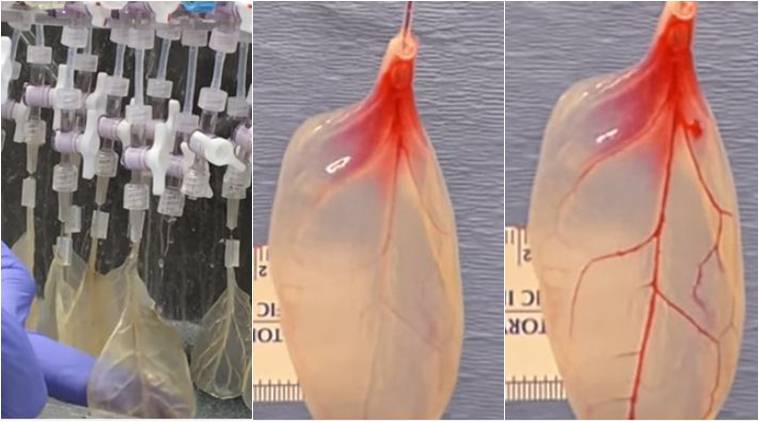
Spinach to Heart?


I saw this this story on the news this morning and it seemed very interesting. Who would think using something as simple as spinach leaves would help patch up a heart. Although they are not completely sure it would work in a host, they have made it beat and have liquid running through the new veins. This also opens up more ideas for other natural foods and human cells.


Sunday, November 20, 2016

A New Technique Allows Insertion of Genes in Non-dividing Cells

Until recently, the only method for modifying DNA was the CRISPR-Cas9 system. However, the new Salk technology is much more efficient than any other method because it allows the incorporation of DNA into non-dividing cells. The cells of the heart, brain, eye, and pancreas do not divide again and are locked in G0. In order for this to be accomplished a specific pathway called NHEJ was targeted by researchers. This pathway repairs routine breaks in DNA sequences by rejoining original strand ends. Researchers constructed a new complex called HITI, homology-independent targeted integration, used to insert genes into the cells. The complex is made up of different nucleic acids. Then, they used a virus to implant the HITI inside the cell to transfer the genetic information to neurons that were derived from embryonic stem cells from humans.  Scientists then completed a genetic modification in adult mice and it was successful. After that, they tried to use the technique as a gene-replacement therapy method. The researchers decided to work with mice that were born blind. They successfully delivered the gene Mertk, one of the genes that, when damaged in humans, causes vision loss. The gene was inserted into the genome of the mice at just three weeks old and by the time they were eight weeks old the mice showed response to light. Furthermore, testing was continued and healing was observed in the retinal cells of the mice. I feel that many people will benefit from this new gene-replacement therapy process. Individuals can be assisted by a gene when having a disability, such as severe eye loss. Also, one that suffers from serious head trauma can gain some of his or her brain cells back. Consequently, he or she will recover from a concussion quicker. This is only the beginning of the great things science can do to help people suffering from genetic damage. Gene therapy is going to revolutionize healthcare in the future. 


Thursday, May 1, 2014

Stem Cell Therapy Regenerates Heart Muscle Damaged from Heart Attacks In Primates

Heart cells created from human stem cells successfully restored damaged heart cells in monkeys. This was published in Nature magazine on April 30th, and the scientist came to the conclusion that if it can work in monkeys, it could probably work in humans too. The main question before the experiment begun was if it was possible to create enough heart cells to remuscularize damaged hearts in a large animal whose heart size and physiology is similar to that of the human heart. The scientist induced a heart attack on these monkeys and injected them with 1 billion heart cells derived from human stem cells and put the monkeys on immunosuppressive therapy to prevent rejection of the transplanted human cells. On average the transplanted stem cells regenerated 40 percent of the damaged heart tissue over subsequent weeks.
          This new research is very interesting because if this same experiment can be duplicated in human, the possibilities are endless with what else stem cells can help cure. This approach with stem cells could be ready for clinical trials in four years. The only problem with stem cell therapy is where to get the stem cells from. There are a lot of ethical and moral dilemmas because the best stem cells come from a human fetus.