Showing posts with label Tasmanian Devil. Show all posts

Friday, October 20, 2023

Tasmanian Devils Threatened by an Infectious Cancer

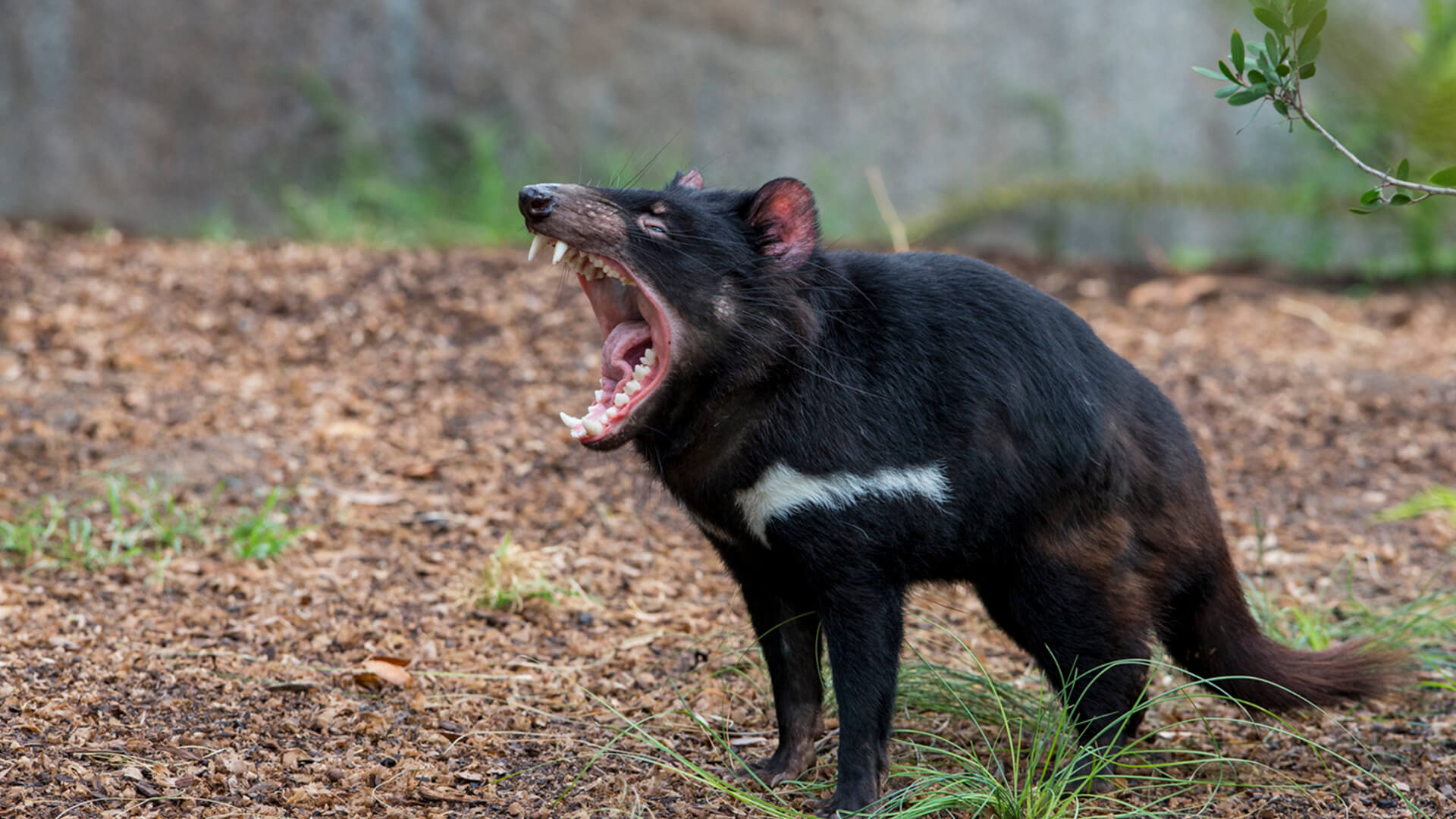
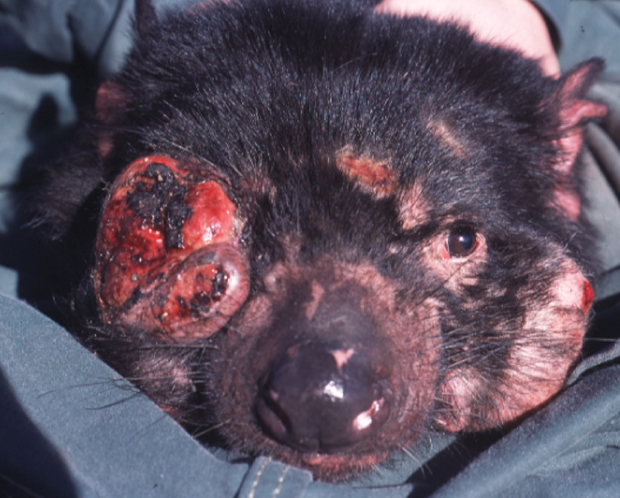
In the mid-1990s zoologists in Tasmania noticed something grotesque. Growing from the maws of one of the world's most tenacious carnivores were masses of malignant tumors. The Tasmanian Devil Sarcophilus harrisii is famed for its high prey drive, aggressive social behaviors, and its loud vocalizations. These tumors quickly popped up on Tasmanian Devils throughout the island, an epidemic of cancer. Most cancers are isolated to the individual afflicted by the cancer, meaning that the cancer starts its cycle and ends its cycle (usually this means death) within the body of the infected. The cancer afflicting Tasmanian Devils was quickly recognized as transmissible via contact with body fluids, and named "Devil Facial Tumor Disease" (DFTD for short). As previously mentioned, DFTD spreads from contact with bodily fluids, Tasmanian Devils have the unfortunate habit of communicating with one another through bites and open mouth displays meant to intimidate rival devils. This pattern of behavior makes it very likely that an infected individual will spread DFTD to an uninfected individual via saliva or any open wounds on the face caused by previous squabbles. 

A pair of Tasmanian Devils biting one another, a common transmission vector for DFTD

DFTD has decimated 80% of the Tasmanian Devil wild populations and is a serious concern amongst conservationists as it could very well mean extinction for the Tasmanian Devil. DFTD cells exhibit tetraploidy, meaning that they have four sets of chromosomes instead of the typical diploid condition. DFTD cells also release Major Histocompatibility Complexes (MCH) which trick the Devil's immune system into thinking that the tumor cells are normal diploid somatic cells.
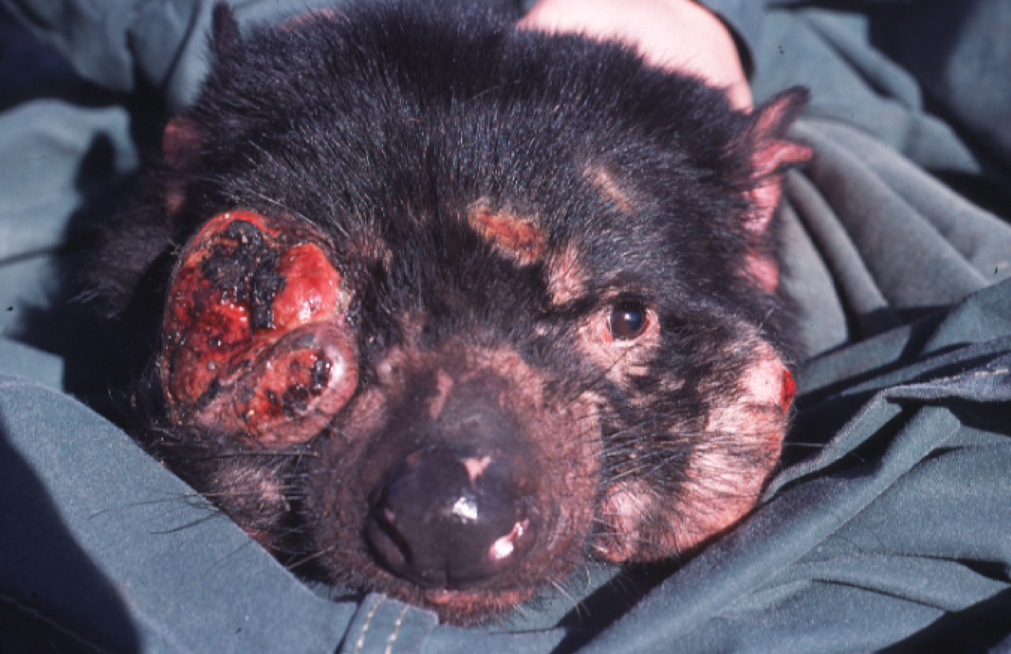
A Tasmanian Devil with advanced DFTD

 This bizarre distinction between the chromosome counts and the release of specific MCH molecules aids scientists in saving the species through vaccines. Previous efforts to create and implement vaccines using dead DFTD cells have had some success in the past, however, these vaccines were only effective in about 20% of the population with the remaining 80% still at risk of dying. Earlier this year an mRNA Adenovirus Vaccine was approved to be tested on captive populations. Much like the Covid-19 Vaccines, this new DFTD vaccine uses a modified adenovirus to break into cells and insert proteins similar to the MCH into the Tasmanian Devil's body.

 This, in theory, should train the Tasmanian Devil's immune system to recognize MCH molecules in the body as a foreign threat. By mounting an immune response to the MCH proteins, DFTD cells that also produce those proteins will be unable to trick the Devil's immune system into allowing the tumors to enter and proliferate within the body. This will hopefully create a more effective preventative for the spread of DFTD and give these charismatic devils a leg up against the looming threat of extinction.

See Nature Article on DFTD here


Friday, November 30, 2018

Genetic mutation drives tumor regression in Tasmanian Devils

      Tasmanian Devils are carnivorous marsupials that are on the edge of extinction due to devil facial tumor disease. Devil facial disease is 100% fatal and it is a contagious form of cancer. The disease is one of four transmissible diseases and it has caused 80 percent of the marsupials population to be wiped out in Tasmania,Australia. While studying the organism, a group of Australian collaborators acknowledged that some of the Tasmanian Devils with the tumor did not die. Gene sequencing was performed on seven organisms that survived the devil facial tumor disease and on three organisms that died due to the disease. Scientists at Washington State University have discovered gene variants  to be linked to tumor regression in Tasmanian Devils.
     Cancers in humans such as Merkel cell carcinoma is known to have tumor regression similar to the Tasmanian Devils. In my opinion, this scientific discovery is important because it can lead to the discovery of tumor regression of other forms of fatal cancers. Drugs can be developed to trigger the same response that the gene variants perform to reduce the effects of a fatal disease.
Image result for tasmanian devil   

Saturday, November 19, 2016

Budding Resistance to Highly Contagious Cancer: A New Hope for Tasmanian Devils

Populations of Tasmanian devils have quickly decreased by 80% over the past 20 years. A highly contagious cancer has taken hold over many populations, ending the lives of devils before they grow old enough to produce many, if any, offspring. Devil facial tumor disease is very unique in that its cancer cells are highly transmissible between individuals. Because Tasmanian devils are very aggressive, their social and mating interactions often involve fighting and bites to the face. When an infected devil encounters an unaffected devil in a fight, the mutated cells are able to spread to the open wounds of the unaffected devil, thus spreading the cancer.

The cancer originally arose from a mutation in a single Tasmanian devil in the 1990s. It grows on the devil’s face, particularly around the mouth. Large tumors can deform the skull or jawbone of a devil, as it places much pressure over the area it resides in. This makes it incredibly difficult and painful for the devils to eat. Tasmanian devils usually die from either the cancer itself or starvation in less than 6 months.


The reason as to why this particular cancer is so contagious is because of its lack of major histocompatibility complex (MHC) found on the cancer cell’s surface. The MHC found on foreign cells allows the immune cells in an individual to detect the cells as foreign objects. Because of the lack of MHC on the devil cancer cells, the immune cells of an affected devil are unable to read the cancer cells as foreign objects, and therefore the devil’s immune cells do not attack the cancerous ones.

However, the decline of Tasmanian devils has slowed somewhat over the past few years. One of the possibilities for this is that Tasmanian devils have started to evolve a genetic resistance to the cancer. To find out more about this possibility, an evolutionary geneticist named Andrew Storfer sequenced 1/6th of the devils genome using 294 individuals from 3 different populations. He discovered that among an increase of five variations of genes among recent devil populations, two of them, CD146 and THY1, assist the immune system in recognizing foreign objects. It is likely that a resistance has evolved in one or both of these genes, resulting in a greater immune response to devil facial tumor disease and therefore slowing both the spread of the cancer and decline of Tasmanian devils. Though Storfer cannot test this hypothesis on physical Tasmanian devils due to their endangered status, he will continue to research the interactions between these two genes and the cancerous cells in the lab to determine if there is stronger evidence to support this hypothesis. This research is extremely important to the continued existence of the Tasmanian devil species. If this hypothesis is true, then Tasmanian devils can make a comeback without human involvement, while scienctists can focus conservation efforts elsewhere.

Thursday, October 27, 2016

Tasmanian Devils’ Comeback against Cancer through Genetic Variation


                Since 1996 Tasmanian Devils have been showing a steep population decline due to cancer. The cancer causes infectious tumors to form on the devils faces and mouths. These tumors then cause the cancer to spread to other members of the population by contact through biting. Not only is the disease extremely infectious, spreading to all the known Tasmanian Devil populations in Tasmania, it is also very deadly. The tumors would cause so much disfigurement in their faces that they become unable to eat and eventually die of starvation. Over the course of 26 years 80% of the original population has declined sending the Tasmania on a sure path to extinction.


               However, it has recently been discovered that this may not be the case. Studies show that there are signs of genetic variation present in Tasmanian Devils making them resistant to the cancer. They collected the genomes of over 296 individuals from 26 years ago and compared them to the genomes collected from current populations and discovered that they are differences between the two in several different genes. It was then discovered that two of the genes exhibiting change are related to immune function or cancer risk. This supports the idea that Tasmanian devils are evolving in a way that increases resistance against this cancer, and because this change is occurring so rapidly, within 6 generations, it points to the variation being a trait already present in individuals that is just now becoming more common as it provides benefits against a recent outside stimuli.

                This is a very exciting turn of events, as it seemed that there was little hope for these iconic mammals. Being able to see genetic variation at work in such a short amount of time is a pretty rare thing, and I look forward to hearing more about the Tasmanian devils in the future.


Tuesday, October 4, 2016

Tasmanian Devils and Cancer

           When you first see Tasmanian Devil, you probably start to think about Taz from the Looney Toons. Just like the fictional character, the Tasmanian Devils are very aggressive and are known to attack one another. A carnivorous marsupial from the island of Tasmania off the coast of Australia, the Tasmanian devil has seen a major decline and is considered endangered mainly due to the infectious disease known as the Devil Facial Tumor Disease or DFTD. In less than 20 years, the population of the Tasmanian Devils declined more than 80% due to DFTD.


            Interestingly enough, some populations of the Tasmanian Devil that were thought to have been extinct by now are actually still alive. Researchers then decided to look at the genome of these animals and determined that these genes were actually protecting the Tasmanian Devils. These researchers also discovered that these genes were helping the immune system to identify DFTD and fight back. Over the past two decades, the Tasmanian Devils seem to have been evolving a resistance to DFTD. Researchers went to the island of Tasmania and sectioned two candidate populations of the animals to view genes related to cancer or immune function. The two likely genes that have been selected for are the CD146 and the THY1 genes. Both of which are involved in immune system regulation as well as cell to cell communication and cell adhesion. Researchers thus believe that these genes are adapting to recognize the tumors formed from DFTD.
          With the strong selection due to the high fatality chance of DFTD, the evolutionary response of the Tasmanian Devil to such a selective pressure is astonishing. Although this is exciting news for the Tasmanian Devil, many of its species still succumb to DFTD. The next step in this process is to determine a way in which the gene can be used to save more of the Tasmanian Devils. A proposition would be the selective breeding of unaffected individuals with favorable genotypes for detection of the DFTD in hopes of the continued survival of the Tasmanian Devil. I personally think that researchers are on the right track for helping to protect this endangered species. I also believe that they are on their way to making a great breakthrough in terms of hopefully being able to apply the way these Tasmanian Devils are able to counteract the DFTD.

(http://www.sciencemag.org/news/2016/08/tasmanian-devils-are-rapidly-evolving-resistance-contagious-cancer)