In the mid-1990s zoologists in Tasmania noticed something grotesque. Growing from the maws of one of the world's most tenacious carnivores were masses of malignant tumors. The Tasmanian Devil Sarcophilus harrisii is famed for its high prey drive, aggressive social behaviors, and its loud vocalizations. These tumors quickly popped up on Tasmanian Devils throughout the island, an epidemic of cancer. Most cancers are isolated to the individual afflicted by the cancer, meaning that the cancer starts its cycle and ends its cycle (usually this means death) within the body of the infected. The cancer afflicting Tasmanian Devils was quickly recognized as transmissible via contact with body fluids, and named "Devil Facial Tumor Disease" (DFTD for short). As previously mentioned, DFTD spreads from contact with bodily fluids, Tasmanian Devils have the unfortunate habit of communicating with one another through bites and open mouth displays meant to intimidate rival devils. This pattern of behavior makes it very likely that an infected individual will spread DFTD to an uninfected individual via saliva or any open wounds on the face caused by previous squabbles.

DFTD has decimated 80% of the Tasmanian Devil wild populations and is a serious concern amongst conservationists as it could very well mean extinction for the Tasmanian Devil. DFTD cells exhibit tetraploidy, meaning that they have four sets of chromosomes instead of the typical diploid condition. DFTD cells also release Major Histocompatibility Complexes (MCH) which trick the Devil's immune system into thinking that the tumor cells are normal diploid somatic cells.
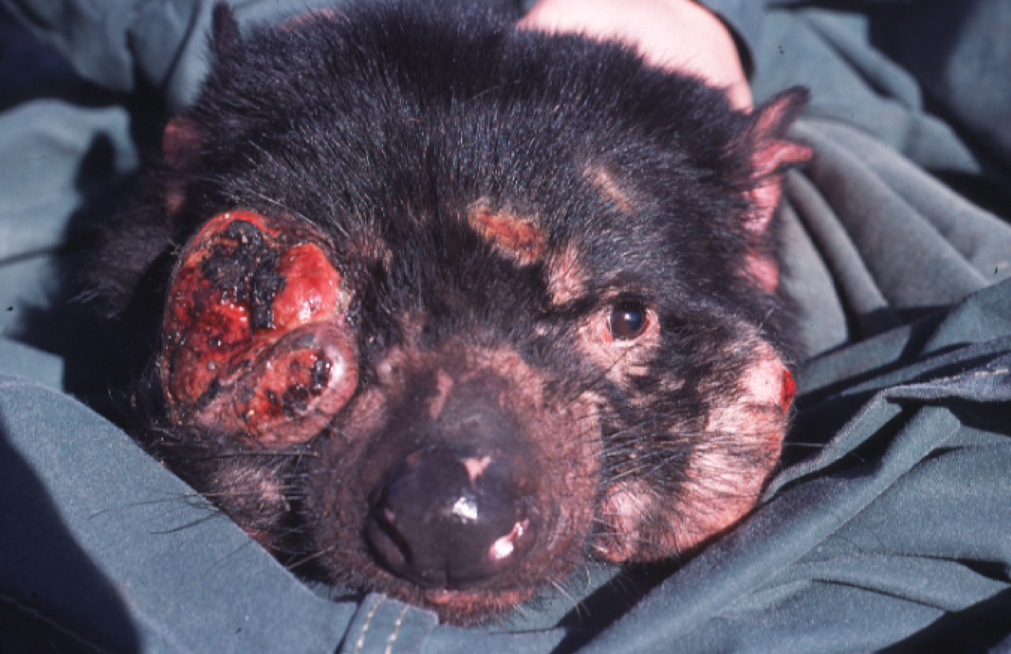
A Tasmanian Devil with advanced DFTD
This bizarre distinction between the chromosome counts and the release of specific MCH molecules aids scientists in saving the species through vaccines. Previous efforts to create and implement vaccines using dead DFTD cells have had some success in the past, however, these vaccines were only effective in about 20% of the population with the remaining 80% still at risk of dying. Earlier this year an mRNA Adenovirus Vaccine was approved to be tested on captive populations. Much like the Covid-19 Vaccines, this new DFTD vaccine uses a modified adenovirus to break into cells and insert proteins similar to the MCH into the Tasmanian Devil's body.
This, in theory, should train the Tasmanian Devil's immune system to recognize MCH molecules in the body as a foreign threat. By mounting an immune response to the MCH proteins, DFTD cells that also produce those proteins will be unable to trick the Devil's immune system into allowing the tumors to enter and proliferate within the body. This will hopefully create a more effective preventative for the spread of DFTD and give these charismatic devils a leg up against the looming threat of extinction.
See Nature Article on DFTD here

