Showing posts with label diploid. Show all posts

Monday, September 16, 2024

Breeding Plants with the Genes From One Parent to Attain More Desirable Traits

    The article, 'Breeding Plants with Genes From One Parent', discusses the research done at the University of California Davis College, when Simon Chan and colleagues, such as Ravi Maruthachalam, while breeding a lab plant known as Arabidopsis, accidentally stumbled across a way to completely omit one parent's genetic information from the offspring. This finding is exponential since plants are typically diploid, they inherit two sets of chromosomes one from each parent; if a trait is desirable, the plant will pass along the gene to its offspring. However, this process could take several generations to make its mark.  Eliminating half the genome, creating haploid crops, could aid in quickening the process of breeding crop plants for desirable traits easier, and creating true homozygous offspring faster. 

    Chan and Maruthachalam modified just one protein, CENH3, found in the centromere of the plant's chromosomes. When the plants with the modified CENH3 gene were crossed with wild-type Arabidopsis, the results were plants with half the normal number of chromosomes, making a haploid plant with only genetic information being passed down from one parent, completely eliminating the other parent's genome. 

    Once replicated by another researcher, Professor Comai, used a different plant species and manipulated the same CENH3 gene and also created plants with one set of chromosomes.  However,  Comai did state that the rules related to each species and the CENH3 gene are distinct from one another.  

    The true finding related to the CENH3 gene is when the CENH3 gene is altered, the centromere of the chromosome is weakened due to the gene being removed from the DNA inside the egg before fertilization. Thus, when embryonic division occurs, the centromeres lacking the CENH3 (female genome in the egg) fail to compete with the centromeres containing CENH3 (male genome in the sperm). Therefore, the female genome is eliminated, engendering the selective depletion of weak centromeres when CENH3 is eradicated. 

I chose this article since the idea is novel.  Typically, like other sexual organisms, plants are diploid and inherit two sets of chromosomes one from each parent.  However, in this article, researchers found a way to make the offspring haploid. This is a task that seems nearly impossible to accomplish.  Although more research is needed, I like this concept since these findings are applicable and useful in today's society, especially in breeding agricultural crops such as wheat, corn, beans, etc., with the potential to feed more people more quickly if bred desirably. 


Friday, October 20, 2023

Tasmanian Devils Threatened by an Infectious Cancer

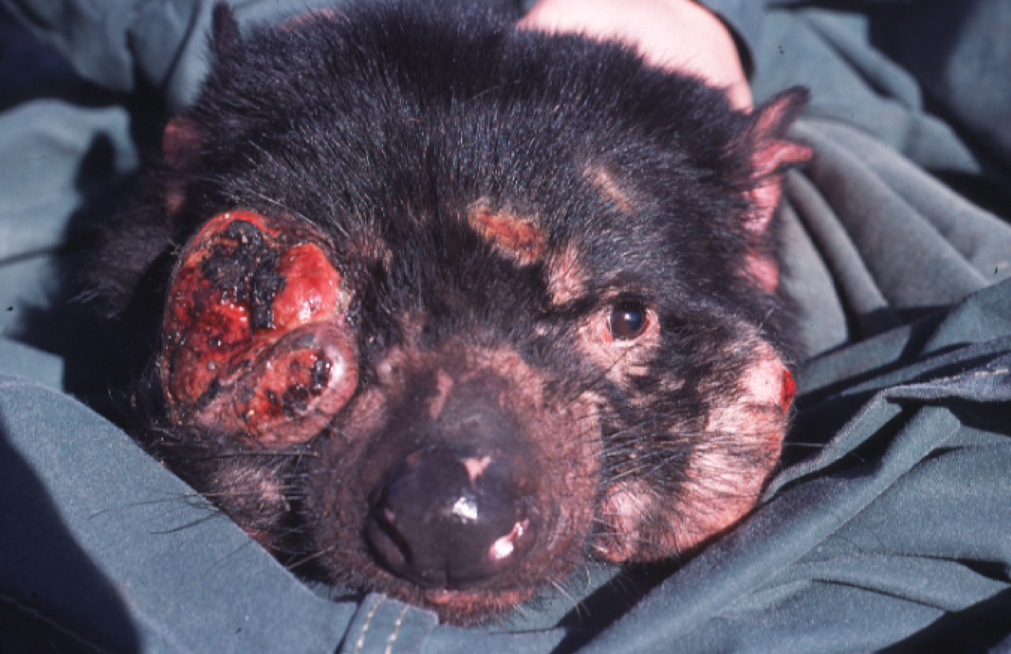
In the mid-1990s zoologists in Tasmania noticed something grotesque. Growing from the maws of one of the world's most tenacious carnivores were masses of malignant tumors. The Tasmanian Devil Sarcophilus harrisii is famed for its high prey drive, aggressive social behaviors, and its loud vocalizations. These tumors quickly popped up on Tasmanian Devils throughout the island, an epidemic of cancer. Most cancers are isolated to the individual afflicted by the cancer, meaning that the cancer starts its cycle and ends its cycle (usually this means death) within the body of the infected. The cancer afflicting Tasmanian Devils was quickly recognized as transmissible via contact with body fluids, and named "Devil Facial Tumor Disease" (DFTD for short). As previously mentioned, DFTD spreads from contact with bodily fluids, Tasmanian Devils have the unfortunate habit of communicating with one another through bites and open mouth displays meant to intimidate rival devils. This pattern of behavior makes it very likely that an infected individual will spread DFTD to an uninfected individual via saliva or any open wounds on the face caused by previous squabbles. 

A pair of Tasmanian Devils biting one another, a common transmission vector for DFTD

DFTD has decimated 80% of the Tasmanian Devil wild populations and is a serious concern amongst conservationists as it could very well mean extinction for the Tasmanian Devil. DFTD cells exhibit tetraploidy, meaning that they have four sets of chromosomes instead of the typical diploid condition. DFTD cells also release Major Histocompatibility Complexes (MCH) which trick the Devil's immune system into thinking that the tumor cells are normal diploid somatic cells.

A Tasmanian Devil with advanced DFTD

 This bizarre distinction between the chromosome counts and the release of specific MCH molecules aids scientists in saving the species through vaccines. Previous efforts to create and implement vaccines using dead DFTD cells have had some success in the past, however, these vaccines were only effective in about 20% of the population with the remaining 80% still at risk of dying. Earlier this year an mRNA Adenovirus Vaccine was approved to be tested on captive populations. Much like the Covid-19 Vaccines, this new DFTD vaccine uses a modified adenovirus to break into cells and insert proteins similar to the MCH into the Tasmanian Devil's body.

 This, in theory, should train the Tasmanian Devil's immune system to recognize MCH molecules in the body as a foreign threat. By mounting an immune response to the MCH proteins, DFTD cells that also produce those proteins will be unable to trick the Devil's immune system into allowing the tumors to enter and proliferate within the body. This will hopefully create a more effective preventative for the spread of DFTD and give these charismatic devils a leg up against the looming threat of extinction.

See Nature Article on DFTD here