Wednesday, August 2, 2023
Coevolution: Hallucinogenic Cacti & Andean Population
Sunday, July 16, 2023
The Simplest Animal with Accelerated DNA Repair in The Presence of Ionizing Radiation
Cancer affects millions of people across the world and available treatments can only do so much to mediate symptoms and stall its progression. However, there is a multicellular organism that has shown to successfully maneuver cell damage and there is no recorded observation of these simple animals overly affected by cancer due to their reparative mechanisms. The Trichoplax adhaerens reproduces asexually, which may have you think its species would be more susceptible to cancer than humans yet that has not been the case. In this study, the expression of reparative genes and those that incite apoptosis have shown to increase with exposure to radiation. Although exposure has caused morphological change in the organism, it is able to extrude these mutations from its body.
The transcriptome analysis compared gene expression at difference rates of radiation exposure. Among the genes analyzed were those that share functional characteristics to human genes, which act as tumor suppressors and function in DNA repair. Some ortholog genes are not well known in humans, yet the study suggests that one in particular, EMC2, functions in response to cell damage. The study states that, "The function of EMC2 is not well known in humans, but our results suggest that at least one of its functions may be X-ray damage response." Studying T. adhaerens' resistance could aid in identifying genes that act in DNA repair and apoptosis in humans given the orthologous genes present. How cancer treatments are conducted could improve and/or could be supplemented by further analysis of T. adhaerens.Monday, April 11, 2022
Pavona decussata transcriptome analysis provides insight into the mechanisms behind coral bleaching recovery
Zhang et al. analyzed the scleractinian coral Pavona decussata, in conjunction with its obligate symbionts, at four stages during a natural bleaching event. The four conditions were healthy, healthy-looking, bleached, and recovered coral fragments. Each fragment was used for RNA sequencing as well as zooxanthellae density and chlorophyll a content analysis. The overall goal was to examine the transcriptomic response at different stages to better understand the mechanism behind recovery.
It was revealed that symbionts were under oxidative stress after a bleaching event. This was the result of an imbalance between photosystem I and photosystem II. This stress caused harm to the coral through stress and metabolic decline. The symbiont expulsion may also be attributed to induced apoptosis as an immune response from the host coral. Comparison between the recovered and bleached tissues revealed recovery of the immune system, activation of cell proliferation, and reparation of damaged DNA as the most significant changes during the recovery; however, many more changes were identified.
Although Pavona decussata was able to recover on a transcriptomic level during this study, I still fear that as the duration between bleaching events becomes more frequent, the time it takes to progress between recovery stages will lengthen. If the coral cannot reach a recovered state fast enough due to constant stress, the coral will not be able to recover.
At this point, since the rate of warming, which causes bleaching events, has increased so rapidly, the use of biotechnology is essential. Understanding which genes are expressed during different stages of recovery can help with conservation efforts. For instance, knowledge of the mechanism of recovery can lead to more precise gene manipulation to help increase resistance to oxidative stress or reduce apoptosis. At this point, since the rate of warming, which causes bleaching events, has increased so rapidly, the use of biotechnology is unavoidable.
Thursday, February 17, 2022
Transcriptome Analysis of Sponge Response to Wounding Revealed Putative Orthologs of Cancer-Related Human Genes
This study focused on the Aplysina aerophoba transcriptomic response to wounding by grazers and mechanical injury. Their response was evaluated by analyzing the differential gene expression in RNA sequence data. According to Wu et al., “In the set of proteins codified by sponge genes responding to mechanical damage, [they] identified putative orthologs of human proteins involved in G-protein coupled signaling pathway, ubiquitination, and components of the MAP kinase signaling transduction pathway”. These genes are associated with cell adhesion, proliferation, and differentiation. When these behaviors become unregulated, it results in a tumor.
Putative orthologs of cancer-related human genes allow researchers to assess the mechanisms of evolution through the lens of genes with the same biological function in other animal phyla. This area of study seems promising because, unlike other organisms involved with cancer research due to their regenerative capabilities, such as planarians, sponges are the first animal lineage to appear on Earth.
What To Read Next: A sponge makes a molecule called manzamine A which stops the growth of cervical cancer cells.
Saturday, July 27, 2019
The Gumboot Chiton's Magnetic Teeth May Be Key for Nanoscale Technology


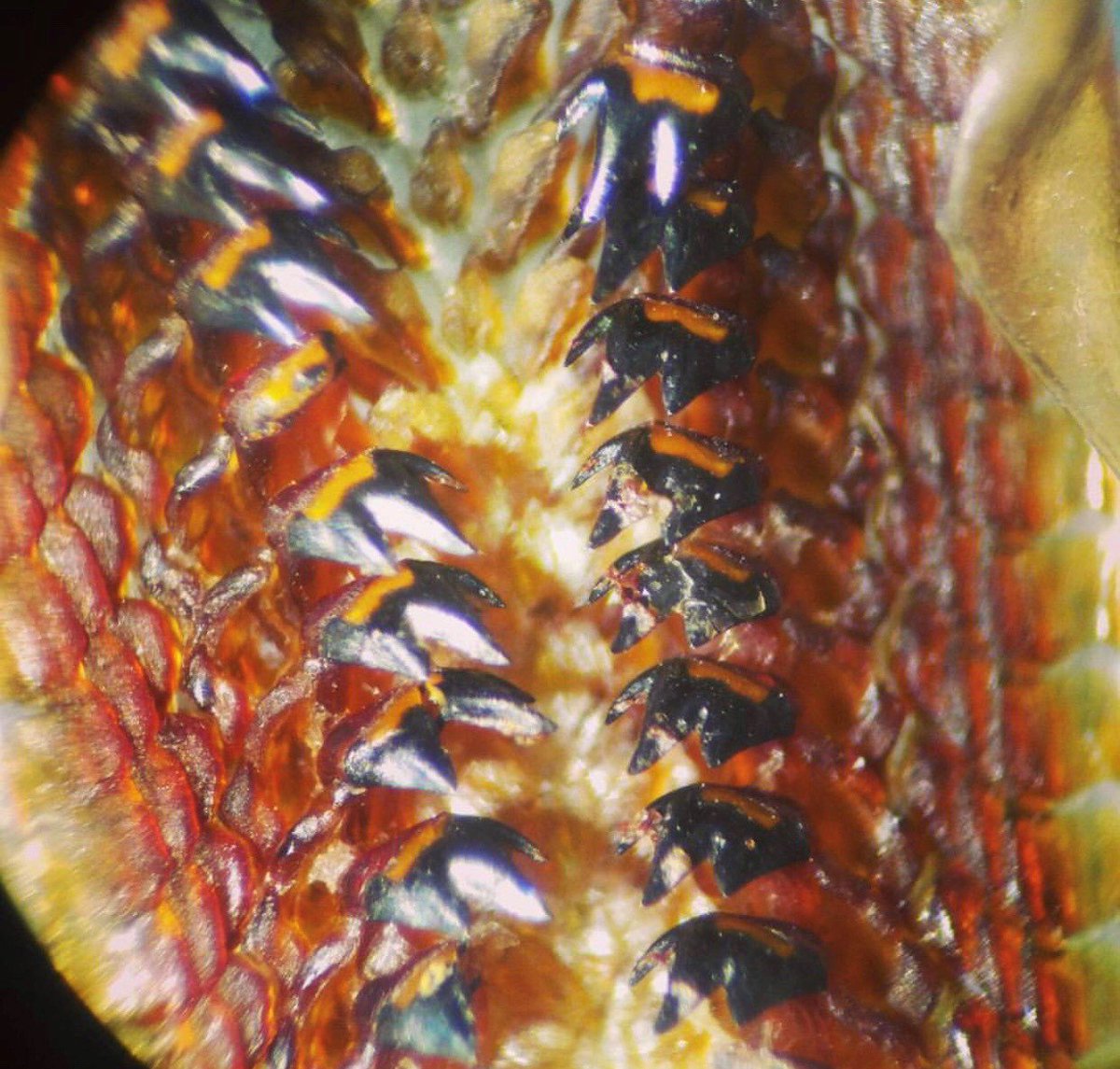
A gumboot chiton (left), also known as the "wandering meatloaf", with its teeth (right).
A research team lead by Michiko Nemoto of Okayama University and David Kisailus of UC Riverside recently discovered how the mollusk is able to produce magnetite teeth. While researchers would usually look toward specific genes in their genome, the research team actually examined the chiton's transcriptome, the set of all mRNA molecules expressed from the genes. In the developing teeth region of the RNA transcripts, they found ferritin, an iron-storing protein. In the mineralized teeth region, they found a large amount of mitochondria that provide the energy needed to transform the molecules into magnetite. A new protein was even discovered which they identified as radular teeth matrix protein1.
I stumbled upon these unique creatures when I was looking for genetic articles on teeth. My interest in dentistry brought me here, but it was exciting to read about these new discoveries and how they are being brought into the light of engineering. Next-generation electronics require nanoscale energy, and by studying gumboot chitons, researchers are closer to developing nanaoscale energy sources since knowing how to control biological magnetite is essential to the process. I was also fascinated by the fact that the research team looked into the transcriptome instead of the genome. Some of my past blog posts looked into researchers who would study specific genes in the genome to find what they were looking for, but the research team in this article examined the transcriptome because they thought it would be easier to look at the regions that are actually expressed.
Links to Sources:
https://news.ucr.edu/articles/2019/01/31/magnetic-teeth-hold-promise-materials-and-energy
https://www.nature.com/articles/s41598-018-37839-2
Wednesday, April 10, 2019
Drosophila Research Working to Combat Aging
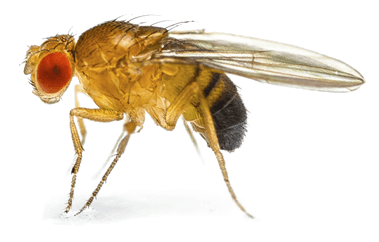
The fact that Drosophila are still being used as model organisms over 100 years after heir first use really amazes me. This research is amazingly useful as well. In the short term, being able to expand the lifespan of fruit flies and other experimental organisms would allow for maximum data collection in terms of scientific experiments. However, the findings of this experiment may also open the door for the next billion dollar industry if this anti-aging process is made possible in humans. The promise of being younger for longer is something that many people would pay absurd amounts to achieve, and whoever is the first to make this possible will have quite the retirement fund.
Wednesday, April 1, 2015
Music Performance Effect On Transcriptome
Music performance involves a lot of cognitive and motor skills which have an unknown biological basis. Neuroscientific studies have showed that the brains of professional musicians differed structurally and functionally from non-musicians. In this study the effect of music performance on the genome-wide peripheral blood transcriptome of professional musicians was analyzed both after a two hour concert and a music free control session.
After the two hour concert up-regulated genes affected dopaminergic neurotransmission, motor behavior, neuronal plasticity, and neurocognative functions including memory and learning. Certain candidate genes like SNCA, FOS and DUSP1 which are involved in song perception and production in songbirds were identified suggesting an evolutionary conservation in biological processes related to sound perception and production. Also, genes were modulated that related to calcium ion homeostasis, iron ion homeostasis, glutathione metabolism, and several neuropsychiatric and neurodegernative diseases that implied that music performance may affect the biological pathways that are essential for the proper maintenance of neuronal function and survival. This was the first study to show evidence for candidate genes and molecular mechanisms underlying music performance. "The findings provide a valuable background for molecular studies of music perception and evolution, and music therapy", says the leader of the study, Dr. Irma Järvelä from the University of Helsinki.
I found this article very interesting due to association between music performance and the up-regulated genes that affected neurocognative and motor functions. In particular this interested me since I play the cello for musical concerts on an almost regular basis but never knew that this ability might be due to evolutionary genes like SNCA, FOS and DUSP1 for sound perception and production in song birds. Furthermore, I learned about the process of transcriptome analysis in the blood and how it can be used to determine when and where a gene is turned on or off in an organism.
Abstract: http://www.ncbi.nlm.nih.gov/pubmed/25806429
Sunday, November 23, 2014
Ferret genome hold clues to respiratory diseases
An internationalized research effort has a draft sequence of the ferret genome, this sequence was used to analyze how flu and cystic fibrosis affect the respiratory track at the cellular level. The ferret was used because they are a good model for the study of human diseases especially influenza because they can be infected by the same strains as humans.
The scientist at Broad Institute of MIT and Harvard sequenced and annotated the genome of a domestic sable ferret. They then collaborated with Katze group on the analysis. They used transcriptome analysis which identifies all the RNA that is being produced, or transcribed, from areas of the genome that is begin activated at a specific time. This analysis helps scientist determine how ferrets cells are responding when challenged by influenza and in cystic fibrosis.
The part of the study that deals with influenza was conducted at the University of Wisconsin-Madison by Yoshihio Kawaoka's group. They exposed the ferrets to reconstructed version of the virus that caused the flu of 1918, 2009 swine flu, and Spanish flu. They then collected trachea and lung samples on the first, third, and eighth days of infection. The samples were then used for transcriptome analysis.
Katze team found that there were two viruses that affected the trachea and lungs differently. The 1918 virus triggered marked transcriptional responses on the first day of infection and this response sustained through day eight. The 2009 swine flu strain triggered a response that started slow and grew with it peaking at day eight. In the lungs the gene transcription triggered was about the same for both viruses.
John Engelhard's group at Iowa wanted to better understand cystic fibrosis. To do this they genetically engineered a ferret lacking the gene for the membrane protein called cystic fibrosis trans membrane conductive regulator, this detective gene is responsible for the disease.
The analysis of the transcriptome of the gene knock-out ferrets reveled that the changes in the expression of the gene can be seen on the first day of life and increase for 15 days. These changes were similar to those found in humans for both diseases. The findings suggest that the disease processes responsible for lung damage occur early in life.
This study is very important to future research in influenza, cystic fibrosis and possible other diseases. The ferrets have proved to be a good model to use for research into these diseases because they respond similarly to humans. Hopefully discoveries are made by learning more about these diseases that can help those who are affected by them.
Article: http://www.sciencedaily.com/releases/2014/11/141117130222.htm
Related article:http://www.genome.gov/pages/research/sequencing/seqproposals/ferretseq.pdf