Showing posts with label allele. Show all posts

Wednesday, August 2, 2023

Coevolution: Hallucinogenic Cacti & Andean Population


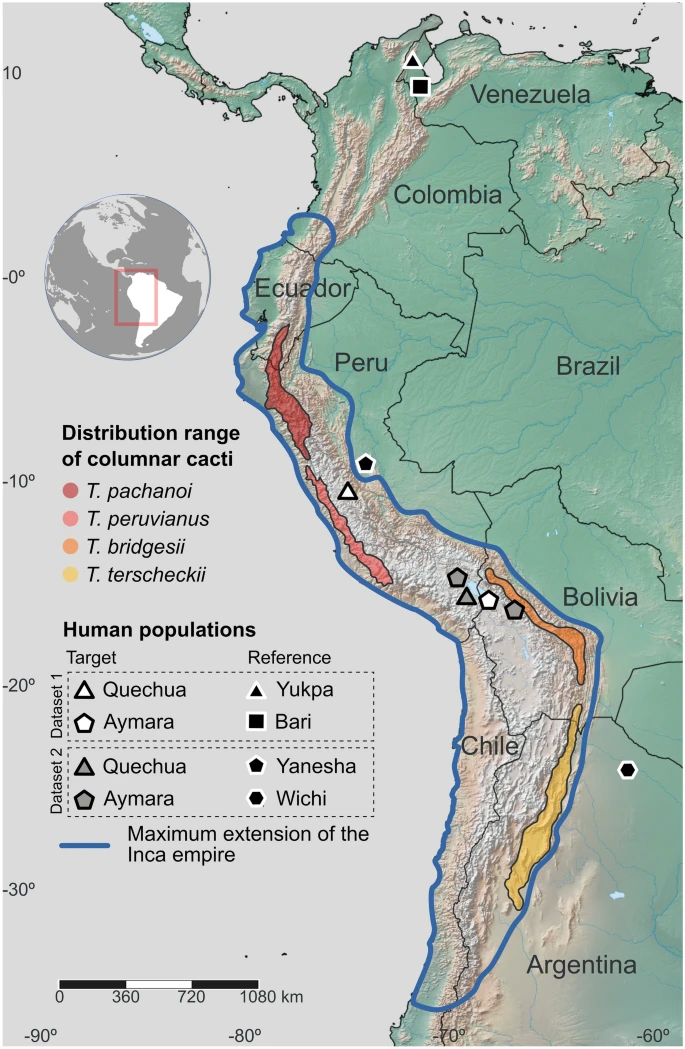
  This study aimed to identify ortholog genes between Drosophila buzzatii and humans, particularly indigenous population located in the Central Andes. Hallucinogen plants, psychotropic cacti in this case, have been an integral part of Shamanism and has been utilized in rituals as far back as thousands of years. The plant of focus is hallucinogenic cacti within the genus Trichocereus, more commonly called San Pedro. It is high in phenylethylamine alkaloids and particularly high in mescaline, a hallucinogenic alkaloid. Due to the long relationship between hallucinogenic cacti and indigenous populations there were suggestions of positive selection pressure in these populations and the development of tolerance for alkaloids, a secondary metabolite.

The vivo study focused in on transcriptomic responses in the cactophilic Drosophila and using the genetic model of the fruit fly were able to identify genes that assist in the metabolism of alkaloids present in hallucinogenic cacti. Ten ortholog genes were identified and support the suggestion that generational exposure to cacti alkaloid have elicited a genetic change. The results potentially suggest a small shift in allele frequencies in reference to the metabolism of alkaloids, a possible result of consumption of San Pedro cacti over the course of many generations.

Other suggestions are made in terms of shifts in allele frequencies induced by distinct diet among these populations, such as the region's diet being rich in roots and tubers. This study and those alike improve understanding of the selection for detoxification genes, how SNPs may impact detoxification of plant secondary metabolites or drugs, and the ethnic variability of these genes. More studies in this variability could individualize drug related use as it relates to misuse, tolerance, and susceptibility to addiction.


Saturday, April 23, 2022

    An article written by Dan Robitzski for the The Scientist explores how behavioral traits are passed down in mice by each parent. Each gene that governs specific behaviors are expressed unequally in various cells in the brain and adrenal system. Maternal alleles shape foraging behavior in male offspring and paternal alleles shape this behavior in female offspring.

    Genomic imprinting is a process that causes genes to be expressed in a parental-origin-specific manner. In contrast to expression of genes from both chromosome homologues.

     In other words, one of the parent's alleles was preferred and expressed over the other in different regions. Research shows that cells in multiple brain regions specifically express a maternal allele for a gene that encodes an enzyme involved in making several neurotransmitters. The paternal copy of this gene was preferentially expressed in the adrenal gland which produces hormones.

    The mechanism that would explain this phenomenon remains unclear, but is assumed to be quite complex. It is interesting to believe genomic imprinting may occur in other species, and why one parental allele may be favored or suppressed over another in different regions in recognizable patterns.  
 

Tuesday, November 20, 2018

Genetic Evidence Reveals Salmon are Shrinking!

      Salmon are an important species in the food chain and many species around the world rely on this fish as a part of their regular diet. There are a total of eight species of Salmon around the world, seven which are native to the Pacific Ocean and one which is located in the Atlantic Ocean. Each species plays a crucial role in maintaining a proper balance in the world's ecosystem, however, that role is being threatened by the fact that Salmon appear to be shrinking! Apparently researchers have been aware of this epidemic for some time now but what they didn't know was what was causing salmon to shrink. In order to find out why salmon are shrinking a study was conducted by the University of Helsinki and the Institute of Finland on a salmon population over the course of 36 years. A quote from a professor at Helsinki was posted by ScienceDaily stating that "we knew from our earlier research that the age at maturity had been decreasing over this period. Now we wanted to see if there were signs of this also at the genetic level" (Craig, 2018). This fortuitous observation provided scientists with a great opportunity to study a trait for adaptive evolution in vertebrates and apply what they learn to other species. The study was conducted by analyzing scales collected from salmon populations in the Treno River in Northern Finland. Upon analyzing the scales researchers found an allele located on a gene that influences maturity in salmon. The single locus responsible for late maturity in salmon was found in the Vgll3 region of the gene. According to the scientific journal posted in Nature, Ecology and Evolution researchers have calculated an 18% decrease in the vgll3 allele associated with late maturity in the salmon population. The gene which is passed on in sex specific selection is responsible for perpetuating this long observed trend in salmon during migration. Scientists are still exploring what evolutionary purpose this allele serves but what they do now know is it plays an incredible role in the trend of salmon populations around the world. By further studying the allelic effects of this gene, scientists may be able to glean more information about the fitness trait of evolution and get a better understanding of the phenotypic diversity of the salmon population as a whole.

Thursday, February 23, 2017

Discovery in the Genetics of Happiness

Happiness is said to be a fleeting thing, but thanks to researcher Meike Bartel, the scientific community is one step closer to understanding just how happiness is expressed in the first place. By sampling almost 300,000 people, Bartel took a sample of each subject's DNA and measured their well-being (self reported measure of life satisfaction and mental health). From this, she was able to determine important information about the link between genetics and happiness, including variants for happiness, depression, and areas on the genome linked to happiness.

Bartel stressed the fact that even though research has found a link between a subject's well-being and their genetic make up, lurking variables such as environmental factors play a major role in the overall well-being of a person. It is important to understand that a subject that does not exhibiting this variation can still be as happy as a person that does, but those with it are more prone to optimistic bias.
Meike Bartels speaking in Dubai about the 'Science of Happiness'


A journal I found on the subject on the National Institute of Health's website entitled "Genes, Economics, and Happiness", suggested that happiness was linked to a longer 5-HTTLPR allele, a serotonin transporter gene. Subjects that had a longer 5-HTT allele had a tendency to report a higher well-being that those that had shorter ones. Additionally, subject's with the shorter allele tended to succumb to stress depression more frequently. In both this journal and Bartel's journal article, the inconsistency of the experiments for this discovery was noted, as later experiments yielded varying results in regards to allele length and the effects on well-being. The topic would be interesting to explore further, as the link between the two variables could be significant.

An important question that was raised during this research is whether this genetic link to happiness could be used to genetically alter a person to have a happier predisposition. Unfortunately, the answer is no... for now anyway. Bartel explains that there are several thousand gene variants responsible for happiness, and altering that much DNA would be too great a task. For now, her focus is on the effects the environment has on genes.

CNBC "Happiness might Well be Genetic"

Wednesday, October 31, 2012

The Influences of Alleles and Environment on Education

Some of the most interesting research combines approaches from different fields of study to explain certain phenomena.  In July, a study relating academic achievement to genetics was published in the Developmental Psychology Journal from the American Psychological Association.  Researchers at Florida State University were trying to see if certain genes would influence whether or not a student would graduate from high school and attend college.  The researchers studied the DAT1, DRD2, and DRD4 genes.  The DAT1 gene encodes a protein that acts as a dopamine neurotransmitter.  The DRD2 and the DRD4 genes encode proteins that acts as dopamine receptors.  Dopamine is an important chemical found in the brain that may have an effect on certain behaviors such as motivation, sleep, violence, and cognitive ability.  Improper dopamine levels may cause the development of certain conditions such as ADHD.


[caption id="" align="aligncenter" width="504" caption="Dopamine attaching to receptors."][/caption]


This study used data from the National Longitudinal Study of Adolescent Health (Add Health).  In 1995, Add Health began studying youths in middle school or high school through early adulthood (the study ended in 2008).  The participants’ DAT1, DRD2, and DRD4 genes were analyzed.  Each participant contained different alleles of the genes being studied.  An allele is the alternative form of the same gene.  The researchers found that test subjects with certain alleles obtained the highest levels of education.  However, having certain alleles does not guarantee graduation from college.  The environment (ie. financial status and prevalence of crime) plays a major factor in determining the level of education.

As a college student, it was interesting to learn that certain alleles may influence academic achievement.  Although there is not a gene for “getting good grades,” certain key aspects of learning such as motivation and attention are clearly controlled by the genes that regulate the levels of dopamine in the brain.  To benefit future students, more studies should be completed to learn about other genes that may affect learning and levels of academic achievement.