Showing posts with label right whales. Show all posts

Friday, October 13, 2023

Did Cetothere Whales Go Extinct?

 The evolutionary history and relationships of whales has long fascinated scientists for decades. The fossil record of whales is deep and expansive with many bizarre bauplans (body-plans) that are unlike anything alive today. Presently whales can be divided into two broad taxonomic groups, the odontocetes (toothed whales, dolphins, and porpoises) and the mysticetes (baleen whales). The extant  mysticetes are traditionally divided into the following three taxonomic families, Balaenopteridae, Balaenidae, and Eschrichtiidae. Two additional families within the mysticeti clade are recognized, Eomystecidae and Cetotheriidae but both of these families are extinct and represented solely by fossils... Or are they?


Illustration of a Pygmy Right Whale Source: Wikipedia Commons

The Pygmy Right Whale Carpera marginata is an elusive mysticete found throughout the world's southern oceans. As the common name would imply, it was traditionally thought to be closely related to Right Whales (Balaena spp.), which belong to the family Balaenidae. Superficially Pygmy Right Whales do appear to be a Right Whale that decided to stop growing halfway through their pubescence. Looks however can be deceiving and the apparent relationship between the full-sized and the pygmy right whales is quite literally skin-deep. Ewan Fordyce and Felix Marx published a paper in 2013 re-assessing the skeletal morphology and taxonomy of Pygmy Right Whales and found something interesting. By comparing the skull and ear-bones of fossilized Cetotheres to those of Pygmy Right Whales they concluded that the Pygmy Right Whales were Cetotheres. 

Phylogenetic Tree of Extant Mysticetes. Note how the Pygmy Right Whale is the sister group to Balaenopteroidea and only distantly related to the true Right Whales (Balaenidae).
 Source: Wikipedia (note this phylogeny was made four years prior to this study and is subject to change)

While the shape and position of bony features is highly revealing of evolutionary relationships, morphology alone is an incomplete dataset. Genetic material such as DNA or other related proteins provide clearer and far more complete pictures of an organisms taxonomy. Luckily for fans of Cetotheres, genetic studies published this year provide further lines of evidence that their lineage may still persist to this day in the form of Pygmy Right Whales. 

It is incredibly important to note that the debate itself is still not settled as to whether or not Pygmy Right Whales are true Cetotheres or a lineage that diverged early during the evolution of  Balaenopteroidea and is nested within that clade instead. The Phys.org article presents this evidence as "Putting the Debate to Rest" whereas the study it draws from is far more tentative in its conclusion as to whether or not Pygmy Right Whales represent the last of the Cetotheres or are a strange, persistent, and early offshoot of Balaenopteroidea. This kind of scientific journalism that presents phylogenetic datasets as solved/absolute disservice the public in two ways. Firstly, it is outright dishonest and misrepresents the work of the authors, giving the general population an overconfidence in our understanding of complex evolutionary relationships. It also harms the publics' understanding of the scientific process of developing taxonomic as these models of relationships are constantly changing with new data points and new statistical computational models.



Wednesday, April 13, 2022

Baby whale genetic testing may help save species, study says


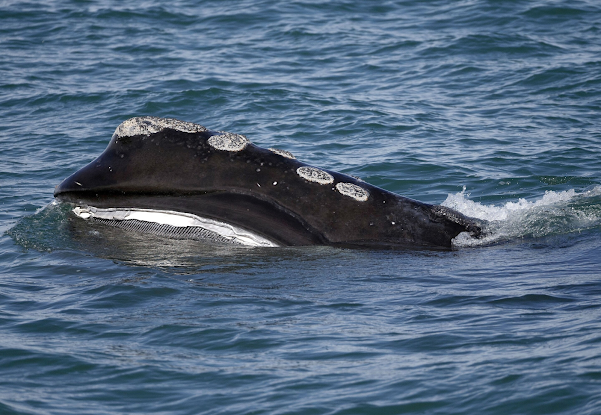
In an article posted by ABC News, a team of scientists led by researchers at the New England Aquarium in Boston studied critically endangered North Atlantic right whales. The scientists analyzed decades of data about the whales and found that they had more success tracking the animals’ survival, growth rates, and life histories when they had access to genetic samples. The results of this study were published in Mammalian Biology.


The scientists focused on 13 right whale calves identified via genetics and were able to determine the ages of 12 of the whales and match 11 with their mothers. They even found that four believed to be dead were actually still alive. Right whales have been historically tracked using photo ID. According to Philip Hamilton, the senior scientist at the aquarium, the photographic archive is still important but it is even more helpful when used alongside genetic data.


Right whales were once abundant off the East Coast but their populations were decimated during the commercial whaling era. The whales are now vulnerable to ship strikes and entanglement in fishing gear. Climate change is also a new danger that has been forcing whales to flee coastal areas in search of food, which puts them at risk to the other dangers previously mentioned.


A greater reliance on genetic data can help fill in the gaps about these whales. Relying on genetics in addition to photo or acoustic data adds another layer of complexity that can help scientists further understand this very endangered and complex species. The researchers learned that it’s possible for mother right whales to be seen without their calves in feeding grounds for short periods. Previously, calves were assumed to be dead if their mothers were alone on feeding grounds during the birth year, according to the study.


Samples used in the biopsy were sent to Saint Mary’s University in Halifax, Nova Scotia, for genetic analysis. According to Timothy Fraiser, a biology professor at the university who was involved in the research, integrating the genetic samples with field research yields data that is more comprehensive than the sum of its parts. This leads to a much richer understanding of right whales than either approach could provide on its own.


Related article: https://www.nature.org/en-us/newsroom/florida-north-atlantic-right-whales-fight-for-survival/


Wednesday, November 30, 2016

Right Whales and a New Mutation

Researchers have recently found that in a specific species of whales, right whales, that there is a new gene mutation causing more death for the endangered species. The mutation occurs in their eyes, making them unable to see bright lights or objects, unfortunately objects such as different types of fishing gear. (Fishing gear is a great cause of death for the whales and other sea life) Although, this is unfortunate for the whales, it is helping scientists to understand more about the eye. According to the research, the whales are missing a "normal light-detecting protein", which means completely missing a cone needed for the eyes to see brighter colors. This is the first mutation of its kind found in any mammals. (More information about the eye).


Researchers are finding that whales only possess one gene for this specific cone. Although the cone cell is missing the rods are still present, helping the whales and exemplifying their ability to see dim-light. From this information, scientists are learning new things about the eye that have yet to be discovered. I find it really amazing how the whale's body recognizes that they are missing a certain part of their eye, so the part that is left begins to be exemplified and work better. Many whales go very deep in the ocean, where light disappears quickly, this can be very beneficial when swimming throughout the ocean, except when coming to the top of the water for air. The longest a whale can hold its breath is 90 minutes, but it usually less than that. Hopefully, for the whales they will not be swimming into any fishing equipment. I hope that the whales get another mutation that can only help their eyes and prevent them from becoming extinct.