Showing posts with label whales. Show all posts

Friday, October 13, 2023

Did Cetothere Whales Go Extinct?

 The evolutionary history and relationships of whales has long fascinated scientists for decades. The fossil record of whales is deep and expansive with many bizarre bauplans (body-plans) that are unlike anything alive today. Presently whales can be divided into two broad taxonomic groups, the odontocetes (toothed whales, dolphins, and porpoises) and the mysticetes (baleen whales). The extant  mysticetes are traditionally divided into the following three taxonomic families, Balaenopteridae, Balaenidae, and Eschrichtiidae. Two additional families within the mysticeti clade are recognized, Eomystecidae and Cetotheriidae but both of these families are extinct and represented solely by fossils... Or are they?


Illustration of a Pygmy Right Whale Source: Wikipedia Commons

The Pygmy Right Whale Carpera marginata is an elusive mysticete found throughout the world's southern oceans. As the common name would imply, it was traditionally thought to be closely related to Right Whales (Balaena spp.), which belong to the family Balaenidae. Superficially Pygmy Right Whales do appear to be a Right Whale that decided to stop growing halfway through their pubescence. Looks however can be deceiving and the apparent relationship between the full-sized and the pygmy right whales is quite literally skin-deep. Ewan Fordyce and Felix Marx published a paper in 2013 re-assessing the skeletal morphology and taxonomy of Pygmy Right Whales and found something interesting. By comparing the skull and ear-bones of fossilized Cetotheres to those of Pygmy Right Whales they concluded that the Pygmy Right Whales were Cetotheres. 

Phylogenetic Tree of Extant Mysticetes. Note how the Pygmy Right Whale is the sister group to Balaenopteroidea and only distantly related to the true Right Whales (Balaenidae).
 Source: Wikipedia (note this phylogeny was made four years prior to this study and is subject to change)

While the shape and position of bony features is highly revealing of evolutionary relationships, morphology alone is an incomplete dataset. Genetic material such as DNA or other related proteins provide clearer and far more complete pictures of an organisms taxonomy. Luckily for fans of Cetotheres, genetic studies published this year provide further lines of evidence that their lineage may still persist to this day in the form of Pygmy Right Whales. 

It is incredibly important to note that the debate itself is still not settled as to whether or not Pygmy Right Whales are true Cetotheres or a lineage that diverged early during the evolution of  Balaenopteroidea and is nested within that clade instead. The Phys.org article presents this evidence as "Putting the Debate to Rest" whereas the study it draws from is far more tentative in its conclusion as to whether or not Pygmy Right Whales represent the last of the Cetotheres or are a strange, persistent, and early offshoot of Balaenopteroidea. This kind of scientific journalism that presents phylogenetic datasets as solved/absolute disservice the public in two ways. Firstly, it is outright dishonest and misrepresents the work of the authors, giving the general population an overconfidence in our understanding of complex evolutionary relationships. It also harms the publics' understanding of the scientific process of developing taxonomic as these models of relationships are constantly changing with new data points and new statistical computational models.

Monday, July 31, 2023

The molecular evolution of genes previously associated with large sizes reveals possible pathways to cetacean gigantism

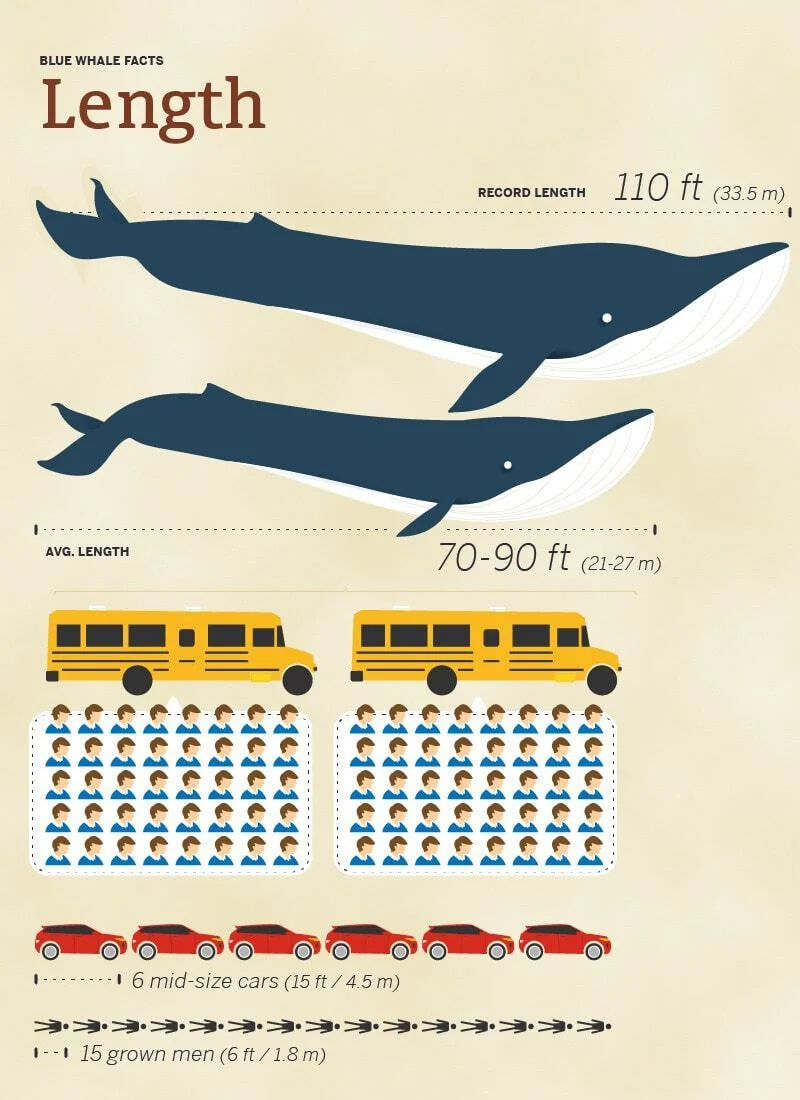
This discussion includes the size of the blue whale and how they came to be the biggest animals on the planet. The blue whale is actually the largest animal to ever exist in terms of both size and weight, as they can grow up to 100 feet long and weigh up to 190 metric tons. This trend only started occurring relatively recently, only starting about five to ten million years ago. A team from the State University of Campinas in Brazil led by biologist Mariana Nery set out to discover the reasons for the massive growth that the blue whale endured. 

To understand the genetic reasons behind the growth, they compared the DNA of nine different genes across 19 species of whales. When studying genes related to body size, they found evidence of positive natural selection in four genes, some of which are associated with growth hormones and insulin pathways. One unexpected result of this study was discovering that the EGF gene, which stands for epidermal growth factor, turned nonfunctional over time. Despite their enormous size, whales do not seem to suffer from the increased cancer risk that usually comes with having more cells. The study suggests that looking into whale genetics might help identify genes that could possibly slow down the spread of cancer in humans as well.


Friday, September 27, 2019

DNA of Strange Whale Confirms it is a Hybrid of Belugas and Narwhals

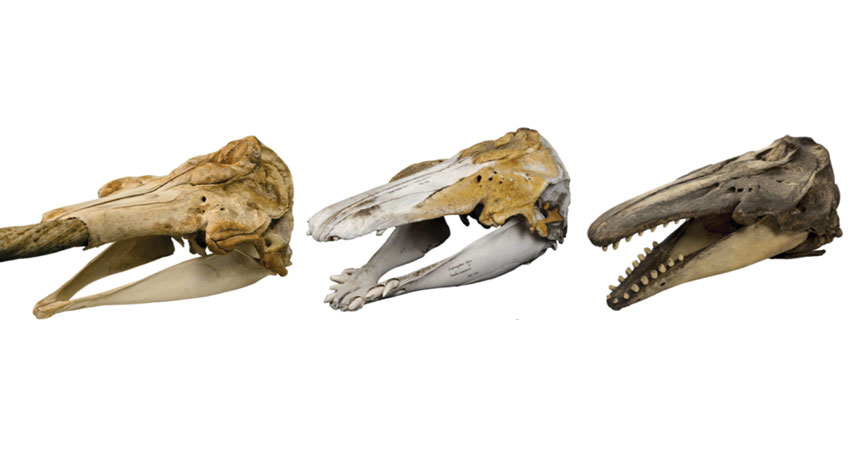
Back in 1987 an Inuit tribe hunted belugas and narwhals in Disko Bay in Greenland. They ended up catching a strange oddity. Locals said they had never seen a stranger looking whale in their lives or since that moment. Past DNA analysis revealed nothing about the mysterious skull and the case remained a mystery, until recently that is. Recently, scientist cracked the case open and started to examine the DNA and structure of the skull and compared it to the skulls of similar marine life in the area, particularly belugas and narwhals. What they found was that the skull was actually a hybrid of both species. After tracking narwhal and beluga mating patterns, the pieces of the puzzle were finally put together. It was determined that Disko Bay was one of the very few places where belugas and narwhals mate. And they also concluded that because female belugas look so much like female narwhals, it is easy to mistake them, even to male narwhals.
beluga, hybrid and narwhal skulls


I find the research interesting in that it took so long to confirm. Just looking at the skulls, it looks like an evolution chart rather than a hybrid comparison. I also think it is interesting how the gene exert a sort of co-dominance in the mouth to show some teeth.
https://www.sciencenews.org/article/dna-confirms-greenland-whale-narwhal-beluga-hybrid
https://www.livescience.com/65757-first-beluga-narwhal-hybrid.html

Thursday, September 26, 2019

Losing Genes Helped Whales Adapt to Underwater Life


Scientists in Germany began to study whales and dolphins and piece together what made them go from land living creatures to water inhabitants about 50 million years ago. They studied the DNA and gene differences between modern day whales and hippos, which are the closest ancestors to 'land living whales' or land living cetaceans. The study found that whales actually "lost" as many as 85 genes that affected physical processes that would be a burden in full time water life. One example dealt with the POLM genes, which regulate the repair of DNA, but is also very damage prone. This is important because DNA gets damaged with cycles of high to low oxygen. So getting rid of an inefficient protein would only help them make that transition from land to sea. Another gene that was lost was SLC4A9, which regulated saliva production. Saliva helps break down food, which unnecessary in water. Also, less saliva helps keep fresh water in the body. This gene would be beneficial to lose in the water.
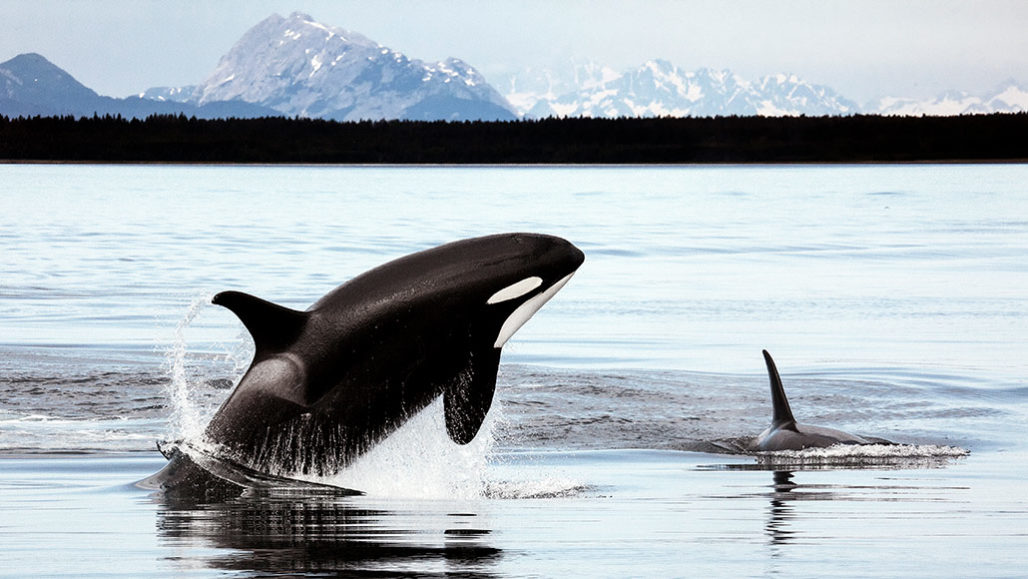
orca jumping
I think this article really highlights how the environments affects both evolution and genetics. Simply changing environments completely changes how an animal operates and lives. It is important to see how environmental changes affected animals in the past and predict how they can impact others in the future.
https://www.sciencenews.org/article/losing-genes-may-have-helped-whale-ancestors-adapt-life-underwater
https://www.inverse.com/article/59582-whales-and-dolphins-lost-genes-tell-their-story

Saturday, October 24, 2015

Synthetic Blood Development Could Be a Breakthrough for Trauma Patients 

Whales and other deep sea diving mammals can hold their breath and keep active for extended amounts of time on just one breath.  This is due to the vast amounts of myoglobin (a protein that helps to hold oxygen in the body) stored in the large mammals’ muscles.

Researchers from Rice University have done studies for quite some time on the myoglobin in the bodies of whales and other marine mammals to hopefully be able to come up with synthetic blood for human trauma patients.  Because the myoglobin in whales can hold so much oxygen, this in turn could be beneficial to humans.  “Whales and other deep-diving marine mammals can pack 10-20 times more myoglobin into their cells than humans can, and that allows them to ‘download’ oxygen directly into their skeletal muscles and stay active even when they are holding their breath” said biochemist, John Olson in a statement.

Whales have a large amount of myoglobin in their muscles which is why they can stay under water for so long.  Humans have less myoglobin in their bodies which is why it is difficult to hold their breath for extended amounts of time.  If synthetic blood were to be developed for trauma patients, it would provide hospitals with a larger blood supply.  This in turn would allow patients to receive blood quicker as well as have that blood “take up” oxygen more efficiently. 
I found this article very interesting.  Although there are many people that donate blood, having synthetic blood on hand could make it easier for patients to be matched for a specific blood type as well as make more blood if needed instead of waiting for a donation. 
To read more, click here and here 

Sunday, September 27, 2015

Whales and Synthetic Blood


 Researchers have recently been studying the ways of the whale and their ability to hold their breath for up to two hours while remaining active. The proteins that allow the whale to do this have helped biochemists and researchers close in on the possibility of creating synthetic blood. Researchers have done this by comparing the muscle protein myoglobin from humans, whales, and other deep-diving mammals. 

"Myoglobin holds oxygen for ready use inside muscle cells, and the study found that marine mammals have ultra-stable versions of myolobin that tend not to unfold. The researchers found that stability was the key for cells to make large amounts of myoglobin, which explains why deep-diving mammals can load their muscle cells with far more myoglobin than humans." (Rice University)

The scientist observing these proteins plans to maximize the amount of hemoglobin that a bacterium can express. In doing this research has shown that protein stability is the key. 

I enjoyed this article because it leads hopeful for trauma patients that are in need of immediate blood transfusion. It also could provide hospitals with a greater blood supply, allowing patients to receive blood quicker and more efficiently. 

This is a very interesting article and goes more in to depth about this topic. Check it out here!