Showing posts with label neurology. Show all posts

Wednesday, April 6, 2022

Can doctors determine if someone is predetermined to have a neurological condition?


    Using more than 123,000 MRI scans from over 101,000 humans - from a 16.5 week fetus to 100 year olds - scientists have mapped how our brain changes throughout our life. Mapping out our brain changes through human lifespans could potentially diagnose neurological conditions. 

    A recent study by Richard Bethlehem and his colleagues analyzed 123,984 MRI scans from 101,457 humans. These studies showed that brain size increased from 10 percent to 80 percent of its maximum volume from about four months of age to three years old. It peaked at 1066 cubic centimeters at around 11 years old, before gradually declining.
    
    The Cortex, or the outer region of the brain, has been linked with neurological conditions, like Alzheimer's disease, whenever it thins out. The average thickness of the cortex peaks around 1.7 years old. The thinness or thickness of the cortex can help to predict if the person will be affected by a neurological disease later in life, based off of early brain development.


Monday, January 30, 2017

A New Way to Treat Autism

A new study by Professor Edward Brodkin of the University of Pennsylvania suggests that the drug d-cycloserine, an antibiotic commonly used to treat tuberculosis, can help improve social skills and functions in children with autism. The study showed an increase in activity in the PCDH10 gene, which is an autism related gene, as well as showed in increase in social behavior in mice.

The amygdala, the area of the brain that is associated with social and behavioral defects in people with autism, is where the PCDH10 gene is expressed. It is not yet known how PCDH10 affects social behavior, however.

This article interested me because my brother is on the autism spectrum. I always knew I wanted to go into medicine, but after receiving his diagnosis I was inspired to pursue neurology.

http://www.medicalnewstoday.com/articles/315514.php
http://www.genecards.org/cgi-bin/carddisp.pl?gene=PCDH10

Friday, November 18, 2016


DNA-Based Zika Vaccine Showed Protection from Infection, Brain Damage and Death


The Zika Virus has wreaked havoc on the lives of millions throughout the globe. Prior studies on Zika virus treatments have only been studied on animals who are naturally resistant to the disease, however, this new clinical study by researcher David B. Weiner, Ph.D., Executive Vice President and Director of the Vaccine Center at the Wistar Institute and the W.W. Smith Charitable Trust Professor in Cancer Research at Wistar is in the midst of establishing how a synthetic DNA vaccine approach can protect against infection, brain damage and death caused by the mosquito-borne Zika virus in vivo.1                           
                                                            
In the clinical study all animals survived when exposed to Zika and even the cerebral cortex and hippocampus areas of the brain was protected from degeneration. As the first of its kind to research using animals susceptible to the virus, this breakthrough can possibly lead to a preventative vaccine that can be used in the future. Its neuroprotective abilities can alleviate concerns over newborns developing microcephaly, which is characterized by small heads and underdevelopment of the brain.2

Currently, two human studies are being conducted in Quebec City and the United States; the results of phase I will be complete by the end of the year. A second study is also being conducted in Puerto Rico, where about 25% of people are expected to be infected. This statistic means that a placebo-controlled design for the vaccine might soon be plausible.


                             In this preclinical study, 100 percent of the animal models were protected from Zika after vaccination followed by a challenge with the Zika virus. Credit: Gino Santa Maria/Fololia


This article demonstrates the importance of epidemiological research. The Zika Virus has proven to be extremely threatening to the livelihood of both newborns and adults whom are susceptible. The consequences of infection long-lasting neurological effects. 

These new studies afford a chance to conquer the Zika Virus and prevent the neural degeneration of populations in areas that are high-risk.


SOURCES:
     1. The Wistar Institue. "DNA-based Zika vaccine showed protection from infection, brain damage and death." ScienceDaily. ScienceDaily, 10 November 2016.
<www.sciencedaily.com/releases/2016/11/161110125203.htm>

     2. David B Weiner et al. In vivo protection against ZIKV infection and pathogenesis through passive antibody transfer and active immunization with prMEnv DNA vaccine. npj Vaccines, November 2016 DOI: 10.1038/npjvaccines.2016.21

Thursday, April 28, 2016

Four Different Genes Associated With Schizophrenia

Schizophrenia is a brain disorder that alters someone's perception of reality and causes abnormal social behavior, with symptoms beginning around age 20. There is currently no cure, and as negative social connotations associated with the disease continue to grow, a scientific obligation to understand schizophrenia on a deeper, genetic level arises. In January of this year, multiple scientists from NYU and other institutions did just that - after analyzing 48 separate case studies of people with schizophrenia, it was discovered that four separate signaling genes are involved with the disease. Combinations of these four genes lead to differing phenotypic expressions that may explain why the symptoms of schizophrenia are so widely varied. A quick Google search pulls up a slew of symptoms - from behavioral (social isolation, lack of restraint, aggression), to cognitive (delusion, amnesia), to psychological (hallucination, paranoia), and beyond. It's not surprising that Kranz et al.'s study revealed at least four different genes involved with this disease that affect a person's phenotype, classifying schizophrenia as a polygenic disorder. They also discovered that these genes impact the growth or regulation of nerve circuits within the brain.


In order to conduct this study, scientists studied 48 ethnically diverse individuals all affected with the disease. They had them undergo targeted exome sequencing of the four genes in question: PTPRG (Protein Tyrosine Phosphatase, Receptor Type G), SLC39A13 (Solute Carrier Family 39 (Zinc Transporter) Member 13), TGM5 (transglutaminase 5), and ARMS/KIDINS220 (Ankyrin repeat-rich membrane spanning protein or Kinase D-Interacting Substrate of 220 kDa). 15 out of the 48 cases (a little over 30%) were all shown to have "rare or novel missense coding variants" (Kranz et al. 2016) in one or more of these genes.

The first gene, PTPRG, was shown to influence traits such as working memory deficits and connection of nerve cells as they form nerve networks. The second gene, SLC39A13, was shown to be associated with severe negative symptoms, global cognitive deficits and poor educational attainment (suggesting a developmental disorder). This can lead to low achievement at school and decreased levels of motivation. The third gene, TGM5, is associated with slow processing speed, childhood attention deficit disorder and other milder symptoms of schizophrenia. Also, this gene is associated with stabilization of proteins that can lead to degenerative conditions that are found in Huntington's disease. The fourth gene, ARMS/KIDINS220, plays a role in global cognitive deficits with good educational attainment, suggesting neurodegeneration after a certain age, usually a little later in life (around 22).

This experiment is extremely important for psychologists, psychiatrists, neurologists, those affected with schizophrenia, and those who may be at risk. Instead of using 'schizophrenia' as a blanket term for everyone exhibiting multiple and varied symptoms of psychosis, this study directly implies that person-specific treatments are needed. If two people both have schizophrenia, their phenotypic expressions may be greatly varied, but may receive the same treatment - which may help one and not the other, or help neither at all. In the future, it's possible schizophrenia may be broken down into multiple classifications of different disorders, which makes more sense in terms of treatments. I hope this experiment leads to more studies, shedding better light on this disorder, reducing the stigma surrounding it, and ultimately leading to some type of cure.


Original Article: http://www.medicalnewstoday.com/articles/309631.php

Tuesday, December 2, 2014

Genes Could be the Key to a Good Memory

A study was conducted to find a connection between genetic variants and the ability to remember stories and lists. This study is the first of its kind.


The researchers had participants who were all free of dementia take memory tests. The tests consisted of remembering stories and words after a certain period of time.

The researchers analyzed the results of the tests in conjunction with individual genome information. They then determined which genetic variants were linked with lower memory test scores. The results for individuals who possessed certain genetic variants showed early signs of Alzheimer’s disease.

The individuals found to have lower scores were found to have variants near the Apolipoprotein E gene, which is involved in immunity. Some previous research has shown that a number of forms of Apolipoprotein E are connected to a higher risk for dementia and related diseases.

The researchers also studied over 700 postmortem brain tissue samples. After studying the samples, they determined that individuals with the genetic variants studied in this experiment were more likely to have signs of Alzheimer’s.


They hope that their discoveries can help scientists understand the link between genes, immune systems, and memory loss due to age.

This article was interesting to read but not surprising to me. It's clear that our genes affect nearly everything about us, so it always seemed likely that genes would affect memory and aging as well. Hopefully, this helps scientists and clinical professionals better understand the exact sources of problems to either fix them or help improve treatment options for aging patients.

Article: http://www.medicalnewstoday.com/articles/286106.php
Secondary Link: http://www.medicalnewstoday.com/articles/265432.php

Thursday, November 20, 2014

New cause for Progressive Myoclonus Epilepsies (PME) has been identified.

     One of the most devastating forms of epilepsy is progressive myoclonus epilepsy. An team of researchers have discovered a new gene that causes this type of epilepsy. It was shown that a single mutation in a potassium ion channel is the main reason for this disease. Researches at University of Helsinki, Finland and Universities of Melbourne and South Australia have identified a new gene for a progressive form of epilepsy. 

     Progressive myoclonus epilepsies (PME) are rare and inherited. They are usually childhood-onset neurodegenerative diseases. The goal of the study was to identify underlying genetic causes in 84 PME patients. They did so using DNA sequencing targeting the protein coding elements of the human genome. A genetic diagnosis was found for 1/3 of the unsolved patients. The most successful finding from the study was that a single mutation in a potassium channel encoding gene (KCNC1) is the cause for a large number of unsolved PME patients. They found that there was a mutation was found in 13 patients that were not inherited from parents, as usual. It had emerged in a germ cell of one of the parents or in the fertilized egg. It was found that each of the 13 patient had dozens of these new mutations, however, they are rarely disease causing. The researchers estimate that this mutation occurs in roughly 1 out of every 5.7 million, being very rare. However, with such a large population on earth, t at least hundreds of people could have this mutation globally.

     "A fascinating aspect of this finding is that this single mutation can be found in several patients all over the world. The mutation site is an example of a 'mutation hotspot' of the genome - a DNA nucleotide which is more prone for alterations", says Professor Anna-Elina Lehesjoki, the corresponding principal investigator of the study in University of Helsinki and Folkhälsan Research Center, Finland. "The fact that the mutation occurs in a well-characterized ion channel gives hope to development of targeted therapy. There are anti-epileptic drugs in the market that target other similar ion channels and follow-up research aims to discover a way to rescue the function of the channel in PME patients."

     The mutation disrupts the function in a potassium channel, which has a central role in signal transmission in the brain. The mutation causes in inhibitory signals in certain parts of the brain to be reduced, which makes patients more susceptible to epileptic seizures and myoclonus in early childhood stages. The mutation also causes degeneration of the cerebellum and subtle cognitive decline.

     I think these findings really bring epileptic studies a long way. The knowledge they now have could potentially aid in diagnostics and potential therapeutic medications for the disease. The study also proved how significant DNA technologies are and how powerful they are in understanding the underlying genetic causes of severe diseases.

Article: http://www.medicalnewstoday.com/releases/285642.php

Monday, October 6, 2014

Turmeric Compound Helps Regenerate Brain Stem Cells

Researchers in Germany recently discovered a bioactive compound in turmeric that promotes stem cell proliferation and differentiation. The study was conducted at the Institute of Neuroscience and Medicine in Julich. Researchers looked at the effects of aromatic aromatic-turmerone on endogenous neutral stem cells known as NSC. These stem cells are found in the adult brain. NSC plays an important role in self-repair and recovery of brain function in neurodegenerative diseases. 

Tumeric Powder, a commonly used spice, encompasses the compound Turmerone,
which holds regenerative neurological abilities.  
The researchers looked at the effect ar-turmerone had on NSC both in-vitro and vivo. NSC from Rat fetal was cultured over a seventy-two hour period in the presence of ar-turmerone. At certain concentrations of ar-turmerone, NSC proliferated 80% more than NSC cultured without the presence of ar-turmerone. The result also accelerated cell differentiation and did not yield any effect on cell death. To test in vivo, researchers injected adult rats with ar-turmerone. The study found that the subventricular zone and the hippocampus expanded. Both areas in mammalian brains are known for neurogenesis, the area where neurons grow. According to lead author, Adele Rueger, this is a major goal for regenerative medicine.
My culture commonly uses turmeric powder in many of our dishes. It's interesting to find out something I eat regularly has such amazing natural medicine indications. This is very promising news for the field of medicine. Considering the effects of ar-turmerone on NSC, the possibility of using ar-turmerone as a possible treatment for neurological disorders has suddenly increased through this study. Hopefully, the new findings are incorporated into future projects in regards to such disorders such as Alzheimer’s disease, which is becoming more prevalent as the years go one. 

Article Related: Hippocampus - http://neuroscience.uth.tmc.edu/s4/chapter05.html

Friday, April 18, 2014

How vision makes sure that little fish do not get carried away!

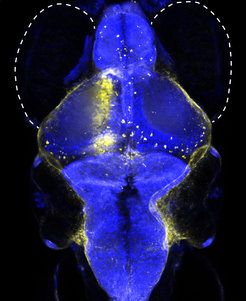
Newly discovered neuron type (yellow) helps zebrafish to coordinate its eye and swimming movements. The image shows the blue-stained brain of a fish larva with the suggested position of the eyes.In this article,  human brain is a very unique nerve, but for many years we had no idea how the brain processed such large scale movements in the visual environment know as "optic flow" so that when running or jogging we can perceive and estimate are speed correctly and not stumble. One animal that uses this characteristic or capability is fish and their swimming techniques especially in rivers with the strong water flow. To prevent the fish from drifting in the water flow, the fish has to use this capability. Finally researchers as well as scientists discovered the way that are movements are compensated. In the department Max Planck Institute of Neurology, he searched for and described the neural networks in the brains in zebrafish larvae that control certain types of movement. The brain of a 5 mm fish contains several hundred thousand neurons.  One advantage of a fish is that the brain of a fish larvae is completely transparent. 
Neurons can be observed directly under the microscope without requiring any surgical discretion. During the experiment the neurons were all encoded with a dye and for each type of movement the fish produced allowed the the neuron that was being used to make the action to light up allowing for scientists to understand the full knowledge to what neurons are used in different movements.


http://www.theguardian.com/science/blog/2012/feb/28/how-many-neurons-human-brainhttp://www.theguardian.com/science/blog/2012/feb/28/how-many-neurons-human-bhttps://images


Tuesday, March 18, 2014

Gene,USP9X, is the Leading Cause of Intellectual Disabilities


The human brain is very extraordinary, yet very difficult to understand. Researchers have been studying the human brain for years, and some things still remain very much misunderstood and unknown, such as Alzheimer disease. In this article, research was done by the University of Adelaide,and it confirms that there is a gene that plays a major role in brain development. This gene is called USP9X,and it is the gene that is responsible for brain development in the early stages. Believe it or not, the development of the brain during the embryonic stage is very critical because USP9X is very much so the brain's framework. If this gene mutates during this time, then that person will have intellectual disabilities, and will not have a normal functioning brain. The brain works very much as a networking system, and everything has to function normally to work. Even though early stages are critical, It is whenever this gene, USP9X, undergoes mutations that the brain will inevitable lead to intellectual disabilities. These disabilities can be related to autism. 
I find this research to be very astonishing and it shines some light into our future. It is great that researchers are finally beginning to collect enough data, such as studying real life cases with people who suffer from intellectual disabilities. Hopefully in the near future, they will be able to find a way to stop this gene from mutating. It is a very challenging task, I know, especially since the brain is a very complex organ, but if this gene can stop undergoing mutation, then their would be less intellectual disabilities, and people could live happier and healthier lives.

Thursday, November 21, 2013

Gene Expression by Brain Immune Cells


A resent study by the Massachusetts General hospital, using a sequencing method has identified a group of genes used by brain immune cells called microgilia which sense pathogenic organisms toxins and damaged cells that require their response. The study has found that these genes activity appears to be protective in respect to aging. Investigators hope that understand these genes will lead to better understanding their role in neurodegenerative disorders like alzheimers and parkinsons disease.


Joesph El Khoury M.D. of the MGH center for immunology and inflammatory diseases and division of infectious diseases stated “for the first time a set of microglia that can sense their environment have been found" and  "identifying these gene will allow us to specifically target them in diseases of the center nervousness system by developing way or unregulated or down regulate their expression." Depending on the situation they encounter microglia may react in a protective manner or releasing toxic substances substances that directly microbes or infected brain cells. However neurotoxic responses can also damage healthy cells contributing to damage caused by neurodegenerative disorders.  "Establishing the sensome of microglia allows us to clearly understand how they interact with and respond to their environment" with nest steps defining the sensome of microglia and other brain cells identifying how they sensome changes in central nervous system disorders to safely manipulate the sensome pharmacologically.

This article was interesting and details how our understanding of human physiology is not only changing but improving. Information from future studies can provide knowledge for therapies and pharmacological treatment.

http://www.sciencedaily.com/releases/2013/11/131114193432.htm
http://www.sciencedirect.com/science/article/pii/S2211124713002969
http://www.ncbi.nlm.nih.gov/pmc/articles/PMC3277080/