Showing posts with label c. elegans. Show all posts

Monday, November 15, 2021

C. elegans Gives Hope to Overcoming Obesity Epidemic


Scientists at the University of Virginia have recently identified 17 genes associated with obesity. High calorie diets covered in high-fructose corn syrup and sugar drive our obesity epidemic. Genes also play a major role in obesity by determining how our bodies metabolize food for energy. Hundreds of genes associated with obesity have been identified by genomicists, but the specific genes that cause or prevent obesity are unknown. O'Rouke and her colleagues studied C. elegans which share more than 70% of their genes with humans. These worms have been used to decipher how common drugs work. The team fed some worms a regular diet and some were fed a high-fructose diet. They screen 293 genes associated with obesity. From their obesity model, they identified 14 genes that can cause obesity and 3 genes that can prevent it. They discovered blocking 3 genes that prevented the worms from becoming obese led them to have better neuro-locomotory function and live longer. In lab mice, blocking one of the genes prevented weight gain, lowered blood sugar levels and improved sensitivity to insulin. This gives hope to anti-obesity therapies to reduce the obesity epidemic. 
Hopefully in the near future these discoveries can be implemented in humans. Worms, which seem completely different from humans, provide essential information about our own DNA. More than 40% of Americans are affected by obesity, so these findings are a huge step forward in helping this problem.

Friday, November 18, 2016

Cell Repair or Death: The Protein That Decides


A recent study that appeared in Nature Structures & Molecular Biology served to examine a newly discovered protein that aids in the repair or death decision of a damaged cell. Genetic information is found in the DNA of each cell, nestled within the double helix. When a strand breaks, the cell has two options: to be repaired, or to be killed through a process called apoptosis. The purpose of apoptosis is to prevent the growth of cancer cells by stopping the issue before it can truly begin. The newly discovered protein, UFD-2, receives and sends off signals, deciding which of these two options are best.
Image result for damaged cells

The study was conducted by using two different strains of C. elegans (the wild type and a genetically modified form). The DNA was exposed to ionizing radiation in order to induce breakage. Once broken, the researchers observed the work of the UFD-2 protein and attempted to understand how and why a cell chooses to repair or chooses to die. They noticed that cells without UFD-2 did not undergo apoptosis, which allows damaged cells to stay alive. This work is important in the study of cancer cells because by allowing the damaged cells to live, there is a higher risk of cancer cells forming. Although more research needs to be conducted, the researchers pose the questions of how DNA damage leads to cancer, and how it affects the aging process. These observations are a preliminary step in further cancer and cell based research.

This article is important because it opens the doors for further research on cancer cells, something that is in huge demand these days. If we can understand how these cells form on a molecular basis and figure out a way to repair the cells instead of destroying them completely, there would be much better results for cancer patients. This data also serves to describe how the aging process works and data on this could lead to a whole new understanding of looking and feeling younger at an older age.

Link: https://www.sciencedaily.com/releases/2016/09/160927111446.htm 

Tasting Light: New Type of Photoreceptor is 50 Times More Efficient than the Human Eye

A new type of receptor, 50 times more efficient at capturing light than the rhodospin in the human eye, was discovered among a family of taste receptors in roundworms.  This new receptor protein has unique properties that suggest potential future applications.  LITE-1 is extremely efficient at absorbing UV-A and UV-B light.  It is 10 - 100 times greater than opsins and cryptochromes.  The genetic code of these receptor proteins is far different from other types of photoreceptors found in plants, animals and microbes.  The chromophore in animal receptors retains some functionality when broken apart, but LITE-1 completely loses its ability to absorb light when denatured.  Scientists determined that having the tryptophan in two places was critical to the function of the protein.  They modified a nonlight-sensitive protein, GUR-3, with tryptophan and it reacted to UV light with a third the sensitivity to UV-B as LITE-1.  Scientists may be able to genetically engineer other photoreceptors.


http://www.ns.umich.edu/new/releases/24359-tasting-light-new-type-of-photoreceptor-is-50-times-more-efficient-than-the-human-eye
https://www.sciencedaily.com/releases/2016/11/161117134629.htm
http://www.cell.com/cell/fulltext/S0092-8674(16)31518-5

Thursday, November 3, 2016

How Animals Change Behavior Based on Social Information

At Rockefeller University's Lulu and Anthony Wang Laboratory of Neural Circuits and Behavior, Cori Bargmann and her coworkers created a variety of experiments in order to look and understand how animals use social information to adapt their behavior. This was done using Caenorhabditis elegans, a tiny roundworm with easily detectable habits. This is a simple organism that can give experimental data that may apply to all species and humans as well.

There are two types of ways that C. elegans looks for food: an exploratory behavior known as roaming and a less active behavior known as dwelling. The research group looked at the differences in the worms' behavior in different environments and settings. This led them to a new role for pheromones called ascarosides. A pheromone is a chemical that an animal produces which changes the behavior of another animal of the same species. The ascarosides are signaling molecules that control behavior in the roundworms such as male sexual activity. It was also observed that this pheromone helped the animals modify their behavior depending on how many worms were nearby. In crowded environments, the worms with a specific genetic variation adopt different behaviors than those who don't. Genetic variants were either insensitive or sensitive. Those that were insensitive make less of a key protein that senses the ascarosides than those that are sensitive.

According to Bargmann, one of the ways that behavior evolves is through the appearance of genetic changes that affect sensory capabilities. This study also shows that natural trait variations result because of environment and genetic changes. Through this study, it was recognized that population density can be a regulator of behavioral strategies. This can be used for future studies to see how human behavior's link to its animal origins. I think this study is awesome because it shows that animals are paying attention to their surroundings and the animals around them. Humans do the same thing and are constantly watching, observing and changing because of the people whom they are social with or who are around them constantly.

Tuesday, November 19, 2013

Worm Leads to Insight on Mystery About Neurons

     
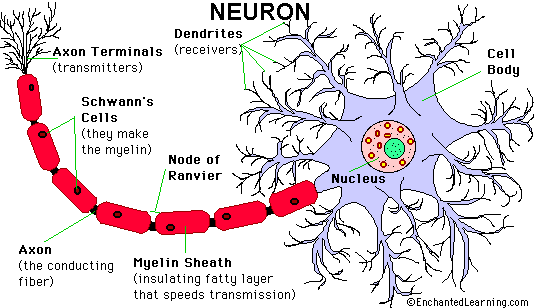
     Scientist have discovered that the unc-16 gene of the roundworm Caenorhabditis elegans can restrict nerve fibers of the brain from clogging up.  The gene codes for a gatekeeper that restricts the flow of cellular organelles from the cell body to the axon, which is used for signaling.  The buildup of organelles at the axon can cause interference with neuron signaling and/or neuro degenerative disorders.  The study of the unc-16 gene brings to light that the breakdown of the gatekeeper may be the underlying cause of degenerative disorders.


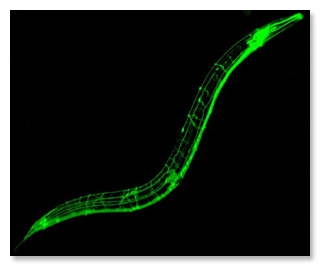
     C.elegans is a small translucent roundworm that has only 300 neurons.  The use of the roundworm as a model organism in the study was beneficial because complex  genetic techniques and imaging methods are applicable due to its size and structure, unlike larger animals, where such techniques would be impossible.  Ken Miller’s laboratory team at the Oklahoma Medical Research Foundation tagged organelles with fluorescent proteins and then used time-lapse imaging to follow the movements of the organelles.   In normal axons, organelles exited the cell body and entered the initial part of the axon, but did not move further. In axons of the unc-16 mutants, the organelles rode on tiny motors that carried them deep into the axon, where they accumulated.


Research on simple organsims is important and even necessary. This is especially true in cases where we are unable to understand diseases and are unable to study them in larger, more complex organisms.  Studies and research with a simple model organism has led to greater insight on important degenerative disorders.  This research can ultimately lead to major discoveries for treatment and cures in the future.