Showing posts with label signaling. Show all posts

Tuesday, November 25, 2014

Mental illness connected to Genetics


It has been speculated that the genetic make of a person may affect their mental stability. Dr. Smoller a professor at Harvard Medical School and Massachusetts General Hospital was an author of a paper that studied the genes involved in the signal process in the brain. The reason the researchers suspected a relation between genes and a persons mental disorders is,  because the case of twins.  It is vital that the researchers found specific genes that coded the specific signal system. There might be a way to found how the signals are getting disrupted and reverse the process.

The studied began with a looking at the genome of patient with  psychiatric illnesses.  Then it was compared to patients who did not have any psychiatric illnesses. The researchers could compare the psychiatric illnesses and determine if there was any variance to the other strand. It was speculated that two disorders involve the calcium channel. There are more studies being done to see if calcium channel blockers could affect the disorder.

Tuesday, November 19, 2013

Worm Leads to Insight on Mystery About Neurons

     
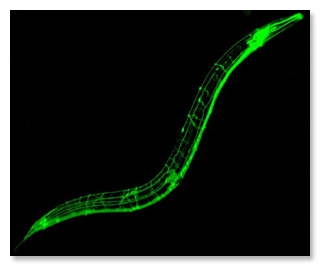
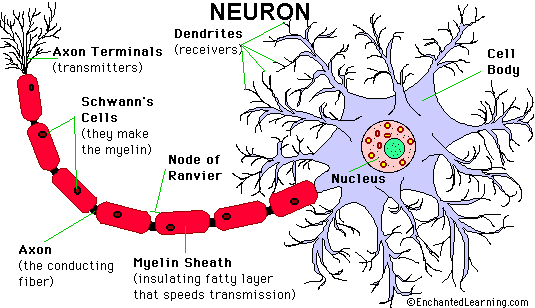
     Scientist have discovered that the unc-16 gene of the roundworm Caenorhabditis elegans can restrict nerve fibers of the brain from clogging up.  The gene codes for a gatekeeper that restricts the flow of cellular organelles from the cell body to the axon, which is used for signaling.  The buildup of organelles at the axon can cause interference with neuron signaling and/or neuro degenerative disorders.  The study of the unc-16 gene brings to light that the breakdown of the gatekeeper may be the underlying cause of degenerative disorders.


     C.elegans is a small translucent roundworm that has only 300 neurons.  The use of the roundworm as a model organism in the study was beneficial because complex  genetic techniques and imaging methods are applicable due to its size and structure, unlike larger animals, where such techniques would be impossible.  Ken Miller’s laboratory team at the Oklahoma Medical Research Foundation tagged organelles with fluorescent proteins and then used time-lapse imaging to follow the movements of the organelles.   In normal axons, organelles exited the cell body and entered the initial part of the axon, but did not move further. In axons of the unc-16 mutants, the organelles rode on tiny motors that carried them deep into the axon, where they accumulated.


Research on simple organsims is important and even necessary. This is especially true in cases where we are unable to understand diseases and are unable to study them in larger, more complex organisms.  Studies and research with a simple model organism has led to greater insight on important degenerative disorders.  This research can ultimately lead to major discoveries for treatment and cures in the future.