Showing posts with label Blood Brain Barrier. Show all posts

Sunday, September 15, 2024

Development of an Adeno-Associated Virus (AAV) Capable of Crossing the Blood-Brain Barrier

For many diseases and disorders, gene therapy using adeno-associated viruses (AAVs) has been relatively successful in transporting specific genes across the body. However, with the blood-brain barrier being highly selective of what enters the brain, it will often reject AAVs from entering. When AAVs are denied entry to the brain patients do not receive the proper gene therapy needed to treat their disease. This is why a team of researchers from MIT and Harvard University set out to engineer a new AAV that could cross the blood-brain barrier with ease. 

To do this the team of researchers developed a variety of new AAVs to specifically find one that would bind to the transferrin protein receptor (TfR1), which is found in high quantities on the blood-brain barrier and is responsible for bringing iron into the brain.


While testing their newly developed TfR1-bound AAV on mice, the researchers found AAVs crossing the blood-brain barrier at levels 6-12 times higher than AAVs that are not TfR1-bound. Another significant observation was that the AAV's increased entry methods were only found for the central nervous system. Finally, the researchers found that when trying to deliver GBA1 into the brains of mice the TfR1-bound AAVs delivered 30 times more copies of GBA1.

The development of TfR1-bound AAVs is extremely significant for the increased effectiveness of AAV gene therapy. Personally, I think this breakthrough should be closely monitored to ensure that using TfR1-bound AAVs does not cause harm in the long run by potentially creating competition for iron attempting to cross the blood-brain barrier. This is important to monitor since a deficiency of iron can lead to many motor and cognitive impairments.

https://www.nimh.nih.gov/news/science-news/2024/new-gene-delivery-method-paves-the-way-for-advanced-brain-therapies

https://registries.ncats.nih.gov/glossary/adeno-associated-virus-gene-therapy/

Monday, March 25, 2024

A New Connection Between ALS and FTLD

What we know about amyotrophic lateral sclerosis (ALS), commonly called Lou Gehrig's disease, and frontotemporal lobar degeneration (FTLD) is that they are both neurological disorders. This article suggests that they may arise from a similar genetic root. 
    Using 73 postmortem brain samples, scientist at MIT and the Mayo Clinic compiled gene expression patterns in 620,000 cells of 44 different cell types, and of individuals who had ALS, FTLD, or were unaffected. The pattern they noticed was that in both diseases, the cells responsible for each disorder had nearly identical expression. The study also confirmed some already present theories of the diseases, like genes we thought to be linked to them showing up in the particular gene expression of problematic cells. The last big discovery showed a pattern of a compromised blood brain barrier in the brains of people with either disease. 
    These findings are significant because it narrows down our understanding of the disease mechanisms by relating them. If we can prove they arise from thr same pathway, possibly even through the same exact genes, we can look what other similarities they have and find the root problem that the genes are causing. It could be in the neurons or the blood brain barrier, neither, or both. And of course, the more we know, the better we can treat.

Source:
https://news.mit.edu/2024/als-ftld-show-strong-molecular-overlaps-0322

Posted by: Michael Breslin

Monday, October 24, 2016

Overcoming the Blood Brain Barrier

The world of medicine is evolving as scientists are finding new ways to make surgical procedures less invasive.  However, one procedure that is still difficult to achieve is being able to have medication pass across the blood brain barrier.The blood brain barrier (BBB) is a feature in the human body that protects the brain and controls the body homeostasis and ion channels. If there are any complications with the structure that can lead to neurodegernaration and neuroinflammation. 
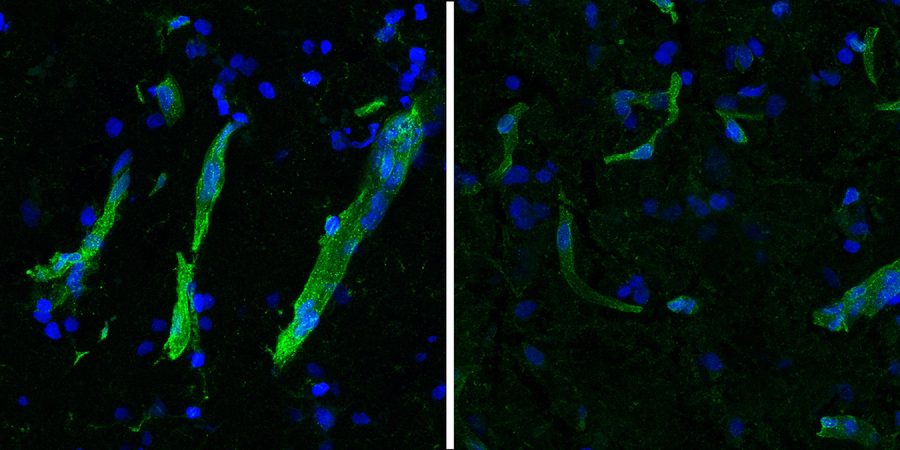
 This poses issues for patients who suffer from neurodegenerative disorders because 95% of medication that is used cannot pass across the BBB intravenously or orally.  In order to administer medication to the brain the patients has to experience surgery to remove their skull so that the medication is injected directly into the site that needs treatment. One approach to solve this problem is determining if viruses can be administered to the affected location and introduces new genes to cells. It has been proven that harmless viruses can pass across the blood brain barrier. The viruses are able to hold different products such as drugs as well as entering the cell and taking over the cell’s DNA. In order to find the right viruses to enter into the brain the researchers used different shelled adeno-assosiated virus. After the different trials it was determined that a virus called AAV-PHP.B was the best at crossing over the blood brain barrier. The team of scientists injected mice and the path in which the virus went was tracked with green florescent. As the team observed the movement it was evident that the virus had reached a larger portion of the brain. In the future, this method could potentially be used to target other areas of the nervous system. This is a great step towards improving the way surgery is performed and will be cost effective. In addition, it will allow patients to carry out their lives unaffected with less recovery time with surgical procedures that are less invasive.


 https://www.scientificamerican.com/article/neuroscientists-discover-a-new-way-to-cross-the-blood-brain-barrier/

http://www.sciencedirect.com/science/article/pii/S0168365916303236


Friday, November 28, 2014

New Drug Reduces the Side Effects of Binge Drinking

Binge drinking is the most common form of excessive alcohol consumption in the US. Many who engage in binge drinking often experience its side effects. While the effects are passed off as a "hangover," the actual side effects do more damage than one would realize. 


Research has shown that binge drinking can cause brain cell loss and inflammation which can potentially lead to brain damage in the long term. This effect can be more prominent in adolescents whose brains are not yet fully developed. A research team led by Professor Mike Page from the University of Huddersfield revealed how a new compound called ethane-beta-sultam has recently reduced the effects of binge drinking in rats, and can reduce its brain damaging effects. 


Drugs for the brain are difficult to manufacture because they need to pass through the blood-brain barrier to be effective. The blood-brain barrier is a membrane that keeps harmful chemicals from penetrating through it and getting through to the brain. Because many drugs fail at this, it is the main reason why neurological disorders are so difficult to treat. Professor Page says that ethane-beta-sultam can break through this barrier. 

During a session of binge-drinking, glial cells (which play a role in the development of the blood-brain barrier) increase, thus attempting to protect the brain from alcohol. When binge-drinking test rats were given ethane-beta-sultam when they consumed alcohol, the number of glial cells in the brain were reduced, thus allowing the drug to enter the brain and reduced the inflammation and loss of brain cells commonly associated with binge drinking. 


When tested later, the rats that received the ethane-beta-sultam had a better memory compared to rats that did not receive the compound. The effects on these rats were either reduced, or returned to normal. Alcohol abuse has risen in the US, and the team has been taking heat for creating a drug that "potentially masks the effects of binge drinking."

Ethane-beta-sultam is not limited to aiding in the effects of binge drinking. Because of its ability to get through the blood-brain barrier, it could potentially lead to new treatments for neurological disorders. 

"But if you accept that alcohol abuse is going to continue, then it might be sensible for society to try and treat it in some way," said Professor Page. I agree with him completely. Because nothing is being done about the rising abuse of alcohol across the country, having a way to help those who participate in it from having severe neurological problems is a great tool to have.


Article: http://www.medicalnewstoday.com/articles/286225.php 

Related Article: 
http://www.sciencedaily.com/releases/2014/11/141127082303.htm 


Monday, April 15, 2013

The Huntington's Inhibitor

There has been research done at the Manchester Institute of Biotechnology on how an enzyme in the brain can interact with a compound for Huntington’s Disease. It is said that it actually inhibits the its activity. This means that it can be used as a possible treatment method. They first identified the molecular structure of the enzyme KMO, which is found in the brain. The found that a compound called UPF 648 was able to bind incredibly well to the enzyme thus acting like an inhibitor. The only problem was that it was not a molecule that would make it past the blood brain barrier. They are now on a search for other compounds that can act as great inhibitors but also make it into the brain through the blood.
Compound found to be an inhibitor to Huntington's

Even though they did not find this compound, I believe this is a huge achievement in itself. They were able to map the structure of KMO which is such a huge deal because it was not done before, and took a great deal of time. Also, I believe that even though UPF 648 was not an ideal compound, it is a step in the right direction. I think that it is a huge accomplishment knowing that one day they could possibly find a compound to suppress Huntington’s.