Showing posts with label Adeno associated virus. Show all posts

Sunday, September 15, 2024

Development of an Adeno-Associated Virus (AAV) Capable of Crossing the Blood-Brain Barrier

For many diseases and disorders, gene therapy using adeno-associated viruses (AAVs) has been relatively successful in transporting specific genes across the body. However, with the blood-brain barrier being highly selective of what enters the brain, it will often reject AAVs from entering. When AAVs are denied entry to the brain patients do not receive the proper gene therapy needed to treat their disease. This is why a team of researchers from MIT and Harvard University set out to engineer a new AAV that could cross the blood-brain barrier with ease. 

To do this the team of researchers developed a variety of new AAVs to specifically find one that would bind to the transferrin protein receptor (TfR1), which is found in high quantities on the blood-brain barrier and is responsible for bringing iron into the brain.


While testing their newly developed TfR1-bound AAV on mice, the researchers found AAVs crossing the blood-brain barrier at levels 6-12 times higher than AAVs that are not TfR1-bound. Another significant observation was that the AAV's increased entry methods were only found for the central nervous system. Finally, the researchers found that when trying to deliver GBA1 into the brains of mice the TfR1-bound AAVs delivered 30 times more copies of GBA1.

The development of TfR1-bound AAVs is extremely significant for the increased effectiveness of AAV gene therapy. Personally, I think this breakthrough should be closely monitored to ensure that using TfR1-bound AAVs does not cause harm in the long run by potentially creating competition for iron attempting to cross the blood-brain barrier. This is important to monitor since a deficiency of iron can lead to many motor and cognitive impairments.

https://www.nimh.nih.gov/news/science-news/2024/new-gene-delivery-method-paves-the-way-for-advanced-brain-therapies

https://registries.ncats.nih.gov/glossary/adeno-associated-virus-gene-therapy/

Tuesday, September 22, 2015

Giant Axonal Neuropathy


Giant Axonal Neuropathy is an extremely rare genetic disorder, which directly affects children’s central and peripheral nervous systems. There are only 31 cases reported worldwide today, 19 living in the United States. The disorder causes children to lose balance, movement of muscles, and the loss of sensation. Children that are born with GAN tend to become progressively impaired and most do not survive beyond their early twenties.
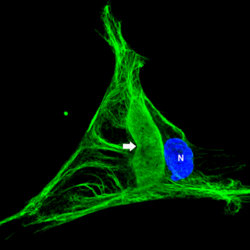
Children with the disease are found to have swollen axons that are filled with abnormal aggregates abundant with neurofilaments Researchers discovered the cause of this disease by looking at mutations within the GAN (Gigaxonin) gene. This protein-coding gene is incredibly vital to neurofilament architecture.
Researchers from the University of North Carolina School of Medicine (UNC), such as Steven J. Gray, PhD, have developed an experimental gene transfer treatment. The treatment approach uses a genetically modified virus called the adeno- associated virus (AAV). The treatment is given by a single injection with use of spinal tap, into patient’s cerebrospinal fluid.  The patient is then monitored for two months while the treatment flows around in the CSF.
I found this article to be extremely insightful into the study of neurofilaments. Neurofilaments are a prime component to the neuronal cytoskeleton. They are composed of polypeptide chains and define the structure and shape of neurons. Without a functioning nervous system many things can go wrong in the body. This study conducted by the University of North Carolina School of Medicine, really gives hope into helping children that suffer from this devastating disease.  
The article can be found at this link
A following article can be found here