Showing posts with label #sperm and egg. Show all posts

Thursday, November 21, 2024

Advances in Understanding Miscarriages

An article published by Mirage News  study done by Rutgers University recently revealed some of the genetic causes behind miscarriages. Researchers found that some women have a gene variant that causes accelerated aging of their eggs, with a difference of a single amino acid in the resultant protein. This leads to higher rates of aneuploidy, and as a result a higher chance of miscarriage. Rutgers decided to conduct a follow-up study on mice, and the results showed that the variant was indeed associated with egg abnormalities.

This new discovery may have an important impact on women's reproductive health. As the article states, it may give women who are aware of this variant more time for planning a family. Having this information might allow women to make more informed, more successful choices.

I personally thought that this was a really insightful article; the writer simplifies the full research into digestible, interesting information. As a woman myself, I do worry about my own reproductive health and fertility, so I find that this article quite helpful in explaining why things like miscarriages happen. I was very surprised to find how simple the cause was as well; everything that was written in the article were all concepts and terms that I was very familiar with. All in all, this article makes me feel less fearful and more in control about my own reproductive health.

ARTICLES
https://www.miragenews.com/researchers-target-genetic-variant-linked-to-1362336/

Friday, February 23, 2024

Can I Have Twins Even If They Don't Run in my Family?

  This article discusses the role of genetics in determining the probability of having twins. It explains that the likelihood of conceiving twins is influenced by both genetic and environmental factors. Monozygotic (identical) twins occur when a single fertilized egg splits into two embryos, while dizygotic (fraternal) twins occur when two separate eggs are fertilized by two different sperm cells. While the occurrence of monozygotic twins is generally not strongly linked to genetics, dizygotic twinning is more likely to run in families. Factors such as hyperovulation, maternal age, ethnic background, and assisted reproductive technologies can also influence the chance of having twins. Additionally, the article provides references to scientific journal articles for further reading on the topic. I found this article very interesting because I always thought that fraternal and identical twins were essentially the same thing, both running in families. I think lots of people believe this too, because I have heard people saying identical twins run in their family. This article disproves this though, basically saying that while fraternal wins usually can be traced back a few generations, identical twins are just a really cool magic trick that occurs during pregnancy and can really happen to anyone regardless of their family line!


Sources : 

1. https://medlineplus.gov/genetics/understanding/traits/twins/

2. https://pubmed.ncbi.nlm.nih.gov/18024802/

Sunday, March 3, 2019

First Semi-Identical Twins

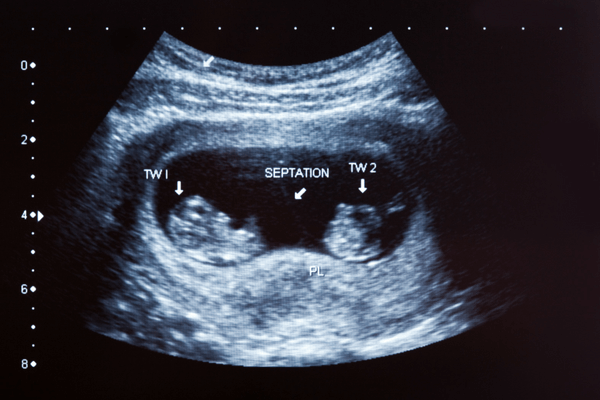
According to Science Daily, boy and girl twins have been identified as only the second set of semi-identical or sesquizcgotic twins in the world. They are also the first to be identified by doctors during pregnancy. The mothers ultrasound at six weeks showed a single placenta and positioning of amniotic sacs that indicated that she was expecting identical twins. At 14 weeks these identical twins have showed to be female and male. As most people know, identical female and male twins are not possible. However, in this case, they are.


Doctors state that the mothers egg was fertilized by two of the fathers sperm before dividing. Doctor Gabbett states that in this case, the fertilized egg appears to have equally divided up the three sets of chromosomes into groups of cells which then split into two, creating twins. Some of the cells have the chromosomes from the first sperm, while the remaining cells contain chromosomes from the second sperm, which results in the twins to share only a portion, rather than 100% of the same paternal DNA.
This is the second case which has not taken place since 2007 in United States. Mostly fraternal twins are highly possible for boy and a girl. The doctors are still studying this case, and are hoping for the mother to have a successful pregnancy so this could be further documented. I believe that with this new fertilization, doctors are able to identify, the how and the why of this pregnancy and would be able to procreate this method, since artificial insemination is now highly popular.

Thursday, May 5, 2016

In a Novel Theory of Mental Disorders, Parents’ Genes Are in Competition


2 Scientists have developed a ground-breaking theory of brain development that can help a deeper understanding about mental disorders like schizophrenia and autism, deriving in part that other events other than genetic mutation can alter gene behavior.

 They propose that it is a battle between the father's sperm and the mom's egg when in effect can cause brain development in one of two ways. If the father's sperm is more effective, it showcases more development along the autistic spectrum, like fascination with objects, patterns, mechanical systems, and the outlay of social development. If the mother's egg is more prominent, it expresses more development in the psychotic spectrum, like hypersensitivity to their own and other people's emotions. And this, in theory, induces a high probability for the child to become diagnoses with schizophrenia or bipolar disorder.

In a general sense, autism and schizophrenia represent complete opposite ends of the spectrum that covers almost all psychological brain disorders. But this theory promotes a new angle of perceiving mental disorders, an angle that in some ways "represent the first environmental influence on the expression of genes."

http://www.nytimes.com/2008/11/11/health/research/11brain.html