Showing posts with label spider web. Show all posts

Tuesday, October 24, 2023

Analysis of Genome Sequence of Spidroins in Female Golden Orb Weavers


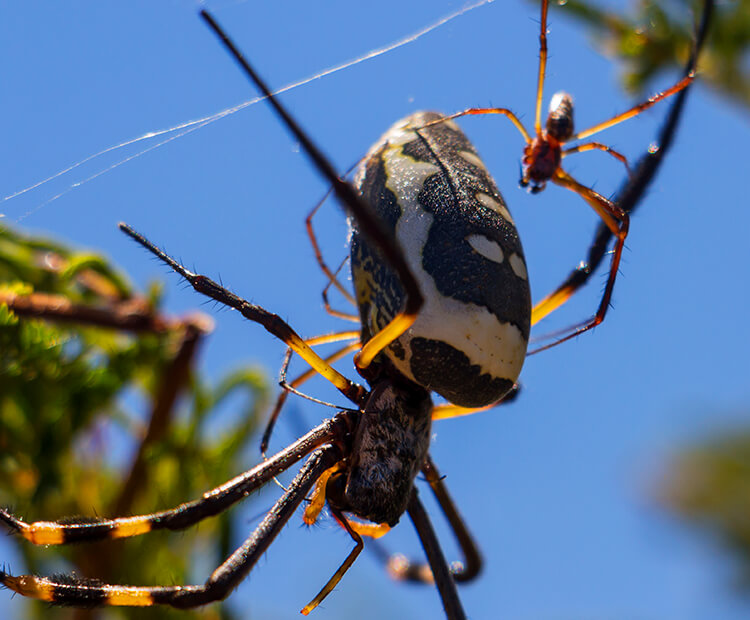
    Orb weavers are a family of spiders found all over the world. The Golden Orb Weaver is native to the Americas and is well known for its elaborate webs and is a non-venomous species. Females can get up to six inches in length and construct large, sturdy webs for their young. 

    Orb weavers are of particular interest to some genetic researchers due to their number of spidroin glands. Female orb weavers possess seven different silk-producing glands that construct different types of silk using a protein called spidroins. Spidroins have gained interest over the years as teachers are investigating their possible uses in medicine and other industries. 

    In 2017, a study was published in Nature that focused on analyzing the genomic sequence of the different silks produced by female golden orb weavers. Their aim was to create a genetic database of the spidroin protein in the variety of silks produced by female golden orb weavers. They found a variety of different genomic sequences involved in creating the different types of silk that enable female golden orb weavers to construct their large, elaborate webs for their young and to capture prey. 

Sunday, December 9, 2018

Insights to Spider Silk

https://www.sciencedaily.com/releases/2018/12/181207112741.htm
https://www.uniprot.org/uniprot/P19837
This spider silk, naturally made by the spinning gland of the spider, has incredible strength and is highly extensible. Researchers even say that its quality is on-par or even surpasses Kevlar. This silk is made of a protein called Spidroin. Spidroin connects to each other to make a polypeptide chain similarly to other proteins by connecting from the C to N terminals. Protein is one of the build blocks of our system and for them, its to create intricate webs to catch prey and provide a home. This silk is sought after by clothing companies, textile, even the aviation industry for its quality and potential use.

Sunday, April 3, 2016

DNA of the Web


30% of people in the US are afraid of spiders while others are the ones to kill or capture them. Charles Xu of the University of Notre Dame along with his team were the ones to create a way to study spiders without even having to interact with one. With the use of black widow spiders and their prey, the house cricket they found a way to non invasively extract, amplify and sequence MitochondrialDNA that was left on the web. A spider's web can hold the DNA of itself and its prey for up to 88 days. Their lab study is the first to have a source of noninvasive genetic material and could help many different field scientists in the future.

Some of the people that could find use in this new technique are conservation researchers, pest management, and biodiversity surveyors, among others.Conservation can benefit from this by taking a web in a particular area of study and find out what species had been in the web. With this information they could possible help that particular endangered spider or insect by conserving that area. Pest management could use the technique to find what spider species are hiding in crates being imported from one place to another. They could also find what species are invading households in an area. Though much more testing is needed, especially out in field, there is a good outlook for these types of scientists.


This was interesting to find due to the fact that it is a noninvasive technique. Which seems unrealistic because of how small the species are. I am not a huge spider fan or insect fan, but I can see how this is important to these types of science. I wonder if they can figure out how to perfect this technique if they could use it for other areas in science.

Monday, April 7, 2014

Mysteries of Spider Silk

Spider silk its like the AK-47 of nature. One can stretch the silk, bend it, and dry it out and it will still be stronger ten steel. Silk is 5 time stronger then steel and can snap back to original form after being stretched out. Kevlar can't even compete, spider silk is stronger then that too. Old spectroscopy research has now shed light on how to get spider silk. On January 27, in apaper in the journal Nature Materials, a student at Stadford,  Kristie Koski described how she was able to non-invasively, examine the mechanical properties of an whole spider web just as it was spun by the spider that created it. She used the technique called Brillouin spectroscopy. This technique shoots lasers of light on spider silk and reflects back to the spectrometer. This sends a vibration like song back to the instrument and then the spider silk can be measured to see how much tension it can take. Using this method Koski can study complete spider webs and not just single strand. A surprising note to Koski's team is that the stiffness of the web varies among fibers, intersection points, and glue spots. The team think this is because the webs had to withstand the weather. This article explains why this might have happened in more detail. I hope with this research we can finally use the spider webs genetic design to make this word a better place.