Showing posts with label orb-weaver. Show all posts

Tuesday, October 24, 2023

Analysis of Genome Sequence of Spidroins in Female Golden Orb Weavers


    Orb weavers are a family of spiders found all over the world. The Golden Orb Weaver is native to the Americas and is well known for its elaborate webs and is a non-venomous species. Females can get up to six inches in length and construct large, sturdy webs for their young. 

    Orb weavers are of particular interest to some genetic researchers due to their number of spidroin glands. Female orb weavers possess seven different silk-producing glands that construct different types of silk using a protein called spidroins. Spidroins have gained interest over the years as teachers are investigating their possible uses in medicine and other industries. 

    In 2017, a study was published in Nature that focused on analyzing the genomic sequence of the different silks produced by female golden orb weavers. Their aim was to create a genetic database of the spidroin protein in the variety of silks produced by female golden orb weavers. They found a variety of different genomic sequences involved in creating the different types of silk that enable female golden orb weavers to construct their large, elaborate webs for their young and to capture prey. 

Tuesday, May 2, 2017

Scientists Sequence Golden Orb-Weaver Genome

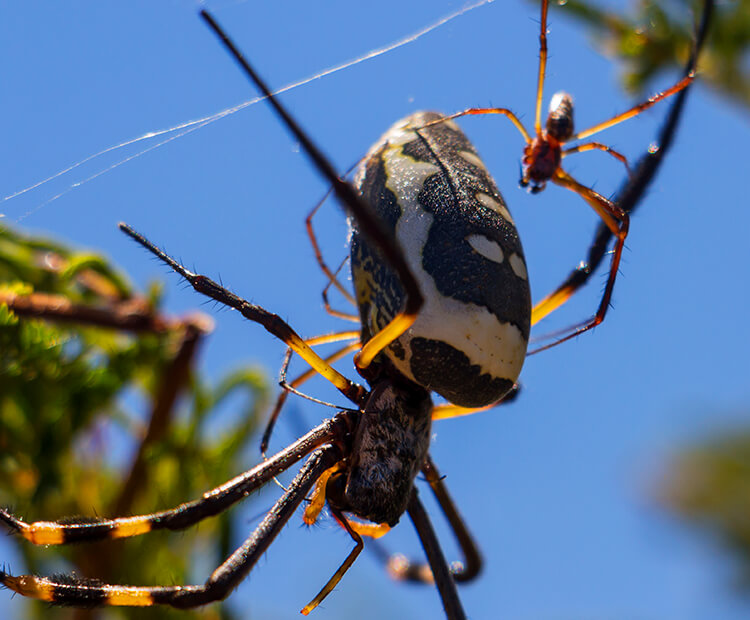
This is a golden orb-weaver spider (Nephila clavipes).
Credit: Matjaz Kuntner, Slovenian Academy of Sciences and Arts

Researchers at the University of Pennsylvania have been undergoing the arduous task of sequencing the entire genome of the golden orb-weaver spider, and have finally completed it. The scientists at Perelman School of Medicine used short tandem repeats to identify 28 silk proteins that make up the orb-weaver's spider silk, including one variety that was created in the venom sack. In addition to the silk proteins, DNA sequences were found that are believed to code for strength, elasticity, and other key features of spider silk.

Spider silk contains repeats of amino acids, some of which are repeated over a hundred times, which make them easy to identify using STR. In contrast to these repeating sequences, there are non-repetitive terminal domains that are vital in the formation of fibers from silk proteins. The process of going from proteins to fibers takes place through a complicated series of events, which ultimately results in the proteins being spun through the spinning duct to form a bi-folded, tightly controlled structure. For more information on the formation and composition of spider silk, please refer to this article from the National Library of Medicine.